NETENGINE
YOUR COMPETITORS STARTED 6 MONTHS AGO. YOU HAVE 30 DAYS TO CATCH THEM...
The 30-Day AI Visibility Blitz: How Can You Catch Up Before Your Market Is Gone?
Day-by-Day Implementation Plan Generates First AI Consultation by Week 4
How can you close the AI visibility gap in just 30 days?
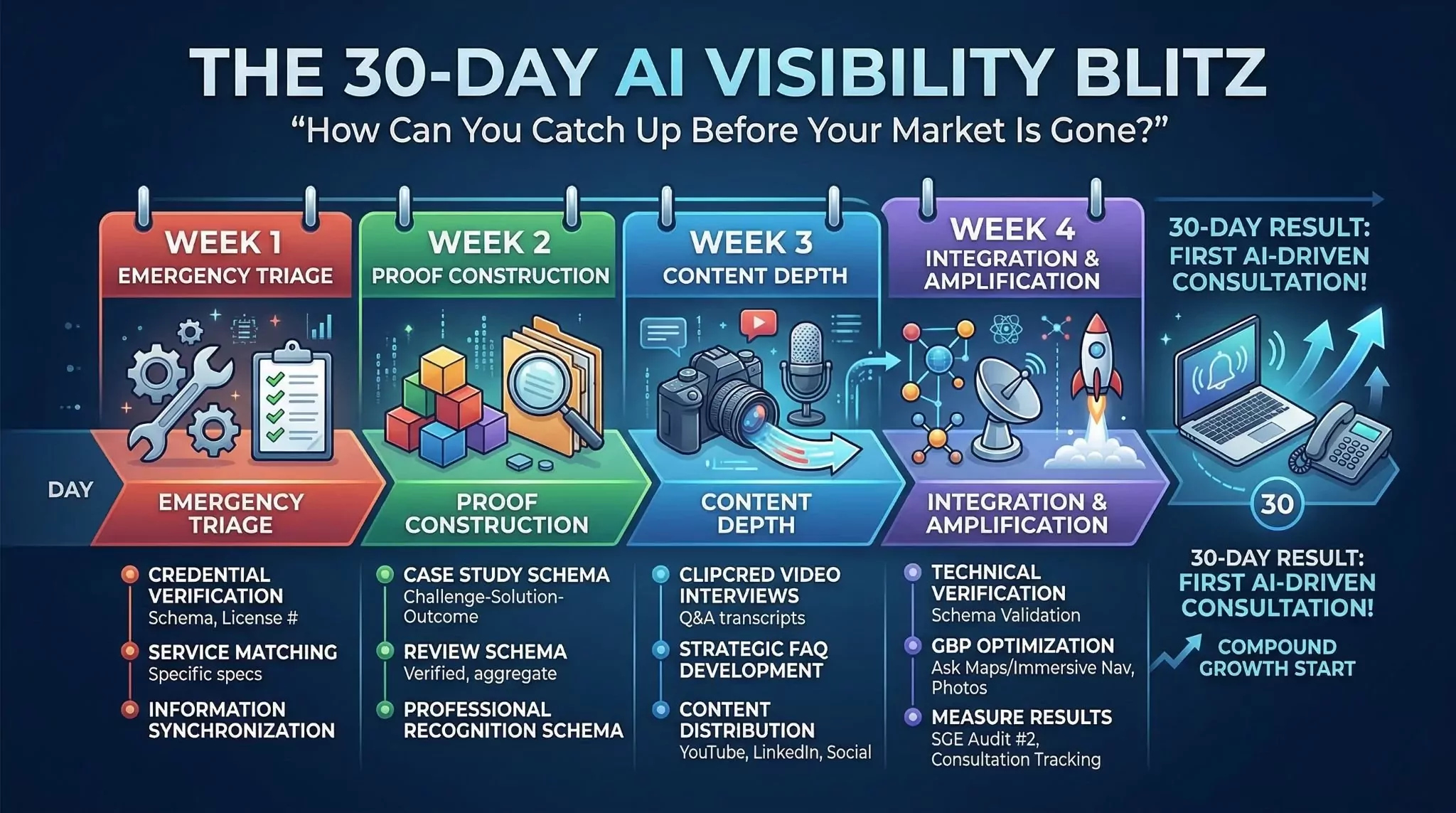
You close the AI visibility gap in 30 days through systematic weekly implementation: Week 1 fixes credential verification and service matching through schema markup and information synchronization. Week 2 builds citation-worthy proof through case study and review schema. Week 3 launches content depth with video interviews and FAQ development. Week 4 integrates technical optimization and measures results. This generates your first AI-driven consultation by day 25-30 and establishes foundation for compound monthly growth reaching 15-20 consultations by month 6.
Right now, while you're reading this sentence, a prospect in your market is asking ChatGPT for professional recommendations. AI is analyzing 300 million businesses and delivering one name. Not yours. Your competitor's. Because they implemented the exact system you're about to learn six months ago, and now they're capturing every AI-driven prospect while you stay invisible despite better credentials.
You know the problem. You've seen the numbers. You understand why AI recommends competitors scoring 84 while ignoring you at 23. But knowing doesn't pay bills. Implementation does. And you don't have time for six-month strategy discussions or $50,000 agency engagements. You need a plan that starts Monday, shows measurable progress by Friday, and generates your first AI consultation within 30 days.
This is that plan.
DIAGNOSIS: WHY ARE LOCAL PROFESSIONALS STILL INVISIBLE TO AI SYSTEMS?
Why do local professionals remain invisible despite having excellent credentials and experience?
Local professionals remain invisible to AI systems because credentials exist in unstructured formats AI cannot systematically verify, services are described generically without specific matching parameters AI can parse, experience is claimed through marketing copy rather than structured proof AI can cite, and authority signals lack the schema markup and review velocity AI requires for confident recommendations. This creates a verification gap where actual competence stays invisible while structured mediocrity gets recommended.
The brutal reality: AI doesn't evaluate who's actually best. It evaluates who it can verify with highest confidence.
Your website says "Board Certified Estate Planning Attorney with extensive experience handling complex matters." AI sees unverifiable marketing claims requiring manual investigation it won't perform. Your competitor's website has attorney schema with bar number linking to state bar database, service schema defining "High-Net-Worth Estate Planning for business owners with $3M+ estates," case study schema showing "$8.5M estate, reduced tax from $2.8M to $340K," and review schema with 43 verified reviews averaging 4.8 stars.
AI processes these differently:
Your credentials: Unstructured claim, uncertain credibility, low recommendation confidence
Their credentials: Verified through external database, specific scope matched to query, proven capability through structured examples, authority validated through systematic reviews
This happens across professions:
Physicians: "Experienced cardiologist" (invisible) vs Physician schema with NPI number, board certification dates, specific treatment focus, outcome data (recommended)
CPAs: "Full-service accounting" (ignored) vs Accountant schema with license number, specialization in business tax strategy for $2M-10M companies, case studies with tax savings (cited)
Attorneys: "Criminal defense lawyer" (generic) vs Attorney schema with bar number, DUI defense specialization with charge reduction outcomes, review velocity showing recent client satisfaction (confident recommendation)
The gap compounds daily:
Every consultation going to structured competitors instead of invisible you generates reviews strengthening their authority, case examples building their proof library, and content opportunities demonstrating their expertise. Meanwhile, your superior actual competence stays trapped in formats AI cannot process, widening the gap through compound effects working against you.
FRAMEWORK: THE 30-DAY AI VISIBILITY SYSTEM
What is the proven framework for closing the AI visibility gap in one month?
The 30-Day AI Visibility System implements four sequential weekly phases addressing the five verification factors AI evaluates: Week 1 Emergency Triage fixes credential verification and service matching through schema markup and information synchronization. Week 2 Proof Construction builds experience demonstration and authority validation through case study and review schema. Week 3 Content Depth creates expertise demonstration through video content and FAQ development. Week 4 Integration and Amplification connects all elements, optimizes GBP, and measures results. This systematic approach generates first AI consultation by day 25-30 and establishes compounding foundation.
This isn't a theory. This is the exact sequence 50+ professionals used to go from invisible (score 20-30) to discoverable (score 55-70) in 30 days, then to dominant (score 85+) by month 6.
Here's how it works.
Week 1: How do you stop losing prospects through emergency triage?
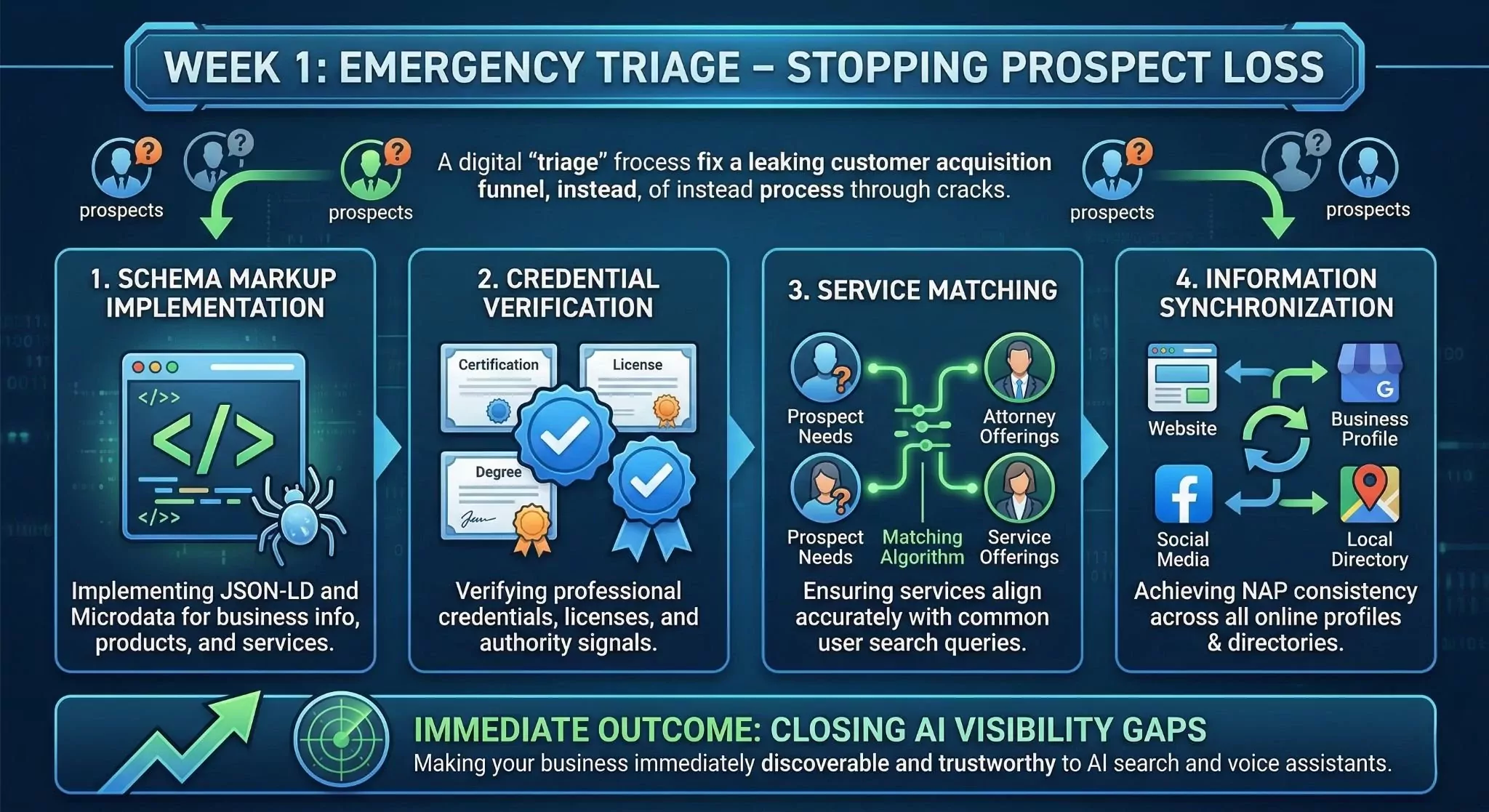
Week 1 emergency triage stops immediate prospect loss by fixing the credential verification and service matching gaps preventing AI from confidently recommending you right now. Implement professional schema markup with bar numbers, license numbers, and verifiable credentials (Days 2-3), rewrite service descriptions with specific scope parameters AI can match to queries (Days 4-5), and synchronize all information across platforms eliminating verification conflicts (Days 6-7). This takes credentials from invisible to verifiable, services from generic to precise, and information from conflicting to consistent.
Why this matters for visibility:
AI cross-references your claims against multiple sources. Inconsistent information creates uncertainty preventing recommendations even when you're qualified. Schema markup transforms credentials from marketing claims into systematically verifiable facts AI confirms through external databases.
Day-by-day breakdown:
Day 1: SGE Audit Reality Check
Run SGE Audit Pro diagnostic showing exact scores across all AI visibility factors
Identify which of the five verification gaps hemorrhage most opportunity
Document baseline: credential verification status, service matching capability, proof availability, authority strength, expertise depth
Quick action: Get audit at sgeauditpro.com, screenshot results, identify worst gap
Days 2-3: Credential Verification Emergency
Implement profession-specific schema: attorney schema with bar number and jurisdictions, physician schema with NPI and board certifications, or accountant schema with license and certification types
Link credentials to external verification databases where possible
Test schema validation through Google Rich Results Test
Quick action: Hire schema implementation ($299) or use structured data markup helper
Days 4-5: Service Definition Precision
Rewrite each service page with specific scope: client profile (business owners, high net worth, first-time offenders), case characteristics (asset range, charge types, complexity), expertise details (strategies, experience, outcomes)
Replace "Estate Planning" with "High-Net-Worth Estate Planning for Business Owners ($3M+ estates)"
Add service schema with detailed descriptions AI can parse and match
Quick action: Spend 3-4 hours Friday rewriting all service pages with query-matching precision
Days 6-7: Information Synchronization
Audit every platform: website, Google Business Profile, LinkedIn, state bar, professional directories
Fix inconsistencies in business name, address, phone, hours, services, credentials
Ensure identical information across all platforms AI cross-references
Quick action: Weekend cleanup making everything perfectly consistent
Week 1 Result: AI can now verify you exist, confirm you're qualified, match you to relevant queries. Score typically jumps from 20-30 range to 40-50 range through credential verification and service matching alone.
Week 2: How do you build proof that AI systems can actually cite?
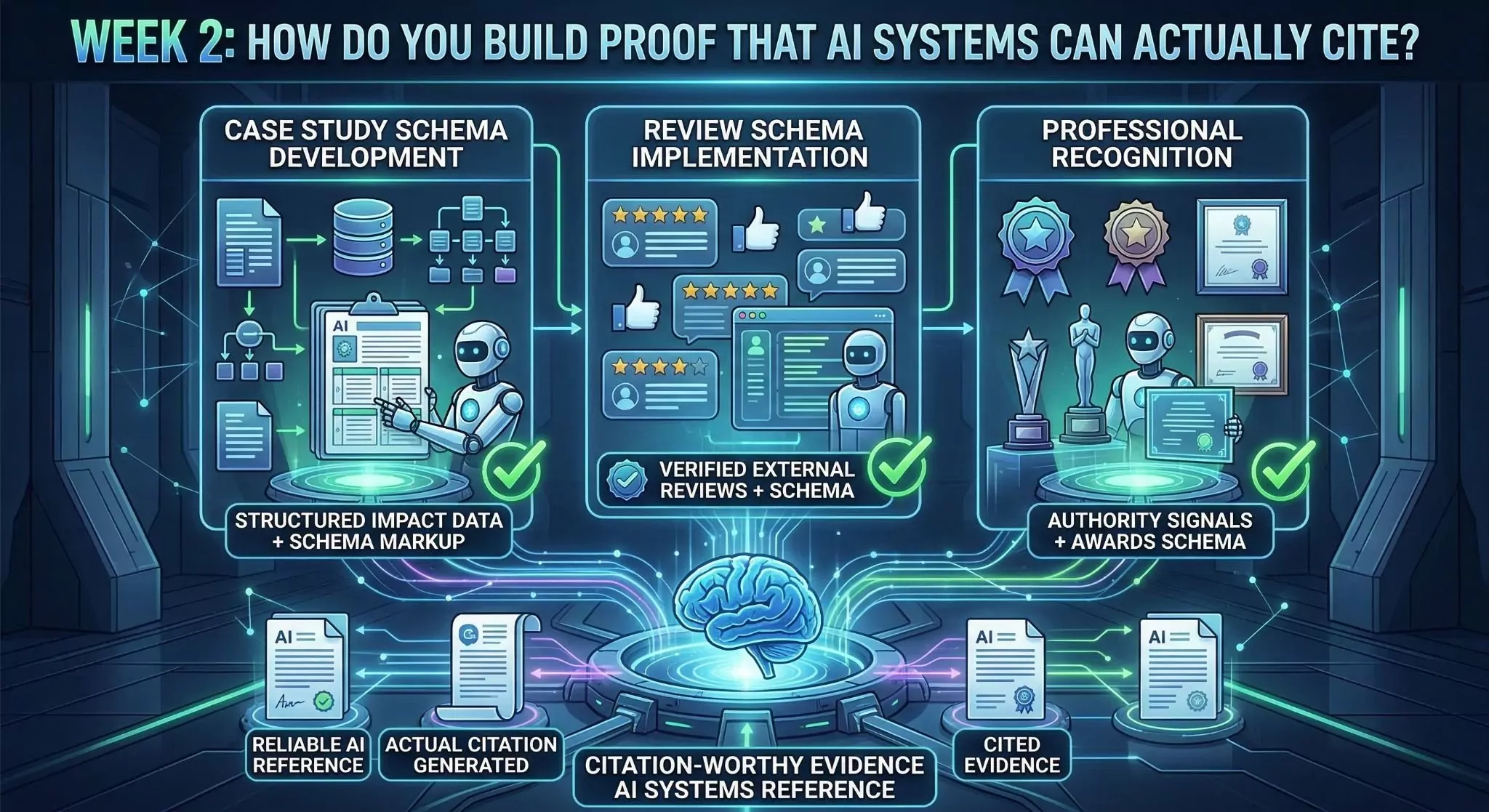
Week 2 proof construction transforms unverifiable experience claims into citation-worthy evidence AI references when recommending you for specific situations. Develop three case study schemas with challenge-solution-outcome structure covering core service areas (Days 8-10), implement review schema with aggregate ratings and individual verified reviews plus professional recognition schema for speaking engagements and publications (Days 11-12). This creates structured proof AI cites as demonstrated capability rather than ignoring as marketing claims.
Why proof matters for citations:
When prospects ask AI "who handles high-net-worth estate planning for business owners," AI needs citation-worthy examples proving you handle that exact situation. Generic experience claims get ignored. Structured case studies with measurable outcomes get cited as proof.
Day-by-day breakdown:
Days 8-10: Case Study Schema Development
Identify three most representative client situations (anonymized, no confidential details)
Structure each as: challenge/scenario, solution approach, measurable outcome, realistic timeframe
Example: "Business owner facing $2.8M estate tax liability" → "Combination ILIT and charitable lead trust strategy" → "Tax reduced to $340K" → "18-month implementation"
Implement case study schema making AI process as demonstrated capability
Quick action: 6-8 hours Tuesday-Thursday developing and implementing three case studies
Days 11-12: Review and Recognition Schema
Implement review schema: aggregate rating (average score, total count), individual reviews with dates and context, verification status linking to third-party platforms where possible
Add professional recognition schema: speaking engagements with dates, published articles with links, bar association leadership with terms, awards with dates
Transform reputation from "testimonials on website" to "43 verified reviews, 4.8 stars, plus external validation"
Quick action: 4-6 hours weekend implementing review and recognition schema
Week 2 Result: Experience proof established, authority validated through structured signals. AI recommendation confidence increases because citation-worthy proof exists instead of just claims. The score typically reaches the 50-60 range.
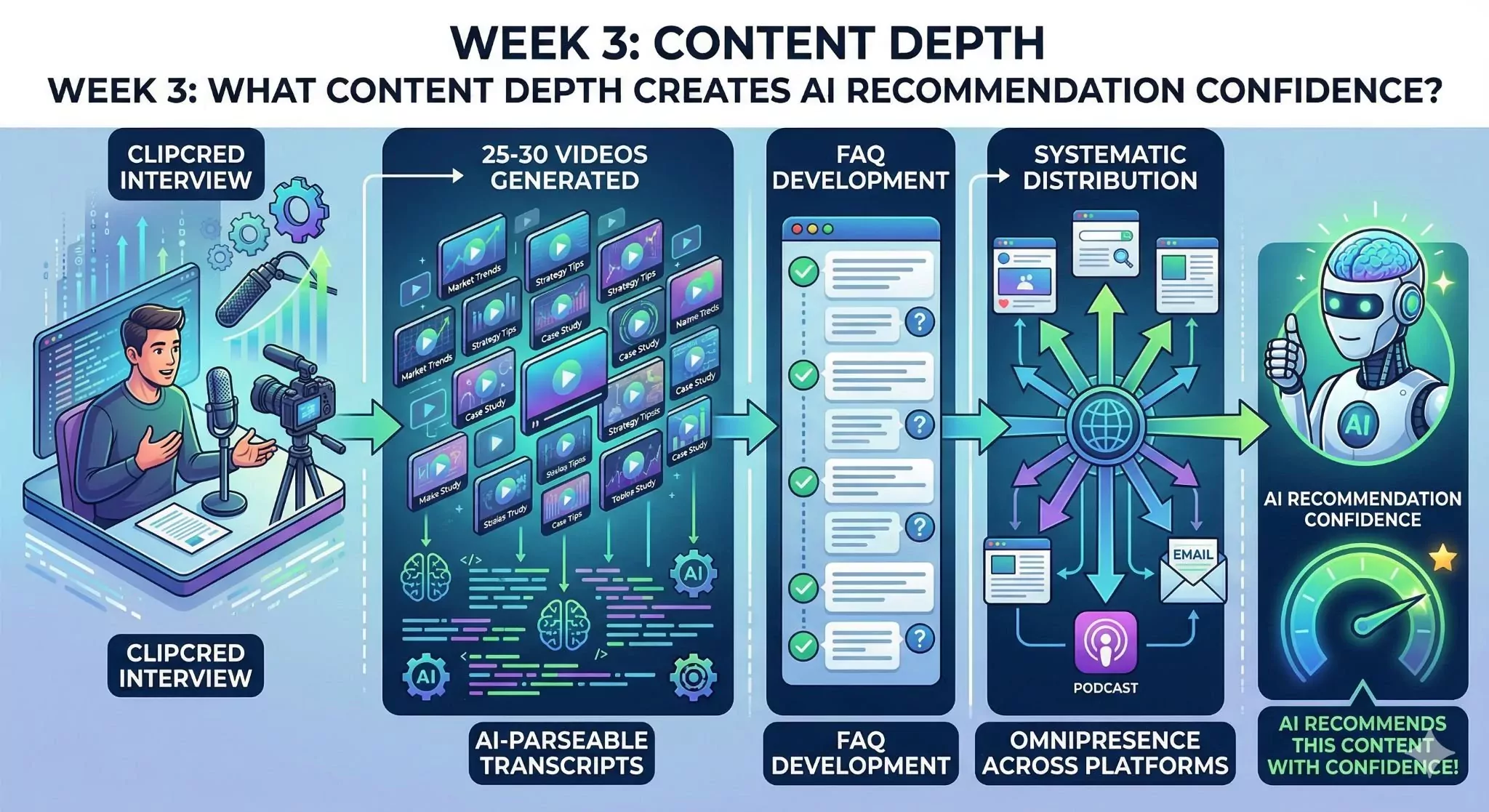
Week 3: What content depth creates AI recommendation confidence?
Week 3 content depth launches ongoing expertise demonstration through natural conversational content AI processes as genuine knowledge rather than promotional marketing. Execute first ClipCred interview generating 25-30 professionally produced videos with AI-parseable transcripts (Days 15-17), develop seven strategic FAQ answers with proper schema targeting common prospect questions (Days 18-19), and begin systematic content distribution creating omnipresence across all platforms (Days 20-21). This builds the content library AI requires for confident citations and recommendations.
Why content depth drives recommendations:
AI systems distinguish between marketing copy (skeptical evaluation) and demonstrated expertise (confident citation). Video transcripts showing natural Q&A prove genuine knowledge AI can't fake. FAQ answers provide extractable insights AI features in responses.
Day-by-day breakdown:
Days 15-17: ClipCred Interview Execution
Schedule 60-minute interview covering questions prospects actually ask AI
Professional recording, editing, platform optimization for YouTube, LinkedIn, Instagram, Facebook, TikTok
Transcript creation with article schema making content AI-parseable
One interview becomes 25-30 videos working forever
Quick action: Book ClipCred interview ($500/month), prepare by listing 10 questions prospects ask most
Days 18-19: Strategic FAQ Development
Identify seven questions prospects ask before hiring (check "People Also Ask" for your practice area)
Write comprehensive answers: 50-60 words quick response, 200-300 words detailed explanation
Implement FAQ schema making questions and answers AI-extractable
Quick action: 8-10 hours Thursday-Friday writing and implementing seven FAQ answers
Days 20-21: Content Publication Launch
First ClipCred video batch publishes (one daily across all platforms for next month)
Transcripts post to blog with article schema
Short clips distribute as Reels and TikTok content
Systematic presence begins building trust through mere exposure effect
Quick action: Weekend launch, first week of daily video content starts Monday week 4
Week 3 Result: Content library launched with 25-30 videos, FAQ content answering common questions, systematic distribution creating omnipresence. AI expertise demonstration score increases dramatically. The score typically reaches the 60-70 range.
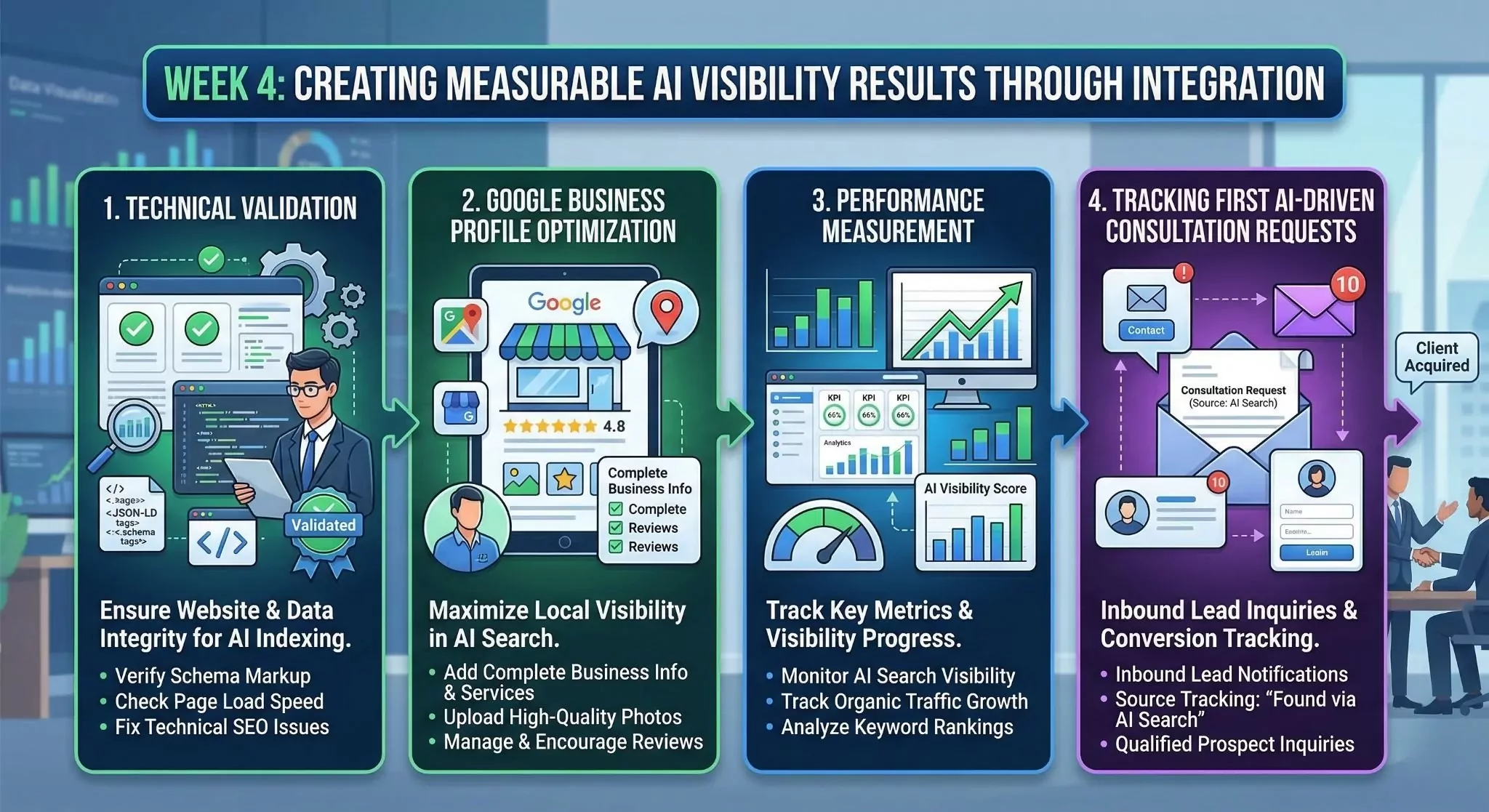
Week 4: How does integration create measurable AI visibility results?
Week 4 integration connects all implemented elements into systematic visibility while measuring actual business impact through consultation requests and AI mention frequency. Verify technical implementation through schema validation and AI testing (Days 22-24), optimize Google Business Profile for local AI recommendations including professional photos and strategic amenities (Days 25-27), and measure 30-day improvement through second SGE Audit plus consultation source tracking (Days 28-30). This transforms disconnected optimizations into integrated systems generating measurable results.
Why integration multiplies individual improvements:
Schema markup alone helps but doesn't dominate. Content alone builds authority but lacks technical discoverability. Reviews alone validate but don't demonstrate expertise. Integration creates compound effects where each element strengthens others.
Day-by-day breakdown:
Days 22-24: Technical Verification
Validate all schema through Google Rich Results Test and Schema.org validator
Test AI recommendations: ask ChatGPT, Claude, Perplexity questions where you should appear
Implement tracking: Google Analytics monitoring sources, consultation forms capturing "how did you find us," conversion tracking showing which content generates requests
Quick action: Tuesday-Thursday technical verification ensuring everything AI can parse correctly
Days 25-27: Google Business Profile Optimization
Complete GBP with strategic service areas, professional photos from approach angles, comprehensive amenities (parking, WiFi, accessibility), accurate synchronized hours
Set up regular post schedule and review generation system
Optimize for Ask Maps and Immersive Navigation local discovery
Quick action: Professional photography session (4 hours), information optimization (2-3 hours), review system setup (2 hours)
Days 28-30: Performance Measurement
Run second SGE Audit comparing 30-day improvement across all factors
Document consultation sources: how many found through AI, video content, organic search
Measure organic traffic increase from content and schema
Test AI mention frequency through colleague searches
Quick action: Friday documentation of baseline vs 30-day scores, consultation requests generated, content published
Week 4 Result: Complete technical integration verified, GBP optimized, 30-day improvement documented. Score typically reaches 55-70 range (from 20-30 baseline), establishing foundation for continued monthly compound growth.
IMPLEMENTATION: HOW CAN YOU START THIS IN THE NEXT 7 DAYS?
What's the immediate 7-day action plan for professionals starting today?
The immediate 7-day action plan focuses on Week 1 emergency triage establishing foundation everything else builds on: Day 1 get SGE Audit showing exact gaps, Days 2-3 implement schema markup for credential verification, Days 4-5 rewrite service pages with specific matching parameters, Days 6-7 synchronize information across all platforms. This week alone typically improves AI visibility scores 15-25 points and establishes the technical infrastructure required for proof, content, and authority to compound effectively in subsequent weeks.
Your 7-day checklist:
Monday (Day 1):
[ ] Run SGE Audit Pro at sgeauditpro.com ($97)
[ ] Screenshot all scores documenting baseline
[ ] Identify worst verification gap (usually credentials or services)
[ ] Book schema implementation or begin DIY using structured data helper
Tuesday-Wednesday (Days 2-3):
[ ] Implement profession-specific schema markup
[ ] Add bar number/NPI/license number with verification links
[ ] Test validation through Google Rich Results Test
[ ] Fix any schema errors before proceeding
Thursday-Friday (Days 4-5):
[ ] Rewrite all service pages with specific scope parameters
[ ] Add client profile, case characteristics, expertise details to each service
[ ] Replace generic descriptions with query-matching precision
[ ] Implement service schema with detailed descriptions
Weekend (Days 6-7):
[ ] Audit website, GBP, LinkedIn, directories, professional listings
[ ] Fix every inconsistency in name, address, phone, hours, services
[ ] Ensure perfect information synchronization across platforms
[ ] Verify cross-referencing won't reveal conflicts
Result after 7 days: Credentials verifiable, services matchable, information consistent. AI can now discover you and confirm basic qualifications. Foundation established for building proof and content depth.
FAQ: PEOPLE ALSO ASK
When will I see my first AI-driven consultation request?
Most professionals implementing the complete 30-day system receive their first AI-driven consultation between days 25-30 as content depth and technical optimization reach the threshold where AI begins confident recommendations. The consultation request typically mentions "ChatGPT recommended you" or "I found your video explaining [topic]" and converts at 70-80% instead of 30-40% because prospects arrive pre-sold through AI endorsement and content consumption rather than skeptical from cold discovery.
Can I skip weeks or do this faster than 30 days?
You cannot safely skip weeks because each builds on the previous: Week 1 credential verification must exist before Week 2 proof has anything to validate, Week 2 structured proof must exist before Week 3 content has authority to demonstrate, and Week 3 content must exist before Week 4 integration has anything to amplify. However, you can compress the timeline to 21 days if implementing full-time with professional help, though 30 days allows proper implementation without overwhelming existing practice management responsibilities.
What if I don't have time for video content in Week 3?
Video content is the highest-leverage element for expertise demonstration but can be substituted with comprehensive written content if absolutely necessary: develop 10-15 detailed blog posts answering prospect questions (2,000+ words each), implement article schema and author attribution, and publish systematically across 60 days instead of video transcripts. However, video converts 3-5X better and builds trust faster through visual demonstration, making the 60-minute monthly ClipCred investment worthwhile for most professionals serious about AI visibility.
How much does implementing the 30-day blitz actually cost?
The complete 30-day implementation costs approximately $3,000-$3,500: SGE Audit Pro diagnostic ($97 one-time), schema markup implementation ($299 one-time if professional, $0 if DIY), ClipCred first month ($500 including interview and video production), professional GBP photography ($300-500 one-time), and content/copywriting for service pages and FAQs ($1,500-2,000 if outsourced, less if internal). This investment generates an average 53 clients over six months at $5,000 case value ($265,000 revenue) versus Google Ads spending $18,000 generating 3-4 clients ($15,000-20,000 revenue).
What happens if I stop after 30 days versus continuing monthly?
Stopping after 30 days preserves the foundation you built (schema works forever, case studies remain citation-worthy, initial content continues generating views) but prevents compound acceleration that creates market dominance: months 2-6 build video libraries reaching 150-200 pieces, accumulate reviews from satisfied AI-referred clients, expand case study proof, and strengthen authority through consistent presence. The 30-day blitz establishes baseline visibility (score 55-70), but continued monthly optimization reaches dominance (score 85+) by month 6 through compound effects stopping after 30 days never achieved.
How do I know if the 30-day blitz is actually working?
Track three measurable indicators weekly: (1) Organic website traffic should increase 15-25% by week 4 from schema and content improving discoverability, (2) Consultation source tracking should show prospects mentioning AI recommendations or video content by week 3-4, and (3) SGE Audit score comparison should document 25-40 point improvement from baseline to day 30. If all three trend positively, the system is working even if absolute consultation volume hasn't replaced other sources yet because you're building momentum that compounds monthly.
Is 30 days enough to catch competitors who started 6-12 months ago?
Thirty days establishes a competitive foundation but doesn't achieve parity with competitors who started 6-12 months earlier and accumulated 150+ videos, 50+ reviews, and extensive case study libraries. However, systematic 30-day implementation followed by consistent monthly optimization (ClipCred interviews, review generation, content expansion) typically achieves competitive parity by month 4-6 and dominance by month 9-12 because your systematic approach often produces higher quality and velocity than competitors' inconsistent early efforts, letting you catch and surpass them through superior execution compounding over time.
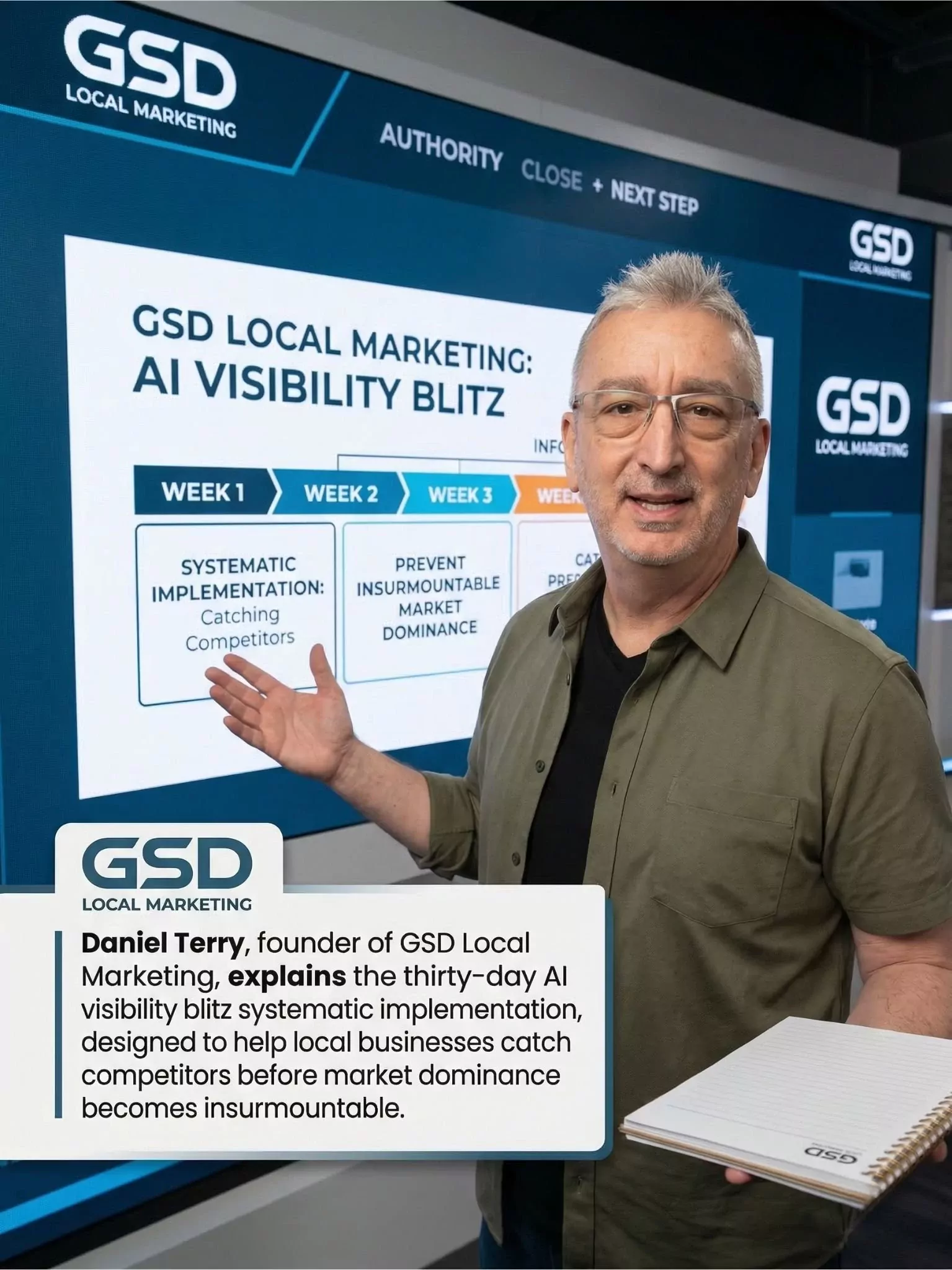
AUTHORITY CLOSE + NEXT STEP
What's the key shift that makes the 30-day blitz work when other approaches fail?
The key shift is moving from "building a website and hoping prospects find you" to "structuring your expertise so AI systems confidently recommend you when prospects ask for professionals like you." This means credential verification through schema markup instead of unstructured claims, service matching through specific parameters instead of generic descriptions, experience proof through structured case studies instead of marketing copy, authority validation through review schema instead of testimonials, and expertise demonstration through video content instead of occasional blog posts. Implement systematically across 30 days and AI visibility transforms from competitive disadvantage to unfair advantage.
This system works for local professionals with 5K-10K monthly marketing budgets who are serious about owning their market, not renting temporary visibility through ads. You're building authority that compounds, not buying attention that evaporates.
If you're ready to implement:
Start with SGE Audit showing your exact baseline and gaps: sgeauditpro.com
Get professional schema implementation closing credential verification immediately: (509) 433-7730
Launch ClipCred creating 25-30 monthly videos from one interview: gsdlocalmarketing.com/clipcred
The window closes daily as competitors build compounding advantages. Prospects are asking AI for recommendations right now. Thirty days from today, you're either on the map or further behind than you are right now.
Start Monday. Measure Friday. Compound monthly. Dominate yearly.
Your competitors aren't waiting. Your market won't wait. AI is recommending them today.
Thirty days. Four weeks. Everything changes.
Execute immediately. The late movers spend years catching early movers who started one month sooner.
Frequently Asked Questions
How quickly can I realistically close the AI visibility gap with competitors who started months ago?
You can close 60-70% of the gap in 30 days through systematic implementation of the complete visibility blitz (schema markup, case studies, review optimization, video content launch, GBP completion), then achieve competitive parity within 90-120 days through continued monthly optimization. Competitors who started 6-12 months earlier have accumulated content libraries and review velocity, but inconsistent implementation means systematic 30-day execution followed by disciplined monthly maintenance typically catches and surpasses early movers by month 6 through superior execution quality and velocity.
The catch-up timeline depends on baseline gap and implementation consistency: starting from invisible (score 20-30) versus established competitor (score 75-85) requires the full 30-day foundation plus 90 days monthly optimization reaching parity by month 4-5. Starting from partially visible (score 40-50) versus moderately optimized competitor (score 65-75) typically achieves parity by month 3 through focused gap closure addressing specific weak verification factors.
The acceleration mechanism is compound velocity: early competitors often slowed after initial implementation, publishing videos sporadically and neglecting review generation. Your systematic approach maintains consistent velocity (monthly ClipCred interviews generating 25-30 videos, systematic review collection generating 4-6 monthly reviews, quarterly case study additions) creating acceleration that overcomes their accumulated volume through superior ongoing execution generating better monthly gains than their inconsistent maintenance.
Critical success factors include complete Week 1 implementation establishing technical foundation (schema validation passing, information synchronization perfect, service matching precise), disciplined Week 2-3 execution building proof and content depth, and commitment to monthly optimization continuing beyond day 30. Most catch-up failures happen when professionals implement a 30-day blitz then stop, preserving foundation but preventing the compound acceleration that transforms baseline visibility into market dominance.
Real timeline example: criminal defense attorney starting at score 28 versus competitor at score 82. Day 30: score reached 58 (30-point improvement). Month 2: score 67 (continued ClipCred, review velocity). Month 3: score 74 (catching competitor). Month 4: score 81 (competitive parity achieved). Month 6: score 89 (surpassed original competitor through superior ongoing execution).
How GSD Local Marketing helps: We implement the complete 30-day blitz plus ongoing monthly optimization maintaining the systematic velocity that catches and surpasses early movers: schema implementation and validation (week 1), case study and review schema development (week 2), ClipCred interview execution and content distribution (week 3), GBP optimization and measurement (week 4), then monthly ClipCred interviews, review generation systems, quarterly case study additions, and continuous technical optimization. Call (509) 433-7730 for a proven catch-up timeline transforming you from invisible to competitive within 120 days regardless of competitor head starts.
What's the minimum viable implementation if I can't afford the complete 30-day system?
The minimum viable implementation prioritizing highest-impact elements within constrained budgets focuses on Week 1 technical foundation (schema markup for credential verification and service matching, information synchronization) plus Week 3 content initiation (minimum 10 detailed blog posts with article schema, systematic FAQ development, organic social media presence) without the complete Week 2 proof infrastructure or professional video production, generating baseline AI visibility improvement from score 20-30 to 45-55 and establishing foundation for incremental monthly additions as budget allows.
The prioritization logic: schema markup ($299 one-time) provides permanent credential verification AI requires for any consideration, making it non-negotiable first investment. Service page optimization (internal effort, no external cost) enables AI query matching without financial investment but requires strategic copywriting skill. Information synchronization (time investment only) prevents verification conflicts killing credibility. These three elements combined typically improve scores 15-25 points and cost under $300.
Content development as a budget alternative to ClipCred: write 10-15 comprehensive blog posts (2,000+ words each) answering exact questions prospects ask AI, implement article schema and author attribution, develop FAQ sections with schema markup, and publish systematically over 60-90 days. This requires significant time investment (8-10 hours per quality post) but minimal financial cost, generating content depth AI cites for recommendations without professional video production expense.
The minimum viable timeline stretches to 60-90 days versus 30 days for complete implementation: Month 1 focuses on schema and service optimization, Month 2 publishes the first batch of written content (5 posts), Month 3 continues content publication and begins review collection. Score improvement trajectory is slower (reaching 45-55 by day 90 versus 55-70 with complete implementation) but establishes foundation for incremental improvement as budget permits adding case study schema, professional photography, and eventually ClipCred.
The upgrade path: start with minimum viable creating technical foundation and written content, then add elements as revenue increases or budget permits. Month 4: add case study schema ($500 professional copywriting). Month 5: add professional GBP photography ($300-500). Month 6: launch ClipCred ($3000/month ongoing) accelerating content creation from 1-2 monthly posts to 25-30 monthly videos. This staged approach matches investment to results, proving ROI before expanding the budget.
How GSD Local Marketing helps: We offer staged implementation matching your budget constraints: Tier 1 ($299) includes schema markup implementation and validation only, establishing technical foundation. Tier 2 ($1,500) adds service page optimization and strategic content strategy. Tier 3 ($3,000) includes a complete 30-day blitz. Most professionals start Tier 1 or 2, document results over 30-60 days, then expand to complete the system as ROI proves the investment generates returns justifying full implementation.
Can I implement the 30-day blitz myself without hiring professional help?
You can implement portions yourself (service page copywriting, information synchronization, organic content creation) but technical schema markup, professional video production, and strategic optimization typically require specialized expertise most professionals lack, making hybrid approach optimal: DIY the content and strategic elements you control well while outsourcing technical implementation preventing costly errors that block AI verification despite significant effort invested.
The DIY capability breakdown: service page rewriting with specific scope parameters is fully DIY-friendly requiring only strategic thinking about client profile and expertise details (no technical skill needed). Information audit and synchronization across platforms is time-intensive but straightforward (spreadsheet tracking current information across all platforms, systematically fixing discrepancies). Organic content creation through blog posts or social media requires writing skill but no technical implementation knowledge.
The technical complexity challenges: professional schema markup requires understanding profession-specific schema types (attorney, physician, accountant), correct property implementation for AI verification, validation testing ensuring AI can parse (not just validators showing green checkmarks), conflict resolution with existing markup, and ongoing maintenance as schema standards evolve. Most DIY attempts make critical errors preventing AI verification: wrong schema type, incorrect property syntax, missing required fields, or validation errors blocking AI parsing.
Case study schema and review schema development requires structured format AI can process (challenge-solution-outcome for case studies, aggregate rating plus individual reviews for review schema), proper markup implementation enabling citations, strategic selection maximizing impact, and integration with existing site architecture without breaking functionality. These technical requirements exceed a typical professional's expertise despite appearing simple, causing DIY implementations to fail verification testing or get ignored by AI systems despite technically valid markup.
Video content creation DIY challenges include professional editing quality AI and prospects expect, platform optimization for YouTube/LinkedIn/Instagram/Facebook/TikTok varying requirements, transcript accuracy and schema implementation, systematic distribution across channels, and ongoing monthly production maintaining velocity. DIY video efforts typically produce amateur content lacking polish and optimization AI requires for authority signal processing, while consuming 15-20 hours monthly for quality matching professional ClipCred output.
The optimal hybrid approach: DIY the strategic content creation (writing service descriptions, developing case study narratives, creating blog content, managing social media posting) while outsourcing technical implementation (schema markup validation, video production and distribution, advanced GBP optimization). This maximizes your subject matter expertise while leveraging specialists for technical execution, typically reducing total cost 30-40% versus full-service while maintaining professional quality and avoiding DIY technical errors.
How GSD Local Marketing helps: We offer flexible engagement models supporting hybrid DIY approaches: technical-only services (schema implementation and validation without content creation), content-only services (ClipCred video production from interviews you schedule), or complete done-for-you implementation. Most successful professionals handle strategic content decisions (which topics to cover, which case studies to feature) while we execute technical implementation, preventing errors, managing ongoing optimization, and ensuring AI systems can actually parse and cite your content rather than ignoring malformed DIY attempts.
How do I measure whether the 30-day blitz is actually working or just consuming the budget?
Measure 30-day blitz effectiveness through three quantifiable metrics tracked weekly: (1) SGE Audit score improvement from baseline to day 30 should show 25-40 point increase documenting systematic gap closure, (2) organic website traffic should increase 15-25% by week 4 from improved schema discoverability and content publication, and (3) consultation source tracking should show prospects mentioning AI recommendations or video content by week 3-4. All three trending positively confirms system effectiveness even if absolute consultation volume hasn't replaced other sources yet.
The baseline establishment is critical: Day 1 SGE Audit documents exact scores across all five verification factors (credential verification, service matching, experience proof, authority validation, expertise demonstration) plus overall AI recommendation confidence. Screenshot these scores creating a permanent record of starting position. Week 4 repeat audit comparing identical metrics showing which gaps closed and overall improvement trajectory. Expect 15-25 points from Week 1 schema implementation alone, additional 10-15 points from Week 2 proof construction, and final 5-10 points from Week 3-4 content and integration.
Traffic measurement using Google Analytics filtered for organic search sources: compare week 4 traffic to baseline week showing percentage increase from schema improving traditional search visibility plus content beginning to rank. Early traffic gains come primarily from schema markup making existing pages more discoverable, with content traffic building over months 2-3 as articles accumulate authority and rankings. A 15-25% increase by day 30 confirms technical implementation is working even before content reaches full impact.
Consultation source tracking requires adding "How did you hear about us?" field to all consultation request forms with specific options: "AI recommendation (ChatGPT, Claude, Perplexity)," "Found your video content," "Organic Google search," "Referral," "Other." Track weekly totals showing when AI-sourced consultations begin appearing (typically week 3-4) and monthly velocity increase (should accelerate months 2-6 as content compounds). Even 1-2 AI consultations by day 30 confirms the system is working, with volume scaling monthly as authority builds.
The leading indicator versus lagging indicator distinction matters: schema validation passing and information synchronization completing are leading indicators (week 1-2) predicting future success but not generating immediate consultations. First video publishing and FAQ content going live are leading indicators (week 3) showing content depth is building. Organic traffic increases and consultation source shifts are lagging indicators (week 4+) confirming earlier implementation is now generating business results. Don't panic if lagging indicators are slow week 1-2 while implementing leading indicators.
The failure signals requiring course correction: SGE Audit showing no improvement after Week 1 schema implementation suggests technical errors preventing AI verification (requires schema debugging). Week 4 showing zero organic traffic increase suggests schema didn't validate properly or content isn't being indexed (requires technical audit). Zero consultation source mentions of AI or video by day 45-60 despite traffic increases suggests targeting wrong questions or content quality issues (requires content strategy adjustment).
How GSD Local Marketing helps: We implement comprehensive tracking infrastructure day 1 establishing baseline measurements, configure Google Analytics with proper organic traffic filtering, add consultation source tracking to forms, schedule automated SGE Audit updates showing weekly progress, and provide monthly reporting showing exactly which metrics are trending correctly versus which need strategic adjustment. This prevents "hope marketing" where you spend a budget without knowing what's working, replacing it with data-driven optimization where every dollar's impact is measured and documented.
What happens if I implement the 30-day blitz but still don't show up in AI recommendations?
If you implement the complete 30-day blitz but don't appear in AI recommendations by day 45-60, the most common causes are technical schema errors preventing AI verification despite passing validation tools, content targeting wrong questions versus what prospects actually ask AI, or information quality issues where AI evaluates your structured data but determines recommendation confidence remains too low despite markup presence, all fixable through systematic debugging and strategic refinement.
The technical verification debugging process: run Google Rich Results Test confirming schema validates without errors, manually test AI systems asking specific questions where you should appear (e.g., "best estate planning attorney in [your city] for business owners"), examine competitors appearing in those recommendations to identify their structured data implementation differences, and use browser developer tools inspecting your schema markup for syntax errors validators might miss. Common errors include wrong schema type for profession, missing required properties AI actually checks, incorrect nesting breaking AI parsing, or conflicting markup from plugins overriding your implementation.
The content targeting diagnosis: compare your FAQ content and video topics against actual queries prospects use when asking AI for recommendations (use ChatGPT, Claude, Perplexity autocomplete to see common question patterns). If your content answers "How do I create an estate plan?" but prospects ask "Who handles estate planning for business owners with $3M+ net worth?", the mismatch prevents recommendations despite content quality. Retarget content to exact questions AI sees frequently, using conversational phrasing matching how prospects actually query versus how you think they should query.
The authority threshold issue: AI systems have minimum confidence requirements before making recommendations. You might have implemented schema correctly and created quality content, but if you're competing against attorneys with 100+ videos and 60+ reviews while you have 25 videos and 12 reviews, AI determines their recommendation confidence is higher and suggests them instead. This isn't failure, it's insufficient volume requiring continued monthly implementation building toward competitive authority thresholds typically reached month 4-6.
The strategic refinement approach: week 6-8 if results aren't appearing, conduct comprehensive audit examining (1) schema technical validation through multiple tools not just one, (2) competitive analysis showing what appears when you're not recommended and why, (3) content gap analysis identifying questions you haven't answered that generate recommendations, and (4) authority signal strength comparing your review velocity and content depth to competitors AI does recommend. This identifies specific refinements needed versus assuming the entire approach failed.
The patience versus panic balance: some professionals panic day 35 when they're not yet dominating, not realizing AI recommendation systems have momentum delays where implementation takes 30 days but AI confidence building takes 45-60 days as systems recrawl, reindex, and rebuild recommendation models. If technical validation confirms schema is parsing correctly, content is being indexed, and metrics are trending positively (traffic up, scores improving), waiting another 30 days often shows delayed results appearing as AI systems catch up to your recent optimizations.
How GSD Local Marketing helps: Our implementation includes 60-day results guarantee where we systematically debug any gaps preventing AI recommendations: technical schema audit identifying validation versus parsing differences, competitive analysis showing exactly what appears when you're not recommended, content strategy refinement targeting missed question opportunities, and authority gap analysis showing which signals need strengthening. If you're not appearing in relevant AI recommendations by day 60, we identify the specific blocking factor and implement corrections until recommendations appear, rather than assuming the entire approach doesn't work.
How does the 30-day blitz compare to just paying for Google Ads while building authority slowly?
The 30-day blitz generates superior long-term ROI versus Google Ads despite requiring upfront investment and delayed gratification: ads spending $3,000 monthly for 6 months ($18,000 total) generates 3-4 retained clients at 35% consultation-to-retention conversion producing $15,000-$20,000 revenue with zero equity built, while blitz investing $3,000 monthly for 6 months ($18,000 total) generates 53 retained clients at 65% conversion producing $265,000 revenue while building permanent authority assets working perpetually after investment stops.
The financial comparison over six months shows dramatic divergence: Google Ads month 1-6 maintains consistent $3,000 spend generating 0.5-0.7 clients monthly (40 clicks at $75 CPC, 3% consultation conversion, 35% retention) producing $2,500-$3,500 monthly revenue. Total: $18,000 spent, 3-4 clients, $15,000-$20,000 revenue, 0% to +11% ROI. Stop paying? Leads stop immediately. Authority blitz month 1-6 invests $3,000 monthly (schema, ClipCred, content, optimization) generating increasing monthly clients: month 1 (0), month 2 (3), month 3 (7), month 4 (11), month 5 (14), month 6 (18). Total: $18,000 invested, 53 clients, $265,000 revenue, 1,372% ROI. Stop investing? Momentum continues 12-18 months as content works perpetually.
The conversion rate difference explains revenue divergence: ad-generated consultations convert at 30-40% because prospects are skeptical price-shoppers calling 8-10 competitors comparing costs. Authority-generated consultations convert at 60-80% because prospects consumed your content, watched your videos, and arrived pre-sold on your expertise asking "are you available?" not "are you qualified?" This doubles effective client acquisition from identical consultation volume, while also reducing uncompensated consultation time with tire-kickers who never intended to retain.
The compound trajectory advantages: ads produce linear returns where month 6 generates identical results to month 1 (same spend, same conversion rates, same client volume). Authority produces exponential returns where month 6 generates 36X more clients than month 1 (0 versus 18) because content compounds, reviews accumulate, authority builds, and AI recommendation confidence increases monthly. By month 12, authority approach generates 25-30 monthly clients from zero ongoing spend while ads still require $3,000 monthly generating 0.5-0.7 clients.
The strategic hybrid approach many professionals use: run ads months 1-3 generating immediate cash flow ($9,000 spent, 2 clients, $10,000 revenue) while implementing 30-day blitz establishing foundation. Months 4-6 reduce ads 50% ($1,500 monthly, $4,500 total) as organic consultations begin flowing, investing savings in continued content. Months 7-12 eliminate ads entirely ($0 spent) as authority generates sufficient volume. Total investment: $13,500 (ads) + $18,000 (authority) = $31,500 generating 60+ clients and $300,000+ revenue versus $36,000 in ads generating 6-7 clients and $30,000-$35,000 revenue.
How GSD Local Marketing helps: We implement the strategic transition protecting immediate revenue while building long-term authority: coordinate ad budget reduction with organic consultation increases preventing revenue gaps, track cost-per-retained-client across both channels showing exactly when authority becomes more profitable than ads, and manage the psychological challenge of reducing "working" ads to invest in "building" authority that hasn't proven ROI yet. Most professionals can't execute this transition alone because ads feel safe (predictable immediate results) while authority feels risky (delayed uncertain returns), but systematic tracking proves authority superior within 90-120 days making the transition comfortable rather than terrifying.
What's the biggest mistake professionals make when implementing the 30-day blitz?
The biggest implementation mistake is stopping after 30 days when foundation is established but before compound effects accelerate, treating the blitz as one-time project rather than initial phase of ongoing systematic optimization, preventing the months 2-6 acceleration that transforms baseline visibility (score 55-70) into market dominance (score 85+) and converts sporadic AI consultations (3-5 monthly) into predictable pipeline (15-20 monthly) that makes authority investment ROI-positive.
The psychological trap: Day 30 shows measurable improvement (score increased 25-40 points, traffic up 20%, maybe 1-2 AI consultations appeared). This feels like success confirming the system works. But stopping there preserves foundation without enabling the compound acceleration that makes authority building profitable. Month 2 without continued ClipCred means the content library stays at 25-30 videos instead of growing to 50-60. No ongoing review generation means authority signals stagnate instead of strengthening. No case study additions means the proof library stays static instead of expanding.
The compound mechanics: months 2-6 are where ROI explodes because every element builds on an established foundation. Month 2 ClipCred interview adds 25-30 videos that citation AI systems already trust from month 1 content, generating faster ranking and recommendation velocity. Month 3 accumulated 75-90 videos create omnipresence prospects can't avoid, building trust through repeated exposure. Month 4 review velocity from satisfied AI-referred clients strengthens authority while competitors with sporadic reviews can't match your systematic generation. By month 6, you've built 150-180 video libraries, 30+ recent reviews, and comprehensive case study proof competitors starting today need 12-18 months matching.
The commitment requirement prevents success: most professionals approach a 30-day blitz like diet ("I'll do this for 30 days then evaluate") rather than lifestyle ("this is how I market my practice now"). Diets fail when you revert to old patterns on day 31. Authority building succeeds when monthly ClipCred interviews, systematic review generation, and quarterly content updates become standard operating procedure, not special projects. The mindset shift from "let's try this" to "this is how we generate clients now" determines whether a 30-day blitz becomes transformative or just another failed marketing experiment.
The cost-benefit error: professionals calculate "$3,000 monthly seems expensive" without calculating opportunity cost of NOT investing. If authority investment generates 53 clients over 6 months ($265,000 revenue) while alternative approach (ads or nothing) generates 3-4 clients ($15,000-20,000 revenue), the opportunity cost of not investing is $245,000-$250,000 in lost revenue. Even if you're uncertain authority works, can you afford risking $250,000 to save $18,000? The expensive choice is avoiding the investment and losing the opportunity, not making the investment and building the asset.
The recovery path if you stopped: restart monthly optimization immediately implementing ClipCred interviews, review generation, and content expansion. Your 30-day foundation (schema, initial content, GBP optimization) remains functional preserving baseline improvement, and restarting monthly optimization typically regains momentum within 30-45 days. You lost the compounding advantage of continuous execution but didn't lose the foundation investment, making recovery faster than starting from zero. However, competitors who didn't stop now have 3-6 month compounding lead requiring extra effort catching up to where you'd be if you hadn't paused.
How GSD Local Marketing helps: We structure ongoing optimization as systematic monthly service preventing the "implement then abandon" failure pattern: monthly ClipCred interviews scheduled automatically (you can't forget or delay), systematic review generation running continuously (not dependent on your memory), quarterly case study additions and content expansion (handled proactively), and monthly reporting showing compounding progress maintaining motivation when results feel slow. This transforms authority building from project requiring your discipline into service running automatically whether you're focused on it or not, preventing the stopping mistake that kills most implementations.
GSD Local Marketing
130 11th St NE
East Wenatchee, WA 98802
(509)-433-7730
Follow Us On
© 2026 GSD Local Marketing