NETENGINE
TRADITIONAL SEO IS 1/8TH OF SEARCH VISIBILITY IN 2026...
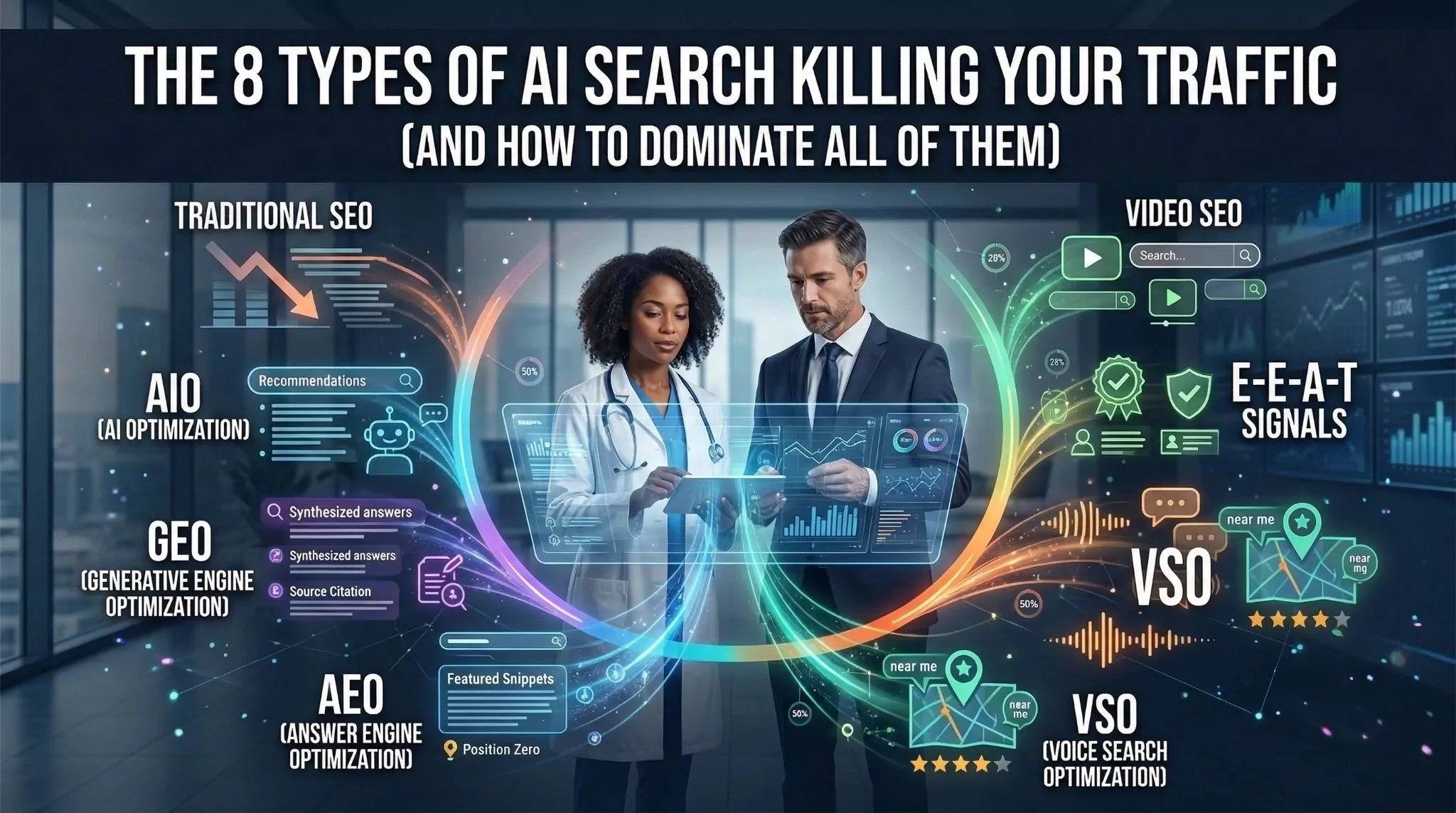
The 8 Types of AI Search Killing Your Traffic (And How to Dominate All of Them)
Master AIO, GEO, AEO, Local, Voice, E-E-A-T, Video & Traditional for Complete Visibility
You're staring at another $800 invoice from your SEO agency.
They got you to #1. Again. Screenshots attached. Rankings look perfect.
Your calendar? Still empty.
Last month, three prospects you'd win in your sleep went to competitors. Not because those competitors ranked higher-they didn't. Not because they're better qualified-they're not. They went there because when prospects asked AI for recommendations, your competitors' names appeared. Yours didn't.
Here's what your agency isn't telling you, either because they don't know or because they're hoping you won't figure it out before renewal: traditional SEO rankings now represent approximately one-eighth of where prospects actually find businesses in 2026. The other seven-eighths? Different types of AI search that your website isn't optimized for and your agency doesn't understand how to fix.
This isn't about firing your SEO team. It's about understanding that the search landscape fundamentally changed six months ago, and while they optimized for one visibility channel, prospects evolved to use eight different search methods. You're dominating 12% of search volume while competitors capture 88%. That's not a close race. That's market invisibility with a participation trophy.
Let me show you all eight types, why each one matters for professionals like you, and how to systematically dominate them without the overwhelm most feel when they hear "eight different strategies."
The New Search Reality Nobody Explained Until Now
Traditional SEO operated in one universe with predictable rules. You optimized your website, built backlinks, created content, climbed rankings. Higher rankings meant more traffic, more traffic meant more consultations, consultations meant revenue. The system was linear, measurable, and reliable.
That universe still exists, capturing roughly 12% of total search volume. But seven other universes emerged alongside it over the last eighteen months, each with different rules, different algorithms, and different ways prospects discover and choose professionals. Your #1 ranking in the original universe means nothing when 87% of search volume happens in the other seven where you're completely invisible.
Here's what changed and why it's destroying traditional SEO ROI for professionals who don't adapt fast
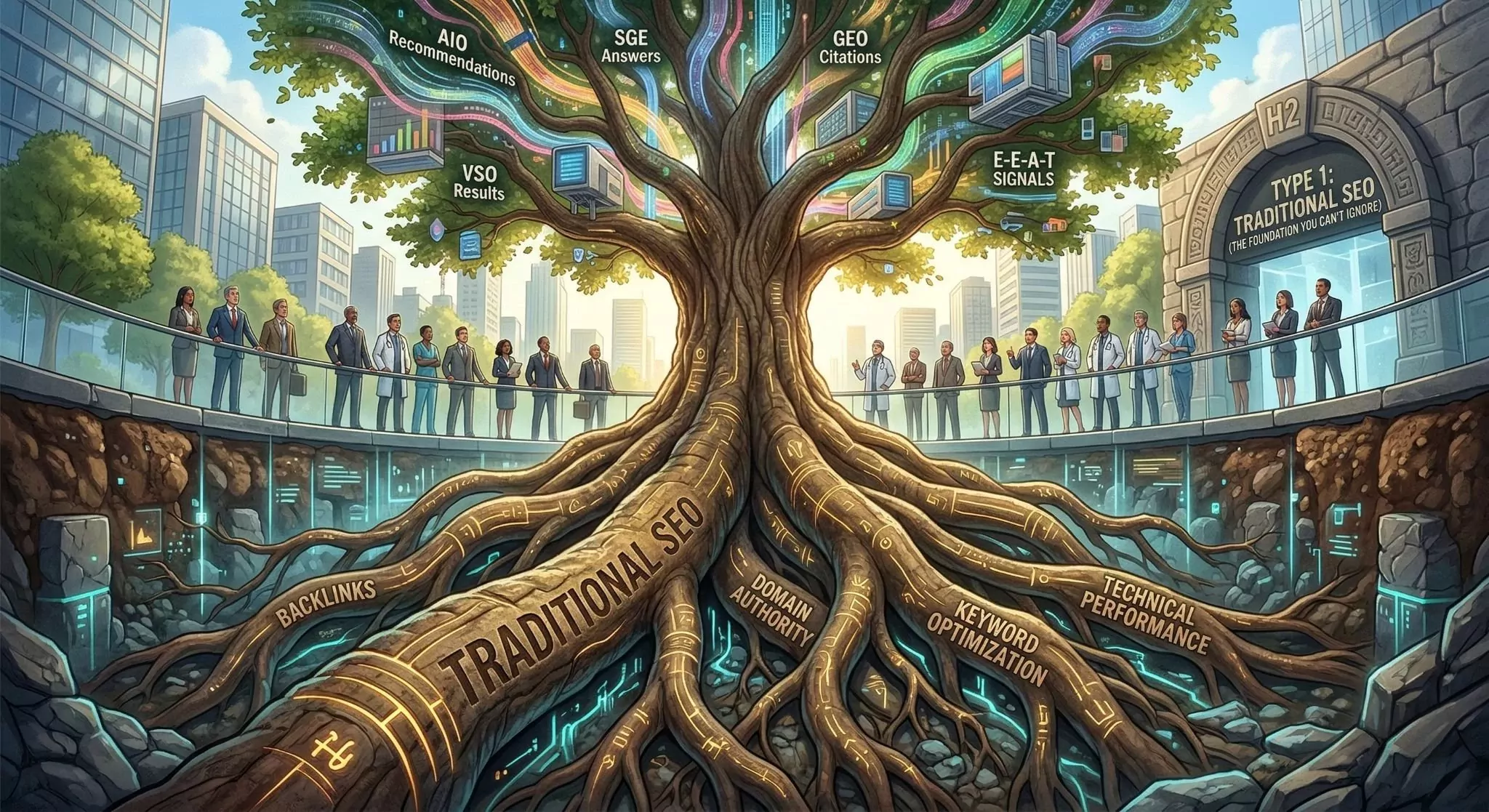
Type 1: Traditional SEO (The Foundation You Can't Ignore)
Start with what you know because it still matters as the foundation everything else builds on, just not as the complete strategy it used to be.
Traditional SEO evaluates your website through backlinks from authoritative sites signaling credibility, domain authority and site age showing stability, keyword optimization and content quality demonstrating relevance, page speed and technical performance affecting user experience, and engagement signals like time on site proving prospect satisfaction. This determines your position in organic blue link results-whether you rank #1, #5, or page three.
Traditional SEO isn't dead. It's insufficient alone but essential as a baseline. A business ranking page three won't get AI-recommended even with perfect schema markup because low rankings signal low authority. Strong traditional rankings create the foundation AI systems evaluate when deciding recommendation confidence. You need this working first. Just understand its table stakes now, not winning strategy.
However, ranking #1 traditionally no longer guarantees visibility or business because prospects encounter seven other search types before they ever see organic results. Each captures prospect attention and steers decisions without traditional rankings entering the equation. Think of traditional SEO as your ticket to the game in 2026. You need it to play. But winning requires dominating the seven additional search types prospects actually use to make hiring decisions.
How GSD Local Marketing helps: Our local SEO service handles traditional ranking foundation while simultaneously optimizing for all eight search types, ensuring you're not just ranking well but actually visible where prospects look. Call (509) 433-7730 for a complete visibility strategy that doesn't leave 87% of your market untouched.
Type 2: AIO (AI Optimization for Recommendation Engines)
AI Optimization focuses on making your business understandable and recommendable to AI systems like ChatGPT, Claude, Perplexity, and Google's Search Generative Experience that prospects increasingly trust for professional recommendations.
When someone asks ChatGPT "Who's the best immigration attorney for family visas in Portland?" The AI doesn't search Google rankings. It analyzes structured data from businesses in Portland, evaluates entity recognition showing you're a distinct professional, assesses credential verification through external databases, and generates recommendations based on systematic confidence in data accuracy and completeness.
Your competitor gets recommended first with reasoning: "Specializes in family-based immigration with 94% visa approval rate, bar-certified in Oregon and Washington, 4.8-star rating from 47 verified clients." You have better credentials in unstructured website copy AI can't systematically parse or verify. When AI can't confidently verify information, it doesn't recommend-even when you're objectively more qualified than competitors AI lists with certainty.
AIO requires four critical elements: structured data AI can interpret through schema markup, factually accurate information AI can verify through cross-referencing, context-rich content demonstrating expertise in formats AI processes efficiently, and authoritative signals AI trusts like verified reviews and professional credentials. Without these elements working together, you're invisible to AI recommendation engines regardless of your traditional Google ranking or actual qualifications.
How GSD Local Marketing helps: SGE Audit Pro at sgeauditpro.com reveals your current AI recommendation eligibility score showing exactly why ChatGPT, Claude, and other AI systems ignore you when prospects ask for professional recommendations. Our $299 schema implementation then fixes every gap the audit reveals, transforming you from invisible to AI-recommended across all major AI platforms prospects use daily.
Type 3: GEO (Generative Engine Optimization for AI Answers)
Generative Engine Optimization determines whether AI-generated answers cite and recommend your business when providing comprehensive responses to prospect queries that never send traffic to websites.
Google's Search Generative Experience doesn't show ten blue links anymore for many queries. It generates one consolidated answer using a few trusted sources, then recommends three to five businesses with specific reasoning. To win GEO, you need content with depth and original insights AI can extract and cite confidently, structured information AI can summarize accurately without misrepresentation, topical authority across related subjects proving expertise breadth, and clear answer formats matching how AI constructs comprehensive responses.
A prospect asks "What should I know before choosing a CPA for my small business?" AI Overview generates a 300-word answer covering key considerations like tax strategy, bookkeeping systems, and advisory services. At the end, AI recommends "Local CPAs specializing in small business accounting" with three specific firms and reasoning: "Focuses on small business tax optimization with QuickBooks expertise and monthly financial review services."
Your competitor gets mentioned with a specific value proposition. You don't get mentioned despite ranking #1 for "small business CPA" because your website content is generic marketing copy AI can't extract specific expertise from or cite with confidence. GEO focuses on being the source AI chooses to generate answers from, not just ranking in traditional results. AI's comprehensive answer makes it irrelevant by providing everything prospects need without clicking through to any website.
How GSD Local Marketing helps: ClipCred creates the content depth GEO requires-one monthly interview becomes 25-30 videos with transcripts demonstrating expertise through natural Q&A that AI processes for extractable insights, specific examples, and citable authority signals your marketing copy completely lacks.
Type 4: AEO (Answer Engine Optimization for Featured Results)
Answer Engine Optimization focuses on owning direct answers, featured snippets, and "People Also Ask" results that appear above organic rankings and often prevent prospects from scrolling to traditional results entirely.
AEO prioritizes speed and clarity over comprehensive depth. Search engines and voice assistants prefer content that answers questions in the first few lines using simple direct language, matches real user query patterns exactly, and structures information for easy extraction. Best practices include question-based headings matching actual searches word-for-word, answers under 50-60 words for featured snippet eligibility, and FAQ sections addressing related queries prospects ask immediately after the first question.
A prospect searches "How much does estate planning cost?" The featured snippet shows a clear answer from your competitor: "Estate planning costs range from $1,500-$3,500 for basic wills and trusts, $4,000-$8,000 for complex family situations with multiple beneficiaries, and $10,000+ for high-net-worth estates requiring tax planning and asset protection."
Your website discusses estate planning costs somewhere in paragraph five of a 2,000-word article using vague language like "costs vary significantly depending on the complexity of your individual situation and specific estate planning needs." AI can't extract a clear answer to feature in position zero, so your competitor's structured response wins the featured snippet and captures prospect attention before organic results even load. Most prospects never scroll past the featured answer.
Winning AEO means appearing in position zero-the featured answer above all traditional rankings that answers prospect questions immediately and often completely, preventing clicks to organic results because the answer feels complete without needing additional sources.
How GSD Local Marketing helps: Premium copywriting structures content for AEO eligibility-question-based format matching actual searches, concise answers under 60 words AI can extract and feature, FAQ sections systematically capturing "People Also Ask" placements, and strategic answer formatting that dominates position zero across your service area queries while competitors fight for organic positions below.
Type 5: Local SEO (Geographic AI Visibility)
Local SEO determines whether you appear when prospects search for nearby professionals using location-based queries and "near me" searches that AI systems interpret geographically and recommend with high confidence.
Local SEO focuses on Google Business Profile optimization with complete accurate information, reviews and ratings with schema markup AI can parse systematically, local keywords and precise service area definitions, NAP consistency across all online mentions, and geographic signals telling AI exactly where you serve down to specific cities and neighborhoods. This drives immediate high-intent action from prospects ready to hire local professionals now, not research general information.
Someone searches "best family law attorney near me" from their phone while sitting in a Starbucks two miles from your office. Google's local pack shows three attorneys with distance, ratings, phone numbers, and brief descriptions. AI Overview mentions these same three with reasoning: "These attorneys practice family law within 5 miles of your current location with 4.5+ star ratings and verified expertise in custody and divorce cases."
You're 2 miles from the prospect with better credentials and more experience than all three. But your Google Business Profile says "Serving Greater Seattle Area" without specific cities or coordinates AI can verify against the prospect's exact location. Your competitor's profile has a precise service area schema covering specific cities, accurate coordinates, and city-level service definitions. AI confidently recommends them with certainty while remaining uncertain whether you actually serve this prospect's specific location despite being closer.
Local SEO converts faster than any other search type because it captures prospects at the exact moment of need in their immediate geography, delivering consultation-ready leads instead of research-phase browsers weeks away from hiring decisions.
How GSD Local Marketing helps: Our Google Business Profile optimization service implements schema-enhanced service area definitions AI can parse for local recommendations, regular posts demonstrating activity signals AI interprets as current operation, strategic photos with proper metadata, comprehensive information architecture, and review management ensuring you appear when prospects ask AI for nearby professionals feeding qualified local traffic that actually converts into booked consultations.
Type 6: VSO (Voice Search Optimization for Conversational Queries)
Voice Search Optimization handles spoken queries that sound like conversations with another person instead of abbreviated keyword searches typed into a search box.
Voice searches use natural language patterns: "What's the best estate planning attorney near me who specializes in trusts and handles high-net-worth families?" "Do I really need a CPA for rental property income or can I use TurboTax?" "Which orthopedic surgeon in Portland has the best reputation for knee replacement surgery?" People speak naturally to voice assistants expecting conversational understanding, not abbreviated efficiency.
To optimize for voice, you write naturally matching conversational speech patterns, target long-tail question-based queries prospects actually ask out loud, focus on local and intent-based searches dominating voice queries, and structure content for voice assistant responses that read answers aloud without visual context. Voice SEO is where AEO and Local SEO converge-voice queries are conversational requiring AEO format and location-specific requiring Local SEO signals, demanding optimization for both simultaneously.
Someone asks their phone "Who's the best divorce attorney in Spokane for high-asset cases?" Voice assistant pulls answers from AI systems evaluating local attorneys. Your competitor's structured data clearly defines "high-asset divorce" as a service with average case value handled and settlement success metrics. AI confidently recommends them through voice response with specific reasoning.
Your website mentions handling "complex divorce matters" without defining what complex means or providing AI-parseable service definitions. The voice assistant can't confidently recommend you because it can't verify you handle the specific case type the prospect asked about using natural language.
How GSD Local Marketing helps: Our content strategy optimizes for voice search patterns through conversational question-answer formats matching how prospects actually speak their queries, long-tail query targeting, and local intent optimization ensuring you appear in voice assistant recommendations when prospects ask AI for professional help using natural spoken language instead of abbreviated typed keywords.
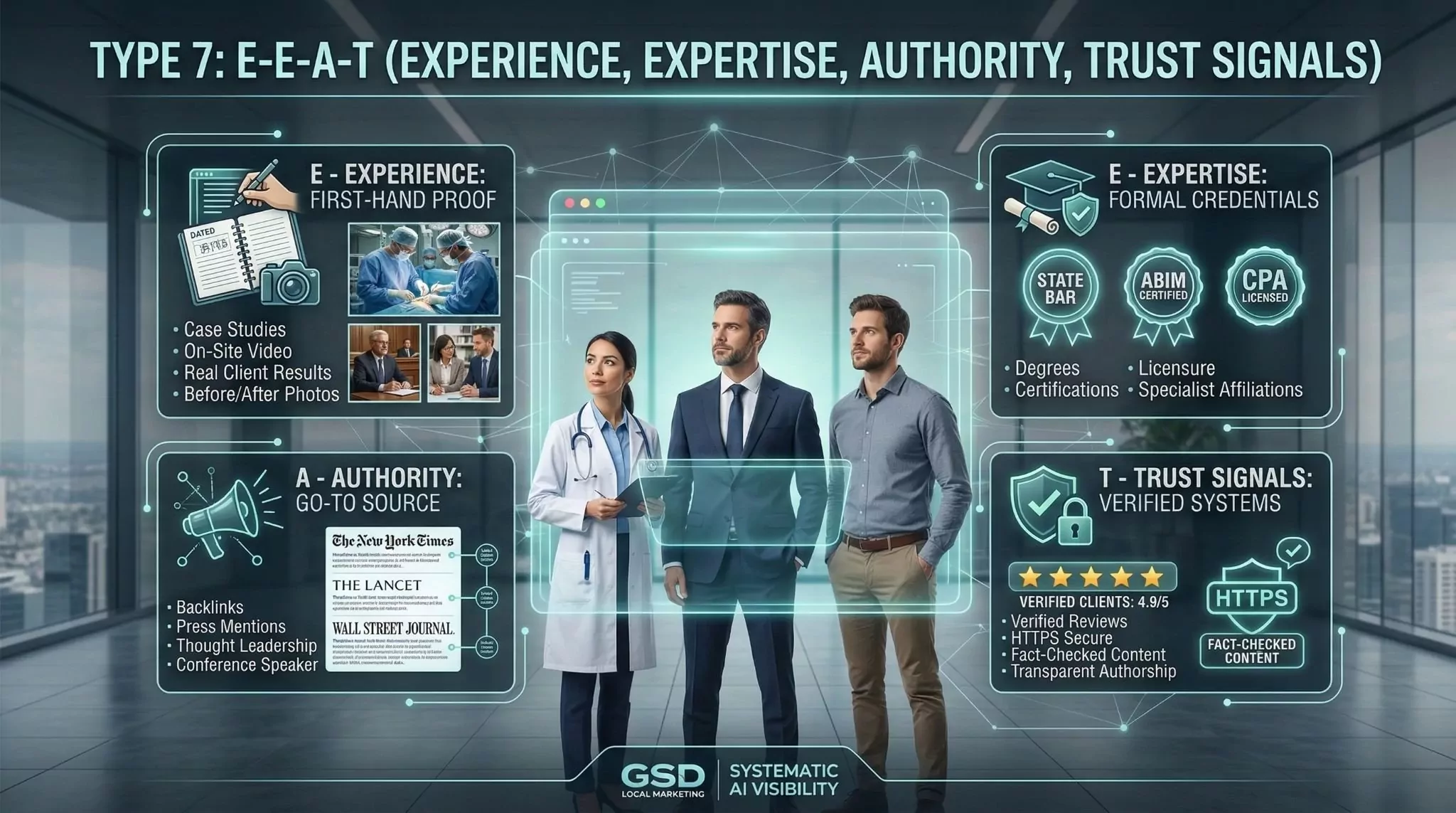
Type 7: E-E-A-T (Experience, Expertise, Authority, Trust Signals)
E-E-A-T represents the trust foundation both Google and AI engines prioritize when determining which businesses deserve visibility and recommendations to prospects making important hiring decisions.
E-E-A-T evaluation focuses on real authors with verified credentials demonstrating actual expertise, first-hand experience shown through detailed case knowledge and practical application, verified information with citations and sources AI can cross-reference, and brand credibility from mentions, reviews, and professional recognition. Strong E-E-A-T signals include author bios with credentials linking to verifiable profiles, case studies proving real hands-on experience, reviews and testimonials with proper schema markup, transparent regularly updated content, and professional recognition from authoritative industry sources.
Two estate planning attorneys appear similar superficially. One has blog posts about trusts and wills written by "Admin" with generic advice anyone could copy from a legal textbook. The other has content with author schema linking to their state bar profile, case study schema showing actual client situations successfully handled, published article schema on contributions to estate planning publications, and professional recognition schema listing speaking engagements at legal conferences with dates and topics.
AI systems trust and recommend the second attorney because they can verify credentials through multiple independent channels, confirm expertise through cross-referenced authoritative sources, validate authority through third-party recognition they can't manipulate, and establish trust through transparent authorship and verifiable information. The first attorney might have identical qualifications but without proper E-E-A-T signals, AI can't verify claims systematically, making recommendations uncertain and risky.
No trust equals no visibility in AI search. E-E-A-T isn't optional anymore-it's the foundation determining whether AI considers you recommendable at all regardless of other optimization efforts.
How GSD Local Marketing helps: ClipCred builds demonstrable E-E-A-T systematically through video content showing real expertise in action not marketing claims, author schema establishing verifiable credentials AI can confirm, case examples proving hands-on experience with real clients, and authority signals AI systems trust when making recommendations to prospects. This transforms invisible expertise into AI-citable proof that generates recommendations instead of being overlooked despite superior qualifications.
Type 8: Video SEO (Visual Search Visibility)
Video SEO captures prospects searching through visual platforms like YouTube, Instagram Reels, TikTok, and video results in traditional search that increasingly appear before text results.
Users search visually now, expecting video answers to questions instead of text articles. To optimize video content, use keyword-rich titles and descriptions matching search queries, add captions and transcripts AI can parse systematically, optimize thumbnails and opening hooks for click-through, and understand platform-specific algorithms determining recommendation. Video content makes you 10X more visible in AI search results because AI systems can parse transcripts, analyze speaking patterns proving genuine expertise, evaluate demonstrated knowledge depth text alone can't convey, and verify expertise through tone and delivery demonstrating confidence and competence.
A prospect searches "How does the estate planning process actually work?" Traditional results show text articles. Video results show attorneys explaining the process on camera with step-by-step walkthroughs. AI Overview includes video recommendation: "Watch this attorney explain the five-step estate planning process with timeline and document requirements" with embedded video preview.
Your competitor appears because their ClipCred videos have transcripts AI can parse for content, titles matching search query patterns exactly, and visual demonstrations of expertise prospects trust more than written claims. You have written content that's comprehensive and well-researched but not video, making you completely invisible in visual search that's growing 40% year-over-year while text search stagnates.
How GSD Local Marketing helps: ClipCred transforms one monthly interview into 25-30 platform-optimized videos with AI-parseable transcripts, keyword-optimized titles, strategic thumbnails, and distribution across YouTube, social platforms, and your website ensuring you dominate visual search, voice queries, and AI recommendations where prospects increasingly search and written content simply doesn't appear or compete effectively.
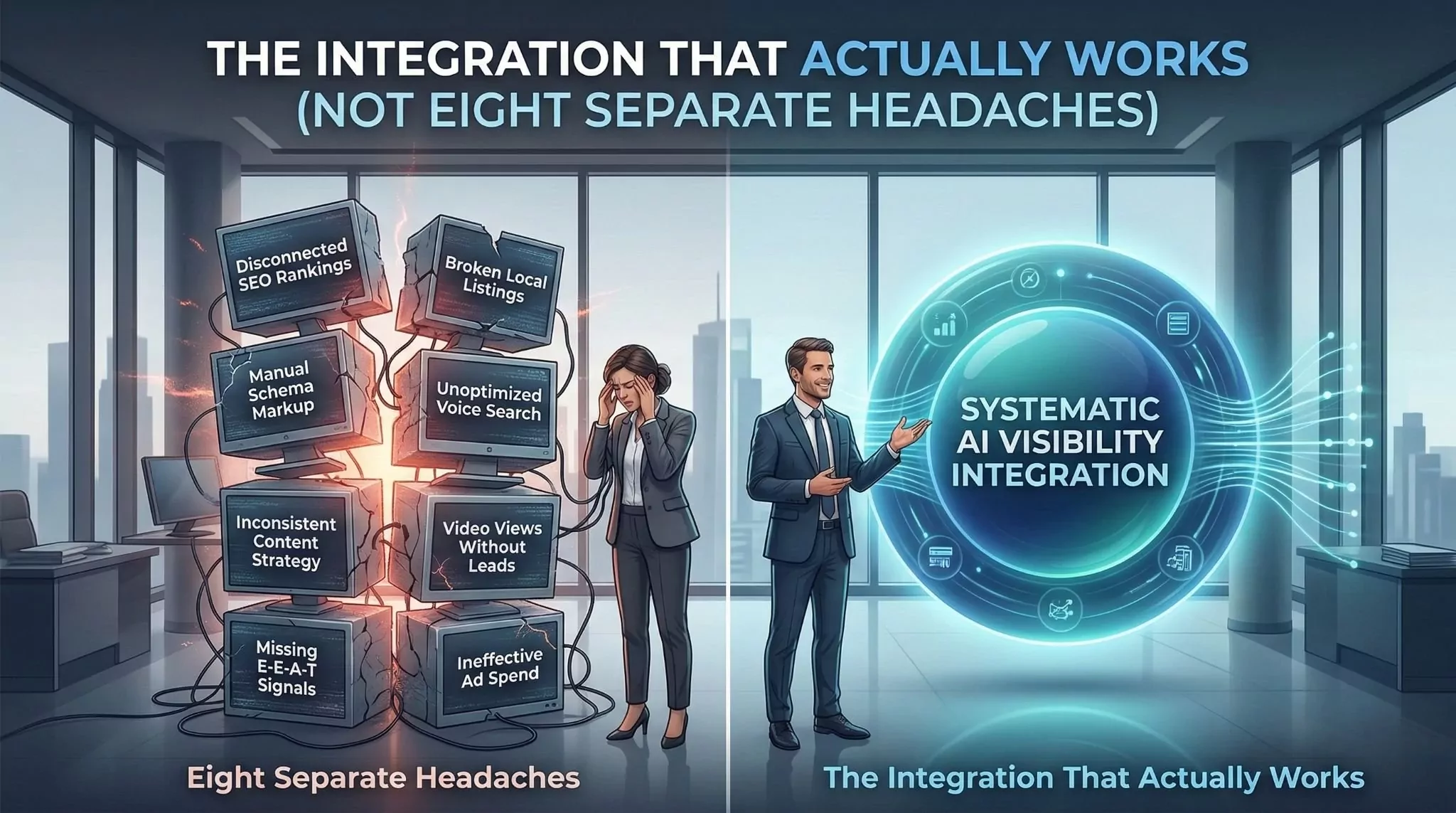
The Integration That Actually Works (Not Eight Separate Headaches)
Here's what separates professionals winning in 2026 from those watching competitors steal their market while rankings look perfect: integrated strategy across all eight search types instead of isolated tactics hoping something eventually works.
Most businesses optimize for one or two search types maximum. Traditional SEO agencies handle organic rankings. Maybe someone manages Google Business Profile for local visibility. That's two out of eight types, leaving you invisible in 75% of how prospects actually search for and hire professionals. Meanwhile, competitors optimizing across all eight types systematically capture every prospect regardless of which search method they happen to use that day.
The compounding effect is devastating and accelerates monthly. Strong traditional SEO improves AI recommendation likelihood because rankings signal authority. AI citations build credibility by strengthening local pack rankings. Local visibility generates reviews improving E-E-A-T signals across all channels. Video content provides transcripts serving both AEO and GEO optimization. Each search type amplifies the others when integrated systematically instead of operating in isolation.
This is the GSD AI Visibility System-not eight separate tactics requiring individual attention but one integrated approach where schema markup simultaneously enables AIO and GEO, ClipCred builds E-E-A-T and Video SEO while creating transcripts for traditional SEO, premium copywriting wins AEO featured snippets, local optimization captures VSO and Local SEO together, and traditional SEO provides the foundation everything else builds on and references.
The result: Prospects find you regardless of which search type they use. ChatGPT recommends you when asked. Google's AI Overview cites you as a trusted source. Featured snippets show your answers in position zero. Voice assistants mention you for spoken queries. Local pack includes you for geographic searches. Video results feature your content. Traditional rankings list you for organic search. You're everywhere prospects look instead of invisible in seven out of eight search universes while competitors who integrated faster capture 88% of available prospect volume.
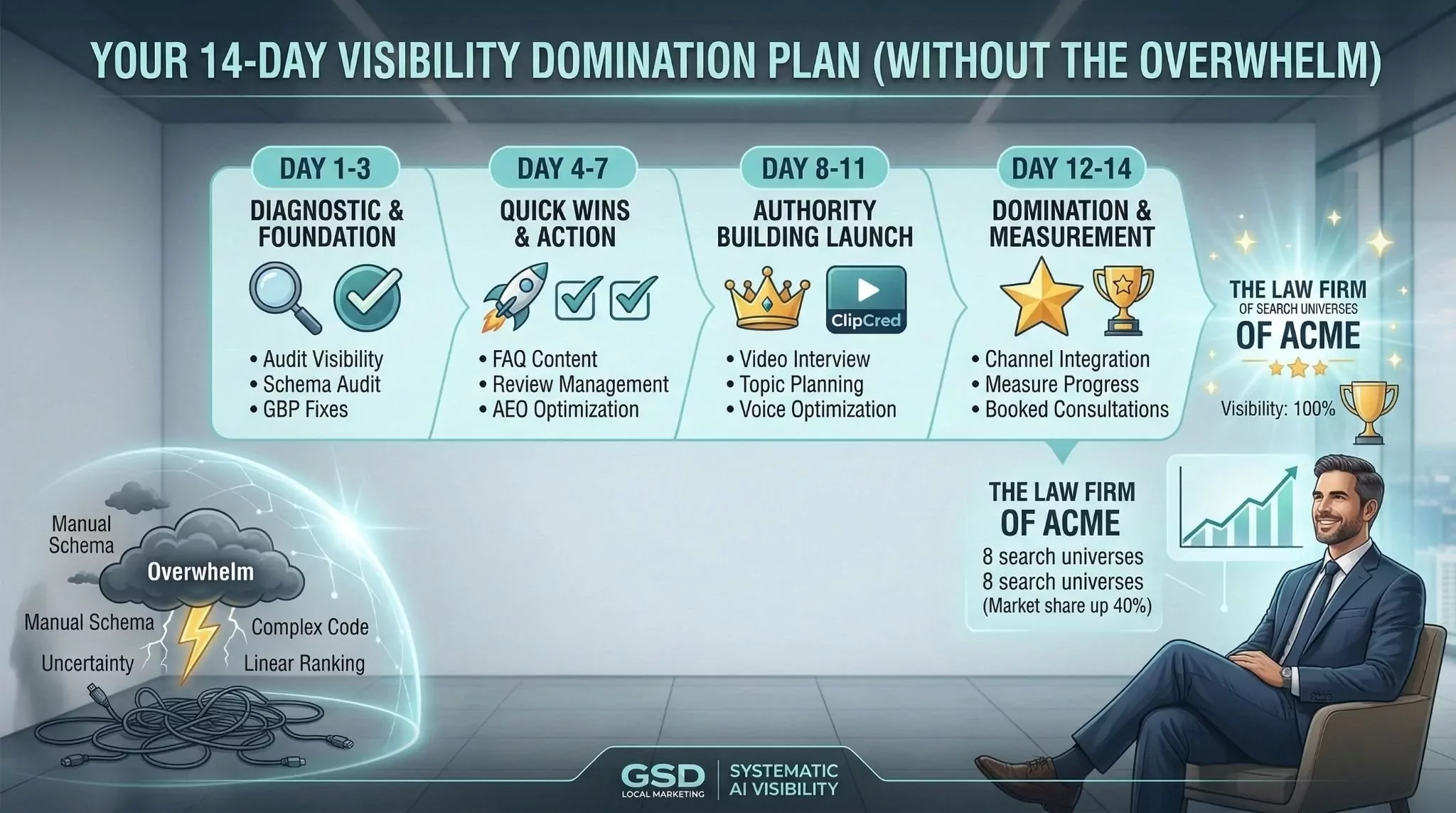
Your 14-Day Visibility Domination Plan (Without the Overwhelm)
Most professionals feel paralyzed looking at eight different search types. Where do you start when everything seems equally important and you're already busy running your practice 60 hours weekly?
Here's the systematic approach that works without heroic effort or overwhelm.
Days 1-3: Diagnostic and Foundation
Get SGE Audit Pro showing your current visibility score across all eight AI search types. Audit Google Business Profile for local optimization gaps and quick fixes. Review existing content for AEO featured snippet and video transcript opportunities. The diagnostic reveals which search types you're completely missing (0% visibility) versus partially optimized (20-40% visibility), letting you prioritize highest-impact improvements first instead of guessing or following generic advice.
Days 4-7: Quick Win Implementation
Implement critical schema markup for immediate AIO eligibility improvement. Optimize Google Business Profile with service area precision and posting schedule. Create FAQ content for AEO featured snippet opportunities on key queries. Add author credentials and E-E-A-T signals to existing content with proper markup. These quick wins immediately improve visibility across four to six search types without requiring major content creation, technical overhauls, or months of effort before seeing any results.
Days 8-11: Authority Building Launch
Schedule first ClipCred interview for Video SEO and E-E-A-T demonstration. Plan a content calendar addressing voice search conversational queries. Develop question-based content for AEO optimization matching actual prospect searches. Building authority takes time but starting the process now ensures compounding benefits over next 60-90 days as content accumulates and AI systems recognize your growing expertise and citation worthiness.
Days 12-14: Integration and Measurement
Connect all eight search types through internal linking and consistent messaging. Implement tracking for visibility across different search types showing progress. Create an ongoing optimization schedule for each search type with realistic time commitments. Integration ensures each optimization amplifies others instead of existing in isolation, multiplying impact beyond what individual tactics deliver separately and creating compounding returns over time.
How GSD Local Marketing helps: We implement this entire 14-day plan as done-for-you service starting with SGE Audit Pro diagnostic ($97) showing exactly where you stand, comprehensive schema implementation ($299) fixing technical gaps immediately, ClipCred launch for systematic authority building serving multiple channels, and integrated optimization across all eight search types. Call (509) 433-7730 for complete AI visibility transformation that doesn't require you to become a search expert yourself.

The Choice That Determines Your Next Six Months
Every day you optimize for only traditional SEO, competitors using integrated AI visibility capture prospects across the other seven search types you're ignoring. Every prospect lost to a competitor with better AI visibility despite worse credentials is revenue you'll never recover and market share that compounds in their favor monthly.
The professionals dominating markets in 2026 don't have better credentials, more experience, or bigger marketing budgets than you. They have better visibility across the eight ways prospects actually search. They're not hoping traditional rankings translate to consultations anymore. They're systematically visible everywhere prospects look, capturing business regardless of which search method prospects happen to use.
Your choice is binary and time-sensitive: Keep paying for traditional SEO that delivers rankings without revenue, wondering why your perfect #1 position generates zero consultation requests while competitors' calendars fill. Or optimize across all eight search types systematically, capturing prospects regardless of how they search and dominate your market while competitors remain invisible in seven out of eight visibility channels.
The gap between early adopters and late movers widens daily and compounds monthly. AI citations accumulate building authority that makes future citations more likely. Video libraries grow creating more discovery entry points. Featured snippets multiply across query variations. Local reviews strengthen over time. Early advantage in integrated AI visibility becomes an insurmountable market position that late movers spend years trying to overcome.
Which side of that gap will you be on six months from now? Prospects are searching today using all eight methods. Are you visible when they look, or are competitors capturing your market while you optimize one channel?
🔍 Get Your AI Visibility Audit: https://sgeauditpro.com
📞 Complete Implementation: (509) 433-7730
🌐 GSD Local Marketing: gsdlocalmarketing.com
Stop optimizing for one search type while prospects use eight different methods to find and hire professionals.
Start dominating all of them systematically before competitors lock up AI visibility in your market.
Because in 2026, visibility isn't about ranking #1 in one channel anymore.
It's about being everywhere prospects actually look across all eight search universes where hiring decisions happen.
Frequently Asked Questions
What is AIO (AI Optimization) and why does it matter?
AIO (AI Optimization) makes your business understandable and recommendable to AI systems like ChatGPT, Claude, and Perplexity. When prospects ask AI for professional recommendations, AI analyzes structured data, entity recognition, and authority signals to decide who to recommend. Without proper AIO, you're invisible to AI recommendation engines.
AI Optimization focuses on making your business systematically understandable to AI recommendation engines that prospects increasingly use to find professionals. When someone asks ChatGPT "Who's the best immigration attorney for family visas in Portland?" the AI doesn't search Google rankings-it analyzes structured data from Portland businesses evaluating entity recognition, authority signals, credential verification, and trust indicators.
Your competitor gets recommended because they implemented attorney schema with bar number and jurisdictions AI can verify through external databases, service schema defining "family-based immigration" with specific visa types listed, published content with article schema demonstrating immigration expertise through proper markup, and review signals with aggregate rating schema AI interprets as trust validation.
You have better credentials and more experience, but your website presents this information in unstructured paragraphs and marketing copy AI can't systematically parse, extract, or verify. When AI can't confidently verify information, it doesn't recommend-even when you're objectively more qualified than competitors AI does recommend.
AIO requires four critical elements: structured data AI can interpret through schema markup, factually accurate information AI can verify through cross-referencing, context-rich content demonstrating expertise in formats AI processes, and authoritative signals AI trusts like reviews, credentials, and professional recognition.
The business impact is immediate and growing. ChatGPT now handles millions of professional recommendation queries daily. Claude, Perplexity, and other AI systems capture additional millions. Each query represents a prospect making a hiring decision, and businesses without proper AIO are completely invisible in these decision moments while AIO-optimized competitors capture every AI-driven lead.
How GSD Local Marketing helps: SGE Audit Pro at sgeauditpro.com reveals your current AI recommendation eligibility score across ChatGPT, Claude, Google's SGE, and other AI systems, showing exactly why AI ignores you when prospects ask for recommendations. Our $299 schema implementation then fixes every gap, transforming you from invisible to AI-recommended across all major AI platforms.
What's the difference between GEO and AEO?
GEO (Generative Engine Optimization) gets you cited when AI generates comprehensive answers. AEO (Answer Engine Optimization) gets you featured in direct answer snippets above organic results. GEO requires depth and original insights AI can extract. AEO requires concise clear answers under 60 words matching query patterns.
Generative Engine Optimization and Answer Engine Optimization serve different but complementary visibility goals in AI search.
GEO determines whether AI-generated answers cite and recommend your business when providing comprehensive responses. Google's Search Generative Experience generates consolidated answers using a few trusted sources, then recommends 3-5 businesses with reasoning. To win GEO, you need content depth with original insights AI can extract and cite, structured information AI can summarize accurately without misrepresentation, topical authority across related subjects proving expertise breadth, and clear answer formats matching how AI constructs comprehensive responses.
A prospect asks "What should I know before choosing a CPA?" AI Overview generates a 300-word answer covering key considerations, then recommends "Local CPAs specializing in small business accounting" with three specific firms including reasoning for each recommendation. GEO optimization gets you selected as one of those three recommended businesses.
AEO focuses on owning direct answers, featured snippets, and "People Also Ask" results appearing before organic rankings. AEO prioritizes speed and clarity over comprehensive depth, preferring content that answers questions in first few lines using simple direct language, matches real user query patterns exactly, and structures information for easy extraction in under 60 words.
The same prospect searches "How much does CPA cost for small business?" The featured snippet shows a clear answer: "Small business CPA costs range from $1,500-$3,000 annually for basic bookkeeping and tax prep, $3,000-$6,000 for monthly financial management, and $6,000+ for comprehensive CFO services." AEO optimization gets you featured in position zero above all organic results.
The strategic difference: GEO makes you the source AI uses to generate answers and recommendations. AEO makes the answer itself appearing before prospects see anything else. Both capture attention before traditional organic rankings, but through different mechanisms requiring different optimization approaches.
How GSD Local Marketing helps: ClipCred creates content depth GEO requires-video transcripts with natural Q&A demonstrating expertise AI can extract and cite. Premium copywriting structures content for AEO-question-based format with concise answers under 60 words eligible for featured snippets. The integrated approach dominates both GEO citations and AEO featured positions.
How does Voice Search Optimization (VSO) differ from traditional keyword optimization?
Voice searches use conversational natural language like "What's the best estate planning attorney near me who handles trusts?" while traditional searches use keywords like "estate planning attorney trusts." VSO requires long-tail question-based content, conversational language matching spoken patterns, and local intent optimization for "near me" queries.
Voice Search Optimization fundamentally differs from traditional keyword optimization because spoken queries sound nothing like typed searches, requiring completely different content and technical optimization.
Traditional keyword searches are abbreviated and efficient: "divorce lawyer Seattle," "CPA small business taxes," "orthopedic surgeon knee replacement." People type shortcuts because typing is slower than speaking and search engines understand abbreviated queries.
Voice searches are conversational and complete: "Who's the best divorce lawyer in Seattle for high-asset cases?" "Do I need a CPA for my small business taxes or can I use software?" "What should I ask an orthopedic surgeon about knee replacement surgery?" People speak naturally to voice assistants expecting conversational understanding.
This creates three critical VSO requirements traditional keyword optimization doesn't address. First, long-tail question-based content matching how people actually speak their queries instead of abbreviated keyword phrases. Second, conversational language and natural phrasing throughout content instead of keyword-stuffed optimization targeting specific terms. Third, local intent signals because voice searches heavily skew toward "near me" and location-specific queries from mobile devices.
Technical VSO requirements include schema markup voice assistants use to extract answers, featured snippet optimization since voice assistants often read featured snippet content, page speed optimization because voice searchers expect immediate results, and mobile optimization since most voice searches originate from phones.
The business impact compounds as voice search grows. Smart speakers, phone assistants, and AI chatbots all process voice queries using natural language understanding that traditional keyword optimization completely misses. Professionals optimizing only for typed keywords are invisible to the 40%+ of searches now happening through voice interfaces.
How GSD Local Marketing helps: Our content strategy specifically optimizes for voice search patterns through conversational question-answer formats matching spoken queries, long-tail query targeting, and local intent optimization ensuring you appear in voice assistant recommendations when prospects ask AI for professional help using natural language instead of abbreviated keywords.
What is E-E-A-T and how do I prove it to AI systems?
E-E-A-T (Experience, Expertise, Authority, Trust) represents credibility signals both Google and AI engines evaluate before recommending businesses. Prove E-E-A-T through author schema with verified credentials, case studies showing real experience, review schema with aggregate ratings, published content demonstrating expertise, and professional recognition from authoritative sources.
Experience, Expertise, Authority, and Trust signals determine whether Google and AI engines consider you credible enough to recommend to prospects making important decisions about professional services.
E-E-A-T evaluation focuses on four distinct but related credibility dimensions. Experience means first-hand knowledge demonstrated through detailed case examples, specific client situations handled, and practical application of expertise showing you've actually done the work, not just studied it theoretically. Expertise means deep knowledge in your field proven through credentials, education, certifications, and content demonstrating comprehensive understanding. Authority means recognition from others including reviews, testimonials, media mentions, speaking engagements, and professional awards. Trust means transparency, accuracy, and reliability shown through updated content, clear authorship, verifiable claims, and consistent messaging.
Two estate planning attorneys appear similar superficially. One has blog posts about trusts and wills written by "Admin" with generic advice anyone could write. The other has content with author schema linking to their state bar profile, case study schema showing actual client situations successfully handled, published article schema on contributions to estate planning publications, and professional recognition schema listing speaking engagements at legal conferences.
AI systems trust and recommend the second attorney because they can verify credentials through multiple channels, confirm expertise through cross-referenced sources, validate authority through third-party recognition, and establish trust through transparent authorship and verifiable information. The first attorney might have identical qualifications but without proper E-E-A-T signals, AI can't verify claims making recommendations uncertain.
Proving E-E-A-T to AI requires structured signals AI can systematically evaluate: author bios with credentials linked to verifiable profiles, case studies with schema markup showing real experience, review and testimonial schema with aggregate ratings, published content with article schema and author attribution, professional recognition schema listing awards and speaking engagements, and educational content demonstrating expertise depth across practice area.
How GSD Local Marketing helps: ClipCred builds demonstrable E-E-A-T systematically through video content showing real expertise in action, author schema establishing verifiable credentials, case examples proving hands-on experience, and authority signals AI systems trust when making recommendations. This transforms invisible expertise into AI-citable proof generating recommendations instead of being overlooked despite superior qualifications.
Why is Video SEO more important than written content for AI visibility?
Video content makes you 10X more visible in AI search because AI systems can parse transcripts, analyze speaking patterns proving expertise, evaluate demonstrated knowledge depth text alone can't convey, and verify expertise through tone and delivery. Additionally, prospects increasingly search through YouTube, TikTok, and visual platforms where written content doesn't appear.
Video SEO delivers superior AI visibility compared to written content for four critical reasons that compound in 2026's search landscape.
First, AI systems extract more verifiable expertise signals from video transcripts than written content. When you write "I have 20 years of estate planning experience," AI sees an unverifiable claim. When video shows you naturally explaining complex trust structures using specific examples and professional terminology demonstrating deep knowledge, AI processes tone, delivery confidence, example specificity, terminology accuracy, and conversational authority signals written content can't provide-all confirming claimed expertise is genuine.
Second, visual search platforms grow 40% year-over-year while traditional text search stagnates. Prospects under 40 increasingly search YouTube before Google, ask questions on TikTok expecting video answers, and browse Instagram Reels for professional recommendations. Your written content is completely invisible on these platforms where millions of prospects search daily, while video-optimized competitors dominate visual discovery.
Third, voice assistants and AI chatbots increasingly recommend video content because video transcripts provide richer context for generating answers. When someone asks ChatGPT "How does estate planning work?" AI might respond "Watch this attorney explain the five-step process" with embedded video, or reference video transcript content in its generated answer with attribution to the professional who created it.
Fourth, video content serves multiple visibility channels simultaneously. One ClipCred video with transcript optimizes for traditional SEO through text content, generates featured snippets from transcript excerpts, appears in video search results, gets recommended by AI systems, ranks in YouTube search, distributes across social platforms, and demonstrates E-E-A-T through visual expertise-seven visibility channels from one asset while written content serves maybe two.
The competitive gap widens as video libraries compound. An attorney with 100 optimized videos from two years of ClipCred dominates every video search, voice query, and AI recommendation in their practice area. Competitors without video remain invisible across all visual and voice search channels regardless of written content quality.
How GSD Local Marketing helps: ClipCred transforms one monthly 60-minute interview into 25-30 platform-optimized videos with AI-parseable transcripts, keyword-optimized titles, strategic thumbnails, and distribution across YouTube, social platforms, and your website ensuring you dominate visual search, voice queries, and AI recommendations where prospects increasingly search and written content simply doesn't appear.
How do I integrate all 8 AI search types without being overwhelmed?
Start with SGE Audit revealing which search types you're completely missing versus partially optimized. Implement quick wins (schema markup, GBP optimization, FAQ content) addressing multiple types simultaneously. Launch authority building (ClipCred) serving several channels. Each optimization amplifies others when integrated systematically rather than treating them as separate tactics.
Integrating eight AI search types feels overwhelming when viewing them as separate tactics requiring individual attention, but becomes manageable when understanding how strategic foundations serve multiple channels simultaneously.
The integration framework has four phases requiring different effort levels and timelines.
Phase 1: Foundation (Days 1-3) starts with SGE Audit Pro diagnostic showing current visibility across all eight search types, revealing which you're completely missing (0% visibility) versus partially optimized (20-40% visibility) versus already strong (60%+ visibility). This diagnostic prevents wasting effort on already-strong channels while missing completely broken ones, and identifies which quick wins deliver maximum impact across multiple search types simultaneously.
Phase 2: Quick Wins (Days 4-7) implements high-impact low-effort optimizations serving multiple search types. Schema markup implementation improves AIO, GEO, and E-E-A-T simultaneously. Google Business Profile optimization enhances Local SEO and VSO together. FAQ content creation serves AEO and GEO at once. Author credential addition strengthens E-E-A-T across all content. These quick wins immediately improve visibility across four to six search types without requiring major content creation.
Phase 3: Authority Building (Days 8-30) launches systematic content creation serving multiple channels. ClipCred video interviews generate Video SEO content, provide transcripts for Traditional SEO, demonstrate E-E-A-T through visual expertise, create GEO-eligible depth, and produce AEO-friendly excerpts-five search types from one monthly interview. Question-based blog content serves Traditional SEO, AEO featured snippets, GEO citations, and VSO voice queries simultaneously.
Phase 4: Ongoing Integration (Days 31+) maintains optimization across all channels through monthly ClipCred interviews adding video and transcript content, quarterly schema audits ensuring markup stays current, regular GBP posts maintaining local visibility, and content updates addressing new voice search patterns and AI behaviors as they evolve.
The key insight: You're not optimizing eight separate channels. You're implementing four strategic foundations (schema markup, local optimization, authority content, question-based writing) that each serve multiple search types, creating 2-3X leverage where one effort improves three to four visibility channels simultaneously.
How GSD Local Marketing helps: We implement the entire 14-day integration plan as done-for-you service starting with SGE Audit Pro diagnostic ($97), comprehensive schema implementation addressing AIO/GEO/E-E-A-T ($299), ClipCred launch serving Video SEO/E-E-A-T/GEO/Traditional SEO, and integrated optimization across remaining channels. Call (509) 433-7730 for complete AI visibility transformation handling all eight search types systematically.
What happens if I only optimize for traditional SEO and ignore the other 7 search types?
Optimizing only traditional SEO captures approximately 12-15% of total search volume in 2026 while competitors dominating all eight types capture 85-88%. You'll rank #1 organically but get zero consultations because prospects find competitors through AI recommendations, voice search, video results, and featured snippets before seeing traditional rankings.
Focusing exclusively on traditional SEO while ignoring the other seven AI search types creates the exact invisible #1 ranking problem destroying professional services marketing throughout 2026.
Here's what actually happens to prospects searching for professionals in your category when you optimize only traditional SEO. Someone asks ChatGPT for an attorney recommendation-AI recommends three competitors with proper AIO optimization, you're never mentioned (AIO failure). Someone searches on Google-AI Overview cites competitor's content and recommends businesses with GEO optimization, you don't appear (GEO failure). Featured snippet shows competitor's answer from AEO-optimized content above all organic results (AEO failure). Local pack displays three businesses with superior Google Business Profile optimization (Local SEO failure). A voice assistant recommends a competitor when the prospect asks the phone "Who's the best attorney near me?" (VSO failure). Video results show competitor's YouTube content, you have none (Video SEO failure). Prospect scrolls six times on mobile before reaching your #1 organic ranking, but they already called the business AI recommended in the Overview (Traditional SEO success, business failure).
The math is brutal. Traditional organic results capture approximately 12-15% of total search volume in 2026 according to search behavior studies. AI Overviews handle 35-40% of searches. Featured snippets and position zero capture 15-20%. Local packs take 10-15%. Voice search represents 15-20%. Video results grab 8-12%. The remaining 12-15% actually scroll to traditional organic results, and even within that minority, position #1 doesn't guarantee clicks anymore because AI trained prospects to trust recommendations over rankings.
Your traditional SEO agency shows you #1 rankings as proof of success. Your analytics show declining organic traffic. Your consultation requests drop. You blame market conditions or competition. The real problem: You're optimizing for 12-15% of search volume while competitors capture 85-88% through channels you're completely ignoring.
The competitive gap compounds monthly. Competitors getting AI-recommended build authority through citations making future recommendations more likely. Their video libraries grow creating more entry points. Their featured snippets accumulate across query variations. Their local reviews strengthen. Six months later, they dominate all eight search types while you still rank #1 organically for the 12% of prospects who reach traditional results-and even that's declining as AI handles more queries without showing organic results at all.
How GSD Local Marketing helps: Our integrated approach ensures you're not optimizing for one search type representing 12% of volume while missing seven channels capturing 88%. We implement systematic visibility across Traditional SEO, AIO, GEO, AEO, Local SEO, VSO, E-E-A-T, and Video SEO simultaneously so prospects find you regardless of search method used, transforming 12% visibility into complete market domination.
GSD Local Marketing
130 11th St NE
East Wenatchee, WA 98802
(509)-433-7730
Follow Us On
© 2026 GSD Local Marketing