NETENGINE

THE 30-SECOND CREDIBILITY TEST...
Why Prospects Don't Trust Your Website (And How to Fix It)
Why Your Professional Website Drives Prospects Away (And What Actually Builds Trust)
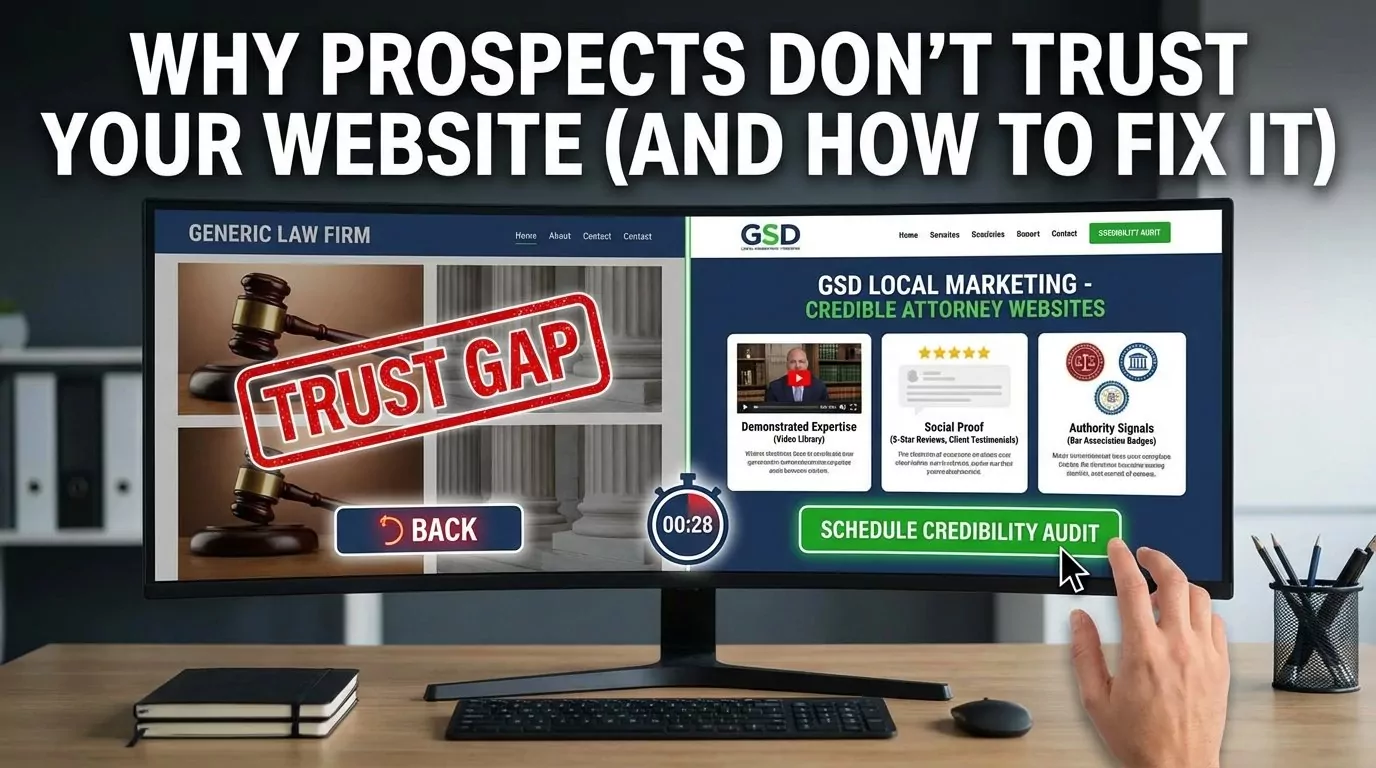
Your website looks professional. Clean design. Nice photos. All the right practice areas listed.
And prospects are leaving within 30 seconds - not because it's ugly or hard to navigate, but because they don't trust you.
If you need a credible attorney website that converts visitors into clients instead of driving them away, GSD Local Marketing builds conversion-optimized legal websites with demonstrated expertise, social proof, and authority signals that close credibility gaps before prospects ever call. Schedule your free credibility audit: (509) 433-7730.
Here's what's actually happening on your current website:
A prospect with a serious legal problem-criminal charges, divorce, immigration issues-lands on your site. They desperately need help. They're scared, stressed, maybe facing life-changing consequences.
They scan your homepage. Read a few sentences. Check your about page.
And within 60 seconds, they click the back button and call your competitor instead.
Why?
Because your website has a credibility gap.
Not a design problem. Not a technical issue. A trust problem.
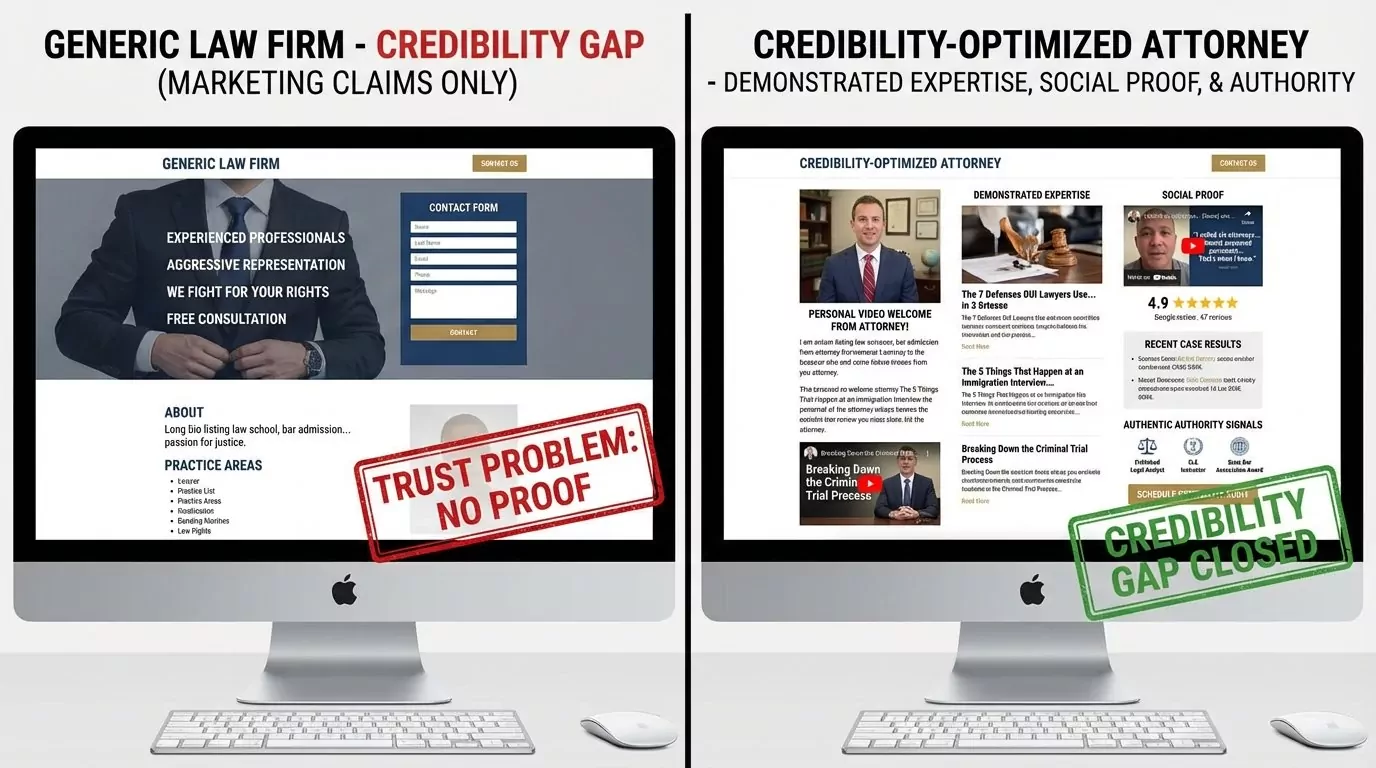
Your website says "we're experienced professionals," but it doesn't prove it. It claims "we get results," but shows no evidence. It promises "we care about clients," but sounds exactly like every other law firm website they've visited in the past hour.
And in 2025, claims without proof equal instant disqualification.
This article shows you exactly what creates credibility gaps on attorney websites-and more importantly, how to close them before prospects leave for competitors who've figured this out.
The 30-Second Credibility Test (And Why You're Failing It)
Here's how prospects actually evaluate attorney websites:
0-10 seconds: Visual scan. Does this look legitimate or sketchy?
10-20 seconds: Authority check. Do they demonstrate expertise or just claim it?
20-30 seconds: Trust validation. Is there proof other people hired them successfully?
30 seconds: Decision. Stay and call, or leave and keep searching?
Most attorney websites pass the visual test. Professional design, stock photos of confident lawyers, nice color scheme.
But they fail catastrophically at the authority check and trust validation.
Here's what prospects see on the typical law firm website:
Homepage: "Experienced attorneys serving [city] since [year]" "Aggressive representation" "We fight for your rights" "Free consultation"
About Page: Long bio listing law school, bar admission, years practicing Maybe a paragraph about "passion for justice" Professional headshot
Practice Areas: Lists of services offered Generic descriptions of each practice area "Call us for help with..."
That's it.
Notice what's missing? Proof.
No evidence they actually win cases. No demonstration of legal expertise. No validation from real clients. No content proving they understand the specific situation prospects are facing.
Just claims and promises identical to every other attorney website.
And prospects don't trust claims anymore.
They trust proof. Evidence. Demonstration. Validation.
When your website doesn't provide these, you've created a credibility gap-and prospects fill that gap with doubt, not confidence.
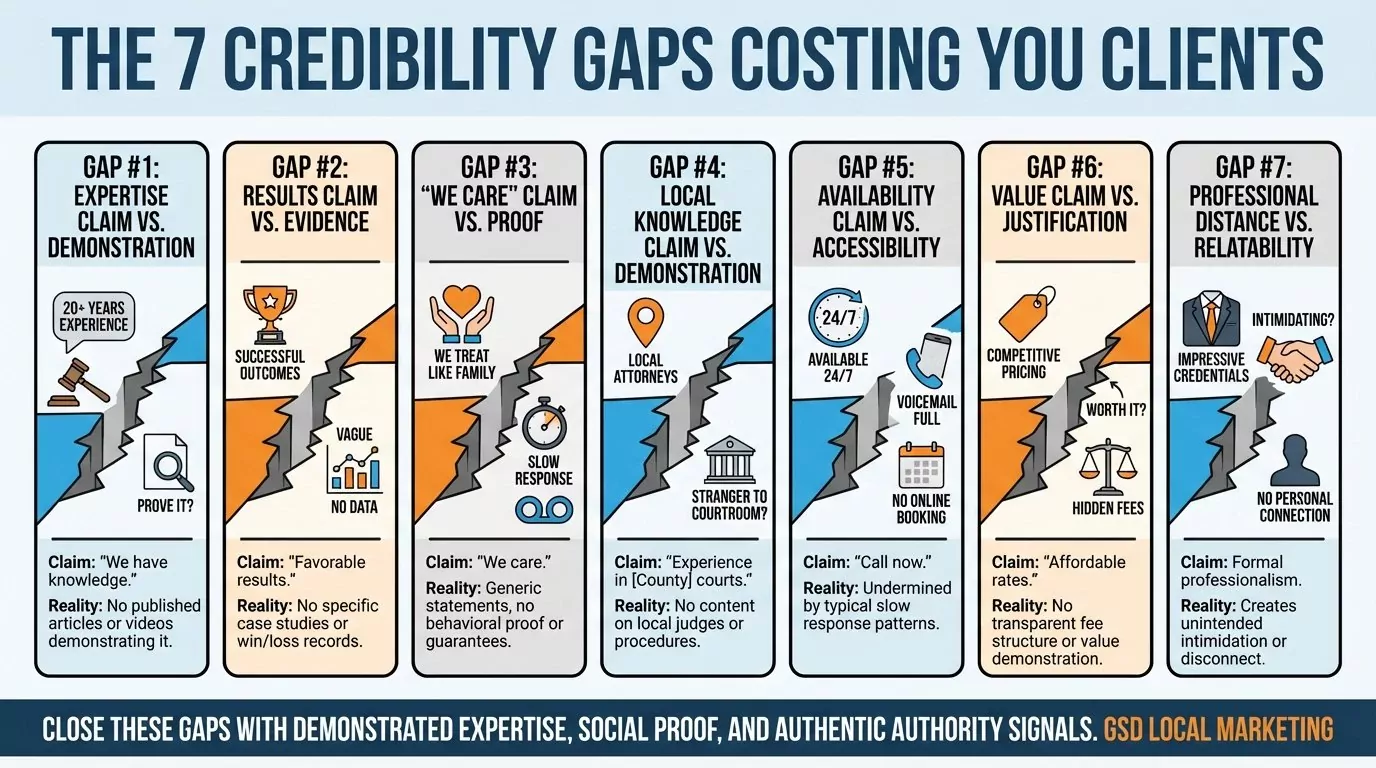
The 7 Credibility Gaps Costing You Clients
Let me show you exactly where prospects lose trust in attorney websites:
Gap #1: The Expertise Claim vs. Demonstration Gap
What your website says: "With over 20 years of experience in criminal defense, our attorneys have the knowledge and skill to defend your case."
What prospects think: "Every lawyer says this. How do I know you actually know what you're doing?"
The gap: Claims of expertise without demonstration.
What closes the gap:
Published articles explaining complex legal concepts
Videos breaking down case strategies
Blog posts analyzing recent legal developments
Detailed explanations showing you understand their specific situation
Example that works: Instead of "experienced in DUI defense," publish an article titled "The 7 Defenses DUI Lawyers Use to Challenge Breathalyzer Evidence (And When Each One Works)."
Prospects reading this think: "This lawyer actually knows the technical details. They're not just claiming expertise-they're demonstrating it."
Gap #2: The Results Claim vs. Evidence Gap
What your website says: "We've successfully handled thousands of cases and achieved favorable outcomes for our clients."
What prospects think: "What does 'favorable' mean? Did you actually win or just negotiate mediocre plea deals?"
The gap: Vague results claims without specific evidence.
What closes the gap:
Specific case results (within ethical guidelines)
Win/loss records where permitted
Detailed case studies showing strategy and outcome
Client testimonials describing actual results
Example that works: "Recent Results: Client facing 3rd DUI with mandatory jail time-reduced to reckless driving, no jail. Client charged with felony domestic violence-case dismissed after preliminary hearing. Client in removal proceedings-granted asylum after 2-year fight."
Specific beats vague every time.
Gap #3: The "We Care" Claim vs. Proof Gap
What your website says: "We treat every client like family and fight tirelessly for the best possible outcome."
What prospects think: "Every lawyer says this. How do I know you actually care and won't just take my money?"
The gap: Generic caring statements without behavioral proof.
What closes the gap:
Response time guarantees ("all calls returned within 4 hours")
Communication policies ("you'll never wonder what's happening with your case")
Client testimonials describing actual experience, not just results
Behind-the-scenes content showing how you actually work
Example that works: Video testimonial where client says: "I called six attorneys before [Name]. Five sent me to voicemail. [Name] answered personally at 7 PM on a Friday and talked to me for 20 minutes before I even hired them. That's when I knew."
That's proof of caring, not claims.
Gap #4: The Local Knowledge Claim vs. Demonstration Gap
What your website says: "As local attorneys, we have extensive experience in [County] courts."
What prospects think: "Okay, but do you actually know the judges and prosecutors I'll be dealing with, or are you just located here?"
The gap: Location proximity confused with actual local expertise.
What closes the gap:
Specific content about local courts, judges, procedures
Analysis of local legal trends and developments
Demonstration of relationships and knowledge of local legal culture
Content addressing jurisdiction-specific issues
Example that works: Blog post: "What to Expect in Judge Martinez's Courtroom: 5 Things Every Criminal Defendant Should Know About Chelan County Superior Court."
Prospects think: "This lawyer actually knows my specific court, not just general criminal law."
Gap #5: The Availability Claim vs. Accessibility Gap
What your website says: "Available 24/7 for emergencies" "Call now for immediate assistance"
What prospects think: "I'll probably get voicemail and wait three days for a callback like every other lawyer."
The gap: Availability claims undermined by typical attorney response patterns.
What closes the gap:
Live chat on website (real person, not bot)
Actual response time data ("average callback: 3.2 hours")
Online scheduling tools
Text message response options
Proof of actual availability through client testimonials
Example that works: Testimonial: "I submitted the contact form at 11 PM on Sunday. [The attorney] called me at 8 AM Monday. We had a consultation scheduled for that afternoon. I hired them on the spot."
That's accessibility proof, not availability claims.
Gap #6: The Value Claim vs. Justification Gap
What your website says: "Affordable rates" "Competitive pricing" "Free consultation"
What prospects think: "What does this actually cost? And why should I pay you instead of the lawyer charging less?"
The gap: Price discussions without value demonstration.
What closes the gap:
Transparent discussion of fee structure
Explanation of what clients get for fees paid
Content demonstrating superior knowledge/approach
Comparison of cheap vs. competent representation
ROI framing for appropriate cases
Example that works: Article: "Why the Cheapest DUI Lawyer Usually Costs the Most: What You Actually Get for $1,500 vs. $5,000 in Legal Representation."
Educating prospects on value before they call eliminates price-shopping.
Gap #7: The Professional Distance vs. Relatability Gap
What your website says: [Formal headshot, corporate bio, legal credentials, professional accomplishments]
What prospects think: "This person seems impressive but intimidating. Will they actually understand my situation or talk down to me?"
The gap: Professional credibility creating unintended intimidation or disconnect.
What closes the gap:
Personal story content showing you were once where they are
Video content showing personality, not just professionalism
Behind-the-scenes content humanizing your practice
Content addressing the emotional aspects of legal problems
Authentic language in addition to legal expertise
Example that works: Video: "Why I became an immigration attorney: My grandmother came here with nothing in 1958. I understand what's at stake when your family's future depends on one interview."
Relatability doesn't undermine credibility-it enhances trust.
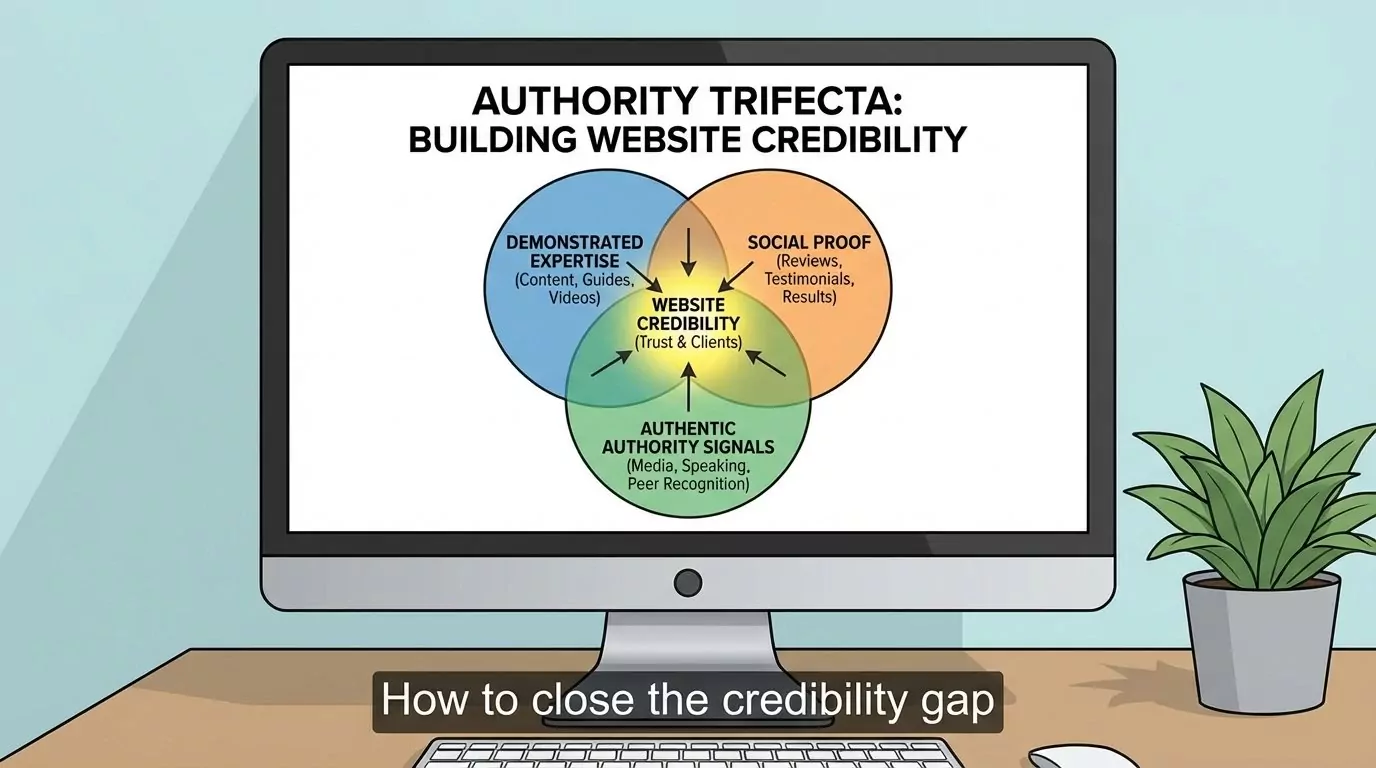
What Actually Builds Website Credibility (The Authority Trifecta)
Credibility isn't built through design improvements or better copywriting.
It's built through three overlapping elements I call the Authority Trifecta:
Element #1: Demonstrated Expertise
Not claimed. Demonstrated.
This means content that proves you understand the legal issues prospects face:
Blog posts explaining complex legal concepts in accessible language
Videos breaking down case strategies and legal processes
Detailed guides addressing specific legal problems
Analysis of recent court decisions affecting your practice area
FAQ content answering questions prospects haven't asked yet
The pattern: Help first, sell second.
When prospects find your article explaining the 5 things that happen at an immigration interview, or your video breaking down the criminal trial process, they think: "This lawyer knows their stuff. They're not just trying to get me to call-they're actually teaching me."
That's demonstrated expertise.
And it closes the credibility gap before prospects ever contact you.
Element #2: Social Proof
Not testimonials. Social proof.
Yes, testimonials help. But real social proof is broader:
Video testimonials showing actual clients describing their experience
Case results with specific details (within ethical rules)
Reviews across multiple platforms (Google, Avvo, Facebook)
Third-party validation (awards, recognition, media appearances)
Peer endorsements from other attorneys
Client success stories showing the journey, not just the outcome
The pattern: Multiple independent validation sources.
When prospects see:
47 five-star Google reviews
Video testimonial from a former client
Case result matching their situation
Article you published in legal journal
Award from state bar association
They think: "This isn't just one person saying they're good. Multiple sources validate this attorney's competence."
That's social proof.
And it eliminates the "how do I know they're not just claiming expertise?" doubt.
Element #3: Authentic Authority Signals
Not marketing. Authentic signals.
These are the subtle indicators that you're actually established in your field:
Published content demonstrating thought leadership
Speaking engagements and presentations
Teaching experience or CLE instruction
Peer recognition and professional involvement
Media appearances and expert commentary
Long-form content showing depth of knowledge
Consistent online presence over time
The pattern: Evidence of actual professional standing.
When prospects see you've been publishing legal analysis for three years, or you teach other attorneys, or you've been quoted in news articles, they think: "This isn't just a lawyer with a website. This is someone other professionals recognize as knowledgeable."
That's authentic authority.
And it creates instant credibility that marketing claims never will.
The AI Visibility Factor (Why Credibility Gaps Matter Even More Now)
Here's what's changing the credibility equation in 2025:
Prospects aren't just visiting your website anymore.
They're asking ChatGPT: "What should I know before hiring a criminal defense attorney?"
They're asking Claude: "How do I evaluate immigration lawyers?"
They're asking Perplexity: "What makes a good family law attorney?"
And AI systems recommend attorneys based on demonstrated expertise, not marketing claims.
When AI scans your website, it's looking for:
Published content showing legal knowledge
Evidence of results and case outcomes
Credibility signals like published articles and professional recognition
Structured data (schema markup) clarifying your expertise
Depth of content on specific legal topics
Your competitor with 100 blog posts demonstrating expertise gets recommended.
You with a 5-page website making marketing claims don't get mentioned.
The credibility gap isn't just costing you prospects who visit your website.
It's costing you prospects who never see your website because AI systems don't recognize you as credible enough to recommend.
That's the real cost in 2025.
The 90-Day Credibility Transformation
You can't close all seven credibility gaps overnight.
But you can make substantial progress in 90 days with focused effort:
Month 1: Foundation (Expertise Demonstration)
Week 1:
Identify the 10 questions every prospect asks before hiring you
Write 2 blog posts (1,200-1,500 words each) answering the two most common questions
Our Local SEO service handles this blog writing systematically-we research what your target clients are searching, write SEO-optimized articles demonstrating your legal expertise, and publish consistently so you build content authority without writing anything yourself, freeing you to practice law while we build your credibility assets.Create 3 short videos (60-90 seconds) addressing three more questions
Week 2:
Write 2 more blog posts on next most common questions
Record detailed video (5-7 minutes) explaining your legal process
Add FAQ section to website with 10 detailed answers
Week 3:
Publish comprehensive guide (2,000+ words) on your most common case type
Create 3 more short videos addressing objections/concerns
Add case studies section with 2-3 detailed examples (within ethical rules)
Week 4:
Write blog post analyzing recent legal development in your field
Record behind-the-scenes video showing how you actually work
Add "What to Expect" content explaining your client experience
Results after Month 1:
8 blog posts demonstrating expertise
10-12 videos showing knowledge and personality
Comprehensive content closing Gaps #1, #4, and #7
Month 2: Social Proof Acceleration
Week 5:
Request video testimonials from 3 recent satisfied clients
Set up Google Review request system
Create case results page with specific outcomes
Week 6:
Record 2 video testimonials professionally
Optimize Google Business Profile with photos, posts, regular updates
Publish detailed case study walking through strategy and result
Week 7:
Add third-party validation (awards, recognition, media) to website
Create "Client Success Stories" page with journey narratives
Implement review request automation for new clients
Week 8:
Publish peer endorsement content (where permitted)
Add social proof widgets to key pages
Create testimonial compilation video (2-3 minutes)
Results after Month 2:
20+ five-star reviews across platforms
5+ video testimonials showing real client experiences
Case results and success stories closing Gaps #2, #3, and #5
Month 3: Authority Signal Building
Week 9:
Submit article to legal publication or state bar journal
Create CLE presentation on area of expertise
Publish comprehensive legal guide (3,000+ words)
Week 10:
Reach out to local media as expert source
Join and participate in professional organizations
Create thought leadership content (contrarian legal analysis)
Week 11:
Implement schema markup (attorney, legal service, local business)
Optimize all content for AI discoverability
Create comprehensive resource page for your practice area
Week 12:
Publish analysis of significant case or legal trend
Record educational video series (5+ videos on related topics)
Review and enhance all credibility signals across website
Results after Month 3:
Published content in professional outlets
Recognized expertise by peers and media
Comprehensive AI-optimized presence closing Gap #6 and amplifying all others
90-Day Transformation:
25+ pieces of expertise-demonstrating content
20+ five-star reviews and 5+ video testimonials
Published professional recognition
Schema markup making you discoverable to AI
Website that closes credibility gaps instead of creating them
The Technical Credibility Factors (Schema Markup and AI Optimization)
Most attorneys ignore the technical side of credibility.
That's a mistake.
Schema markup is structured data that tells AI systems exactly who you are, what you do, and why you're credible.
When implemented correctly, schema markup includes:
Attorney schema identifying you as a licensed legal professional
Legal service schema clarifying practice areas and specialties
Organization schema establishing firm credibility
Review schema highlighting client testimonials
Article schema making your content discoverable
Local business schema for geographic relevance
Without schema markup: AI systems struggle to understand your expertise and rarely recommend you.
With proper schema markup: AI systems recognize you as a credible attorney and include you in recommendations.
The cost? $299 for professional implementation.
Our schema markup service implements attorney schema, legal service schema, organization
schema, review schema, article schema, and local business schema comprehensively-making your expertise, credentials, practice areas, and credibility signals systematically readable by ChatGPT, Claude, Perplexity, and Google's AI, transforming you from invisible to recommended when prospects ask AI for attorney suggestions.
The ROI? Appearing in AI recommendations when prospects ask for attorney suggestions.
That's not optional anymore. It's foundational.
When "Professional" Website Design Actually Hurts Credibility
Here's a counterintuitive truth:
Sometimes the most professional-looking websites have the biggest credibility gaps.
Why?
Because they prioritize appearance over proof.
Beautiful design. Perfect layouts. Stunning photography.
But zero content demonstrating expertise. No social proof. No evidence of results. No personality.
Just elegant emptiness.
Prospects think: "This looks expensive, but I have no idea if this attorney actually knows what they're doing."
Meanwhile, the attorney with a simpler website but 100 blog posts demonstrating expertise gets hired.
I'm not saying design doesn't matter. It does.
But design without substance creates a credibility gap that no amount of visual polish can close. The Local Authority Copy System creates website copy that demonstrates expertise rather than claims it-trust-building messaging that educates prospects about legal processes while positioning you as the obvious choice, ensuring every page advances credibility rather than creating doubt through generic marketing language.
The hierarchy is:
Demonstrated expertise (content proving you know your field)
Social proof (validation from clients and peers)
Authority signals (professional recognition)
Professional design (making it easy to consume 1-3)
Get that order wrong, and prospects leave regardless of how beautiful your website looks.
Our website design service prioritizes this hierarchy correctly-conversion-focused design that showcases demonstrated expertise through content architecture, highlights social proof strategically, displays authority signals prominently, and wraps everything in professional aesthetics that enhance rather than replace credibility,
creating sites that convert visitors into pre-sold consultations.
The Credibility Audit (15 Questions That Reveal Your Gaps)
Want to know where your credibility gaps are?
Ask these questions honestly:
If a prospect lands on my homepage, can they tell within 30 seconds what makes me different from every other attorney in my practice area?
Do I demonstrate expertise through published content, or just claim it through marketing copy?
Can prospects see evidence of actual case results, or just vague "successful outcomes" language?
Do I have video testimonials showing real clients describing their experience?
When prospects search my name on Google, do they find content I've published demonstrating expertise?
Does my website show my personality, or could my headshot and bio describe any attorney?
Can AI systems like ChatGPT understand my expertise through schema markup and structured content?
Do I address the specific fears and questions prospects have before hiring an attorney?
Is my about page about me, or about why prospects should trust me with their legal problem?
Do I have 20+ recent five-star reviews that prospects can verify?
Does my content explain my legal process, or do prospects have to call to find out what working with me is like?
Can prospects find evidence I'm recognized by peers as competent (awards, speaking engagements, published articles)?
Do I show behind-the-scenes content that humanizes my practice, or maintain professional distance?
Is my contact information easy to find, and do I actually respond quickly when prospects reach out?
If I were the prospect, would I trust this attorney based solely on what's on the website?
What This Actually Costs You
Let's do the math on credibility gaps:
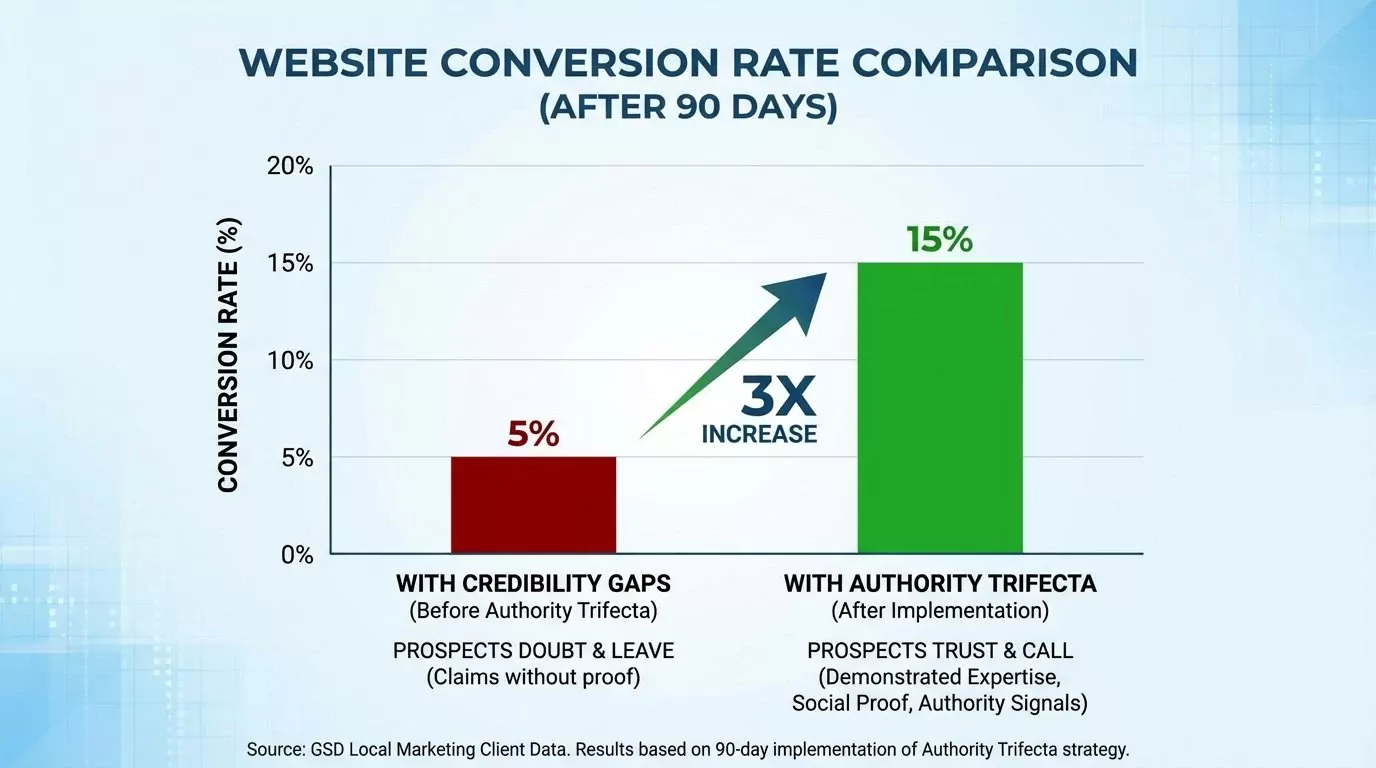
Scenario 1: Attorney with Credibility Gaps
100 monthly website visitors
5% conversion to consultations (5 consultations)
40% consultation-to-client conversion (2 clients)
Average case value: $5,000
Monthly revenue: $10,000
Annual revenue: $120,000
Scenario 2: Same Attorney, Credibility Gaps Closed
100 monthly website visitors (same traffic)
15% conversion to consultations (15 consultations-prospects trust you)
60% consultation-to-client conversion (9 clients-they're pre-sold)
Average case value: $5,000 (same cases)
Monthly revenue: $45,000
Annual revenue: $540,000
Difference: $420,000 annually
From the same traffic. Same practice area. Same attorney.
The only difference: Credibility gaps closed through demonstrated expertise, social proof, and authority signals.
That's not hypothetical. I've watched this exact transformation happen with multiple attorney clients.
Same website traffic. Dramatically different conversion rates. Hundreds of thousands in additional revenue.
Credibility gaps aren't just marketing problems. They're six-figure revenue killers.
Ready to Close Your Credibility Gaps?
Stop losing prospects to attorneys who've figured out what actually builds trust online.
Start demonstrating expertise instead of claiming it.
Start proving results instead of promising them.
Start building authority that makes prospects call pre-sold instead of skeptical.
Here's what we do at GSD Local Marketing:
✅ ClipCred Video System - 25-30 monthly videos demonstrating expertise
✅ Local SEO - Blog content that proves you know your field
✅ Local Authority Copy System - Website copy that builds credibility, not just claims it
✅ Schema Markup - AI-readable structure that gets you recommended ($299)
✅ Website Design - Conversion-focused sites built for credibility, not just appearance
📞 Schedule Your Free Credibility Audit
(509) 433-7730
We'll show you exactly where your credibility gaps are-and how to close them before prospects choose your competitors.
Frequently Asked Questions
What is a "credibility gap" on an attorney website?
A credibility gap is the disconnect between what your website claims and what it proves, causing prospects to doubt your competence within the first 30 seconds of visiting.
Most attorney websites claim "experienced," "aggressive," "client-focused" representation but provide zero evidence supporting these claims-no published content demonstrating legal expertise, no specific case results showing actual wins, no video testimonials from real clients describing their experience, no authority signals like published articles or professional recognition.
Prospects scan your homepage, see generic marketing language identical to every competitor, and think "everyone says this-how do I know you're actually good?" This doubt creates the credibility gap. The consequence is devastating: prospects leave to find attorneys who demonstrate expertise instead of just claiming it, even if those competitors charge more or have less actual experience.
The gap exists because attorneys confuse professional design with credibility building-beautiful websites with zero substance create larger credibility gaps than simple websites with extensive proof of expertise.
In 2026, this gap will cost law firms even more because AI systems like ChatGPT only recommend attorneys with demonstrated authority through published content, schema markup, and credibility signals; vague marketing claims are invisible to AI, meaning prospects never discover you when asking for attorney recommendations.
Closing credibility gaps requires the Authority Trifecta: demonstrated expertise through published content, social proof through testimonials and reviews, and authentic authority signals through professional recognition-transforming your website from claims factory to credibility engine.
Why don't prospects trust attorney websites anymore?
Prospects distrust attorney websites because they've been conditioned by experience: every law firm website makes identical claims about being "experienced," "dedicated," and "results-driven" without providing evidence, creating cognitive overload where prospects can't differentiate between competent attorneys and incompetent ones based on website content alone.
This skepticism intensifies for legal services because the stakes are high-criminal charges, family dissolution, immigration status-making prospects hyper-vigilant about attorney credibility before risking thousands of dollars and life-changing outcomes.
Generic marketing language triggers immediate distrust: "aggressive representation" could mean anything from effective negotiation to reckless courthouse theatrics, "experienced" could mean 30 years of excellence or 30 years of mediocrity, "we care about clients" is unfalsifiable and therefore meaningless without behavioral proof.
Additionally, prospects now research extensively online before contacting attorneys, encountering 5-10 law firm websites in one session-when all websites sound identical, trust defaults to whoever provides actual proof rather than marketing claims.
The rise of AI search compounds this: when prospects ask ChatGPT "how do I choose a criminal defense attorney?", AI recommends evaluating published content, case results, client reviews, and professional recognition-exactly what most attorney websites lack.
The distrust isn't personal; it's rational pattern recognition from encountering hundreds of claim-heavy, proof-light professional websites.
Rebuilding trust requires demonstrating expertise through published legal analysis, proving results through specific case outcomes and video testimonials, and establishing authority through third-party validation-essentially treating your website as evidence presentation rather than advertisement, which aligns with how attorneys actually think about persuasion in legal contexts.
What's the difference between "claiming expertise" and "demonstrating expertise" on a website?
Claiming expertise is stating you're knowledgeable: "Our attorneys have extensive experience in immigration law and stay current on changing regulations." Demonstrating expertise is proving you're knowledgeable through content that only someone with actual expertise could create: publishing a 2,000-word article titled "The 7 Most Common Mistakes in I-485 Adjustment of Status Applications (And How Immigration Officers Evaluate Each One)" with specific regulatory citations, case law analysis, and tactical guidance.
The difference is un-fakeable: anyone can claim 20 years of experience, but only someone with genuine expertise can explain complex legal concepts accessibly, analyze recent court decisions intelligently, break down case strategies comprehensively, and answer questions prospects haven't thought to ask yet.
When prospects read demonstrated expertise content, they think "this attorney actually knows the technical details-they're not just marketing themselves, they're teaching me," creating immediate credibility that claims never achieve.
The strategic advantage is permanent: once you've published 50 blog posts demonstrating immigration law expertise, competitors can't catch up without investing equivalent time and knowledge, creating a moat around your practice.
Our ClipCred system accelerates this by turning one monthly interview into 25-30 videos demonstrating expertise-you answer questions about your practice area in conversational language, we handle filming, editing, transcription into blog posts, and distribution across all platforms. After 12 months, you have 300 videos and 150 blog posts proving expertise that competitors simply cannot replicate without similar time investment.
This demonstrated expertise also makes you discoverable in AI search: when ChatGPT gets asked "what should I know about asylum applications?", it recommends attorneys who've published comprehensive content on asylum law, not attorneys who merely claim immigration experience on generic websites.
How many reviews does an attorney website need to build credibility?
The credibility threshold is 20+ recent five-star reviews across multiple platforms, particularly Google Business Profile where prospects search first, but quantity alone doesn't build trust-what matters is review recency (recent reviews signal current competence vs. legacy reputation), review detail (specific descriptions of attorney performance vs. generic "great lawyer" statements), review distribution (consistent positive reviews over time vs. suspicious review bursts), platform diversity (Google + Avvo + Facebook validation vs. single-platform concentration), and review response (attorney engagement with reviewers vs. ignored feedback).
A law firm with 50 reviews averaging 4.9 stars where the most recent review is 6 months old creates doubt: "are they still practicing? Did quality decline?" A firm with 25 reviews averaging 4.8 stars with 15 reviews from the past 90 days signals active, consistent client satisfaction.
The power multiplier is video testimonials: one 60-second video of a real client describing their experience-showing their face, using the attorney's name, explaining the specific problem and outcome-builds more credibility than 20 text reviews because video is substantially harder to fake and provides emotional authenticity text cannot.
Our system helps attorneys generate reviews systematically: automated review requests sent to satisfied clients 7-10 days post-case resolution, multi-platform review distribution (Google, Avvo, Facebook) to build comprehensive social proof, video testimonial capture for highest-impact clients, and review response management to demonstrate engagement.
The goal isn't gaming review systems; it's creating sustainable processes that capture authentic client feedback attorneys already earn but traditionally lose because they don't systematically request reviews.
Twenty reviews minimum, 50+ reviews ideal, video testimonials transformational-that's the credibility formula for 2025 legal marketing.
Does schema markup really affect whether prospects hire me?
Schema markup doesn't directly convince prospects to hire you, but it determines whether prospects discover you in the first place, especially through AI search which is rapidly becoming the primary research method for legal services.
Schema markup is structured data that tells search engines and AI systems exactly who you are (attorney), what you do (criminal defense, family law, immigration), where you practice (Wenatchee, Washington), what credentials you hold (bar admissions, specializations), and what results you've achieved (case outcomes, client reviews).
Without schema markup, AI systems like ChatGPT struggle to understand your expertise when prospects ask "who's a good DUI lawyer in Wenatchee?"-your website might contain excellent content, but if AI can't parse it systematically, you're invisible in recommendations. With proper attorney schema, legal service schema, organization schema, and review schema implementation, AI systems recognize you as a verified legal professional with specific expertise, making you eligible for recommendation when prospects ask AI for attorney suggestions.
The ROI is substantial: our $299 schema markup implementation has generated documented new clients for attorney clients within 30-60 days because prospects increasingly start legal research by asking ChatGPT or Claude rather than Googling-when you appear in AI recommendations while competitors don't, you capture clients who never visit competitor websites at all. Additionally, schema markup improves traditional Google search visibility by enabling rich snippets (star ratings, review counts, practice areas) that increase click-through rates 30-50% compared to standard search results.
Think of schema markup as the technical foundation that makes your demonstrated expertise discoverable: you can publish 100 brilliant legal articles, but if AI systems can't systematically understand your expertise, that content remains invisible to prospects researching via AI assistants. Implementation is one-time, maintenance is minimal, impact is permanent-making it the highest-ROI technical investment attorneys can make in 2026.
What if I don't have time to create content for my website?
The "no time" objection dissolves when you understand you're already creating content daily-you're just not capturing it for marketing purposes. Every client consultation contains 5-10 blog post topics (questions clients ask repeatedly). Every court appearance involves strategies worth explaining in video format. Every case you handle demonstrates expertise that could become a case study.
The shift isn't finding time to create content; it's extracting maximum value from expertise you're already demonstrating privately.
Practically: record yourself explaining common legal processes during lunch breaks-that's video content. Dictate answers to frequent client questions during your commute-transcribe into blog posts. Document your case preparation strategy-that's behind-the-scenes content showing expertise.
The transition from creation to extraction saves 80% of time while producing more authentic, valuable content than manufactured marketing material.
This is where done-for-you systems become invaluable: our ClipCred system creates 25-30 professional videos monthly from one 60-minute interview where you simply answer questions we prepare based on what your target clients are searching (we research the questions, schedule the interview, handle filming via Zoom, professionally edit videos, write accompanying blog posts, optimize everything for SEO and AI discovery, and distribute across LinkedIn, YouTube, Instagram, Facebook, and your website).
Our Local SEO service writes your weekly blog content based on practice area and target client needs.
Our Local Authority Copy System handles website copywriting that builds credibility instead of just making claims. You're not "creating content"-you're having conversations about legal topics you already discuss daily with clients, and systems handle capture, production, optimization, and distribution.
Time investment: 3-4 hours monthly for content capture, zero hours for production and distribution, generating measurably higher website conversion rates and AI visibility that produces new client inquiries.
The attorneys building unbeatable online credibility aren't working harder; they're leveraging systems that turn existing expertise into scalable content assets.
How long does it take to close credibility gaps and see more clients from my website?
The realistic timeline follows a predictable pattern with measurable milestones. Month 1: foundation building with minimal direct client acquisition but critical infrastructure-publishing 6-8 blog posts demonstrating expertise, creating 10-12 short videos, implementing schema markup, requesting initial client reviews.
You'll typically see 1-2 consultation requests from prospects who mention finding your content, and analytics showing increased time-on-site as prospects consume content instead of bouncing. Month 2: momentum acceleration as content compounds-your article library grows to 12-16 posts, video collection reaches 20-25 pieces, Google reviews climb toward 15-20, and you have 2-3 video testimonials.
Consultation requests increase to 4-6 monthly from organic website traffic, with prospects arriving more educated and often pre-sold: "I read your article about DUI defenses and watched three of your videos-I want to hire you." Month 3: credibility transformation becomes visible-30+ published pieces of expertise-demonstrating content, 30+ videos across platforms, 20+ five-star reviews, professional schema markup making you discoverable in AI search.
Consultation requests jump to 8-12 monthly from the website, conversion rates increase from 30-40% to 60-70% because prospects trust you before calling, and you start appearing in ChatGPT recommendations when prospects ask for local attorney suggestions. Months 4-6: compound effects dominate as early content ranks in Google, videos get recommended by YouTube algorithm, AI systems consistently include you in attorney recommendations, and referral sources start mentioning "I saw your videos" as why they recommend you.
Website-generated consultations stabilize at 15-20 monthly with 70%+ conversion to retained clients. Months 7-12: full authority establishment where the website becomes the primary new client source, credibility gaps are permanently closed, and you're building insurmountable competitive advantages as competitors who start today are 6-12 months behind your content library.
The key insight: most attorneys quit at month 2-3 when results feel incremental, missing the month 4-6 inflection point where credibility compounds exponentially. Those who commit to 90 days of consistent expertise demonstrate experience transformation; those who commit to 6-12 months build practices where prospects call pre-sold at premium fees because demonstrated credibility eliminates price competition.

GSD Local Marketing
130 11th St NE
East Wenatchee, WA 98802
(509)-433-7730
Follow Us On
© 2026 GSD Local Marketing