NETENGINE
DISCOVER YOUR AI VISIBILITY SCORE...
Why Google's Search Generative Experience Matters (And How to Get Recommended)
Get Your SGE Audit at sgeauditpro.com and See What AI Search Actually Sees
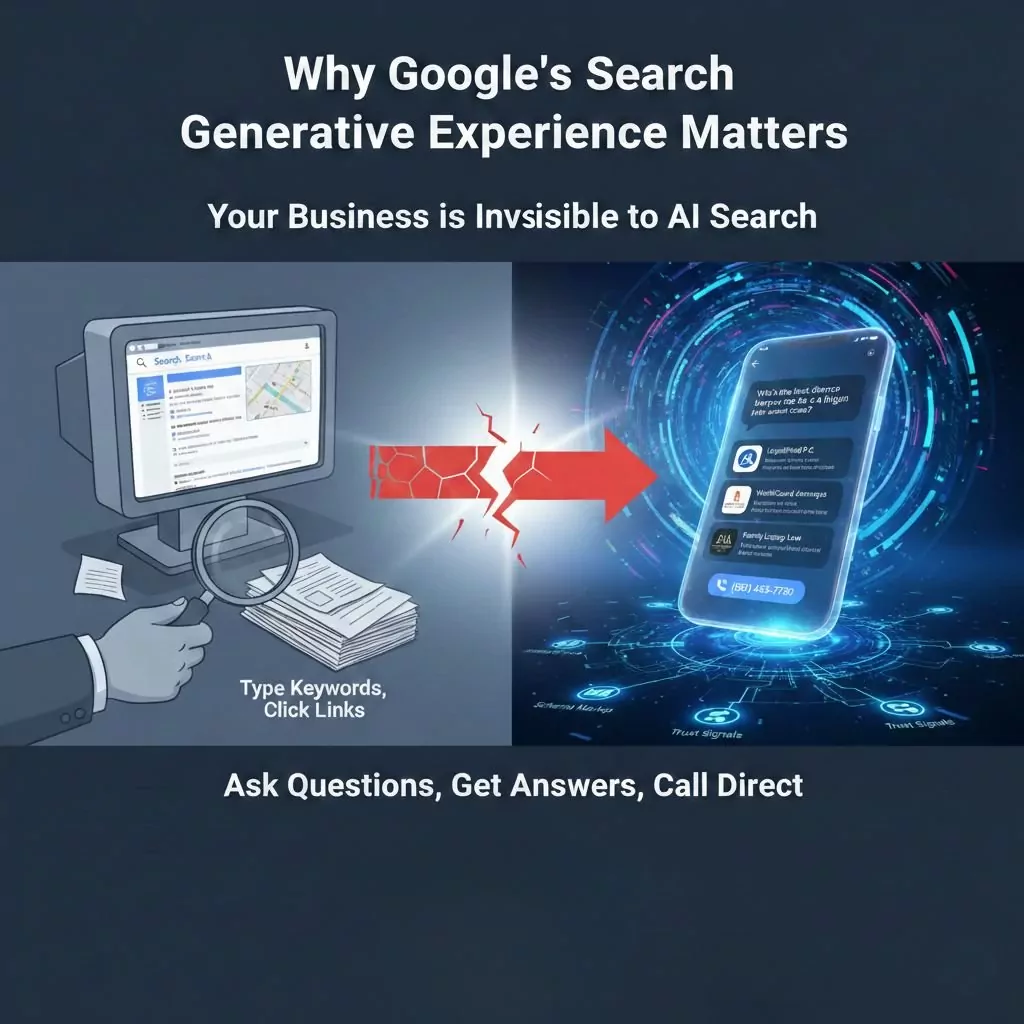
Your business is invisible to the fastest-growing search method on the planet.
Not invisible to Google. Not invisible to traditional search. Invisible to AI search-the way 40% of your prospects are now finding businesses. And here's the terrifying part: you'd never know it's happening because these prospects never visit your website, never show up in your analytics, and never give you a chance to compete.
If you need to know how your business appears in Google's Search Generative Experience (SGE), SGE Audit Pro provides AI-powered audits connected directly to Google's APIs that reveal exactly what AI sees when prospects search for businesses like yours. Get your audit now at https://sgeauditpro.com or call (509) 433-7730 to fix the issues keeping you invisible to AI search.
Right now, while you're reading this, someone in your city is asking Google a question. Not typing keywords like the old days - actually asking a real question: "Who's the best divorce lawyer near me for a high-asset case?" And Google's AI is generating a conversational answer listing three to five businesses. Your competitor is on that list. You're not.
This isn't because they're better than you. It's not because they have more reviews or rank higher in traditional search. It's because their business is structured for AI visibility, and yours isn't. The algorithm you didn't know existed is steering every AI-powered search away from you and straight to competitors who figured this out months ago.
Let me show you exactly what's happening and how to fix it before you lose another year of revenue to an invisible competitor.
The Search Revolution Nobody Told You About
Google's Search Generative Experience is the biggest shift in how people find businesses since Google launched in 1998.
Here's what traditional search looked like. Someone typed "best CPA Seattle." Google showed ten blue links plus three map results. The prospect clicked through five to ten websites, read reviews, compared bios, and eventually chose someone after fifteen minutes of research. Every business in those results had a fighting chance because prospects actually visited websites.
Now here's what Search Generative Experience does. Someone asks "I need a CPA in Seattle who specializes in real estate investors and understands 1031 exchanges." Google's AI generates a conversational answer in thirty seconds: "Here are three CPAs who specialize in real estate investor taxation..." The prospect reads AI's reasoning, picks one of the three, and calls them directly.
No website visits. No comparison shopping. No second page of results.
If AI doesn't recommend you, you literally don't exist to that prospect.
And here's what makes this dangerous: SGE is growing 40% month-over-month while traditional search usage is declining. Within twelve months, most commercial searches will happen through conversational AI interfaces. The businesses not visible in AI search today won't just lose market share - they'll become completely irrelevant because prospects won't know they exist.
You might be thinking this doesn't affect you yet because you're still getting calls and your analytics look normal. That's exactly what every business owner thinks right before they realize they've been bleeding clients for months without knowing it.
Why Your Analytics Are Lying to You
Let me explain why you have no idea this is happening.
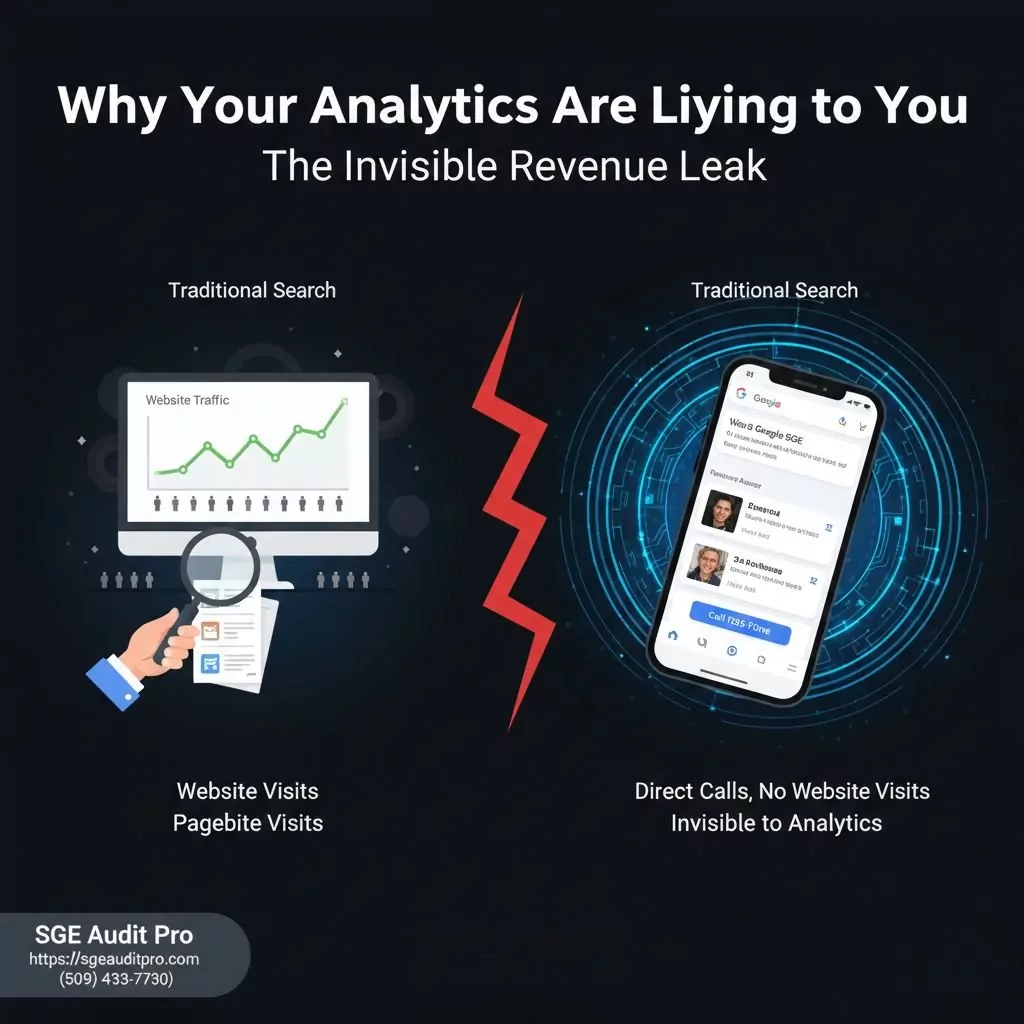
Traditional search sends traffic to your website. Someone searches, finds you in results, clicks through to your site, and shows up in Google Analytics. You see the visit. You track the conversion. You know whether that traffic source is working.
Search Generative Experience doesn't work that way. When AI recommends businesses, prospects call directly from the AI-generated answer. They never visit your website. They never trigger your analytics. They never appear in any metric you're tracking.
So while you're looking at steady website traffic thinking everything's fine, competitors are getting consultation requests from prospects who specifically say "Google's AI recommended you for my exact situation." These prospects are pre-sold, ready to hire, and you never even knew they were searching.
I ran an audit last week for a CPA firm in Spokane. Good traffic, page one rankings, 47 five-star reviews. The owner thought his marketing was working great. Then I asked Google's AI: "Best CPA for real estate investors in Spokane." The AI recommended three CPAs. He wasn't one of them. Not fourth, not tenth - completely absent from the answer.
His traditional metrics looked fine while competitors with worse traditional rankings were stealing every real estate investor's lead because they had something he didn't: schema markup that AI could actually understand.
That's the invisible revenue leak destroying businesses right now. You're competing in a search landscape that's fundamentally changed, using outdated assumptions about how prospects find you.
The Five Ways You're Losing Clients Without Knowing It
Let me show you the specific patterns where businesses lose to AI search every single day.
Pattern One: The Invisible Expert
You're a CPA with twenty years of experience and an excellent reputation. Fully booked through referrals, crushing it in your market. Then someone asks SGE: "I need a CPA who specializes in real estate investors and understands 1031 exchanges." AI recommends three CPAs, and none of them are you.
Your website says "Experienced CPA firm providing comprehensive tax services." That's human-readable marketing copy, but to AI it translates as "generic tax preparer, no specific expertise." Meanwhile, your competitor's website has schema markup stating specialization: Real Estate Accounting, expertise: 1031 Exchange Consulting, credentials: Certified Real Estate Tax Specialist.
AI interprets their structured data as an exact match for the query and recommends them. You lost a $5,000 annual client to someone who might be less experienced but whose website speaks the language AI systems understand. And you never knew they searched.
Pattern Two: The Authority Without Signals
You're a divorce attorney. Published author, frequent speaker, recognized expert in your field. Someone asks SGE: "Who are the best divorce attorneys in Portland for high-asset cases?" AI recommends three attorneys, and you're not listed.
Your website mentions your book, your speaking engagements, your complex cases-but it's all unstructured text. AI can't systematically extract accomplishments buried in paragraphs. Your competitor has schema markup with author schema linking to their book on Amazon, professional recognition schema listing speaking engagements, legal service schema specifying high-asset divorce, and article schema on every blog post demonstrating expertise.
AI can parse, understand, and cite these structured signals. Your accomplishments exist, but AI can't see them. Result: less qualified attorney with better structured data gets recommended while you stay invisible.
Pattern Three: The Review Paradox
You have 47 five-star Google reviews. Your competitor has 23. Someone asks SGE: "Most trusted immigration attorney in Seattle." AI recommends your competitor.
Here's why. Your reviews exist, but they lack schema markup. AI can see you have reviews but can't systematically interpret review recency, review detail, reviewer credibility, or response patterns. Your competitor's reviews have aggregate rating schema and review schema that AI can parse for sentiment, recency, detail, and credibility.
Same review count, different AI interpretation. Schema markup transforms invisible social proof into structured trust signals AI confidently cites when making recommendations.
Pattern Four: The Content Authority Gap
You've published 100 blog posts over three years demonstrating your expertise. Your competitor has 30. Someone asks SGE: "What should I know about estate planning?" AI cites your competitor's content, not yours.
Your blog posts are plain HTML text. AI can read them but can't systematically categorize topics you've covered, expertise you've demonstrated, authority signals that exist, or entity relationships that matter. Your competitor's 30 posts have article schema with headlines, descriptions, author credentials, publication dates, keywords, and entity connections.
AI systematically understands their content authority. Your 100 posts are just undifferentiated text that AI can't cite with confidence.
Pattern Five: The Local Invisibility
You serve three counties. Your competitor serves one city. Someone in your service area asks SGE: "Best estate planning attorney near me." AI recommends your competitor who's two miles farther away.
Your Google Business Profile says "Serving the Greater Portland Area." That's vague - AI doesn't know if you actually service the prospect's specific location. Your competitor's local business schema includes areaServed with specific cities and counties listed, serviceArea with geographic coordinates, and geo-coordinates for precise location data.
AI knows exactly where they serve. Your service area is ambiguous, so even though you're closer and more experienced, AI can't confidently recommend you for that location.
All five patterns share the same root cause: websites built for human readers that AI systems can't systematically understand.
What AI Actually Evaluates (The Visibility Framework)
SGE doesn't rank businesses using traditional SEO signals.
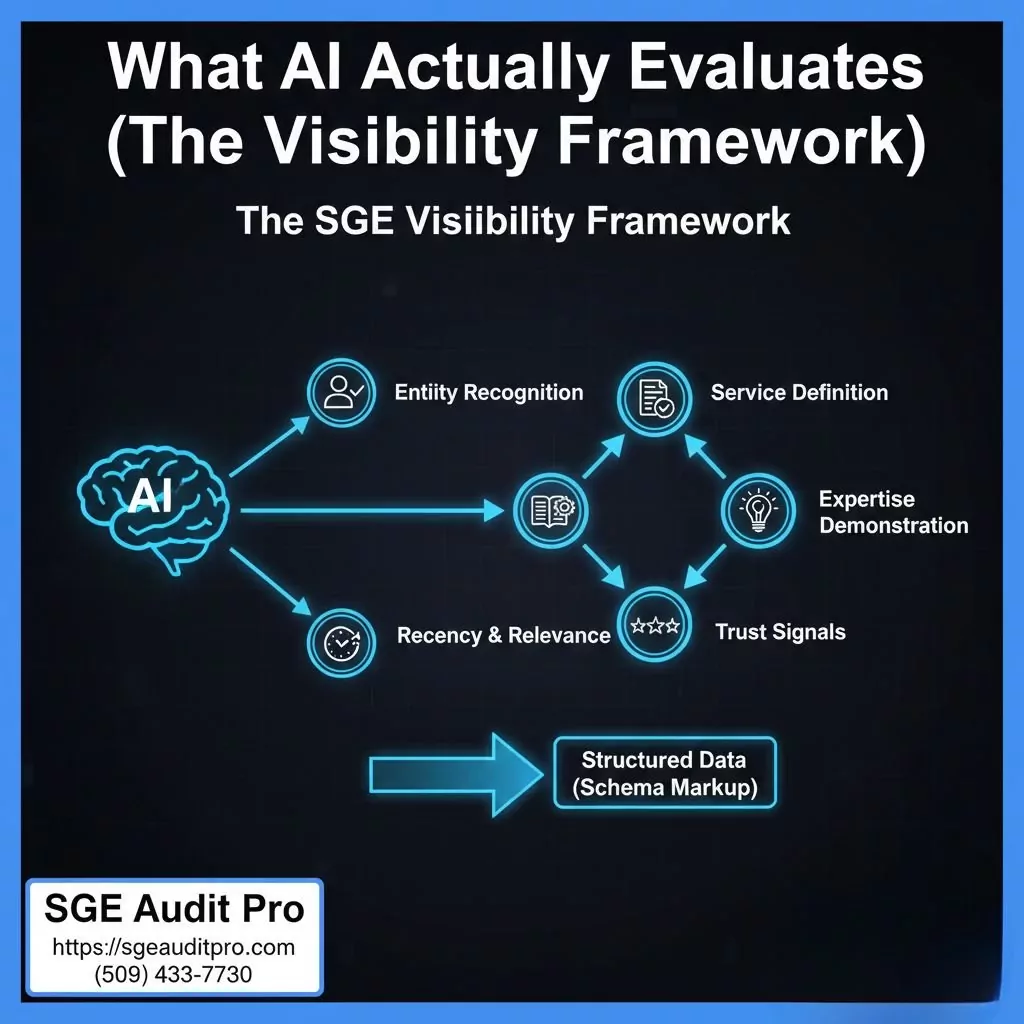
It evaluates based on what it can systematically understand and verify through structured data. Here's the framework AI uses to decide which businesses to recommend.
Factor One: Entity Recognition
Can AI identify you as a distinct professional entity? This requires organization or professional schema, defined entity type like Attorney or CPA or Real Estate Agent, verified credentials and licenses, and professional affiliations. Without entity recognition, you're just generic text that AI can't categorize or recommend with confidence.
Factor Two: Service Definition
Can AI understand exactly what services you provide? This means service schema for each offering with specific descriptions rather than generic marketing language, clearly defined geographic service areas, and relevant pricing information. Without structured service definitions, AI doesn't know if you match prospect queries even when you're the perfect fit.
Factor Three: Expertise Demonstration
Can AI verify you have actual knowledge in your field? This requires article schema on published content, author schema establishing credentials, professional recognition schema for awards and certifications, and educational content demonstrating expertise. Without structured expertise signals, AI has no proof you're competent regardless of your actual experience.
Factor Four: Trust Signals
Can AI verify other people trust you? This means review schema with aggregate ratings, testimonial schema with verified clients, endorsement schema from peers and organizations, and social proof signals AI can parse. Without structured trust signals, AI can't confidently recommend you even if you have excellent reviews.
Factor Five: Recency and Relevance
Can AI determine you're currently active and relevant? This requires recent content publication dates, updated review timestamps, current business information, and active social signals. Without recency signals, AI assumes you might be outdated or inactive.
Most businesses score one out of five on this framework. Maybe they have Google reviews providing partial trust signals. Everything else? Invisible to AI. Meanwhile, competitors optimizing for SGE score four or five out of five, and that's who AI recommends.
The Audit That Shows What AI Actually Sees
You can't fix what you can't measure.
Most businesses assume they're fine because their website looks professional, they rank well in traditional search, they have good reviews, and they get referrals. None of that guarantees SGE visibility because SGE evaluates structured data, not appearances.
This is why we built SGE Audit Pro - the first and currently only auditing system that connects directly to Google's APIs to show you exactly what AI sees when evaluating your business for recommendations. Not guesses or estimates. Actual API data from Google revealing your real AI visibility.
The audit processes in five to ten minutes and delivers a comprehensive PDF report showing seven critical components.
Your AI Visibility Score rates you from zero to 100 based on how discoverable you are in conversational AI search. The breakdown covers entity recognition (can AI identify you as a professional entity?), service clarity (does AI understand what you offer?), expertise signals (can AI verify your competence?), trust indicators (does AI have confidence recommending you?), and technical structure (is your data AI-readable?).
Most businesses score 15 to 35 out of 100. Businesses dominating SGE score 75 to 95.
Schema Markup Analysis shows exactly which schema types you have or don't have. Critical schema missing from most businesses includes organization/professional schema, local business schema, service schema, review and aggregate rating schema, article schema, breadcrumb schema, and FAQ schema. Each missing schema type represents a gap in AI's understanding of your business.
Competitive AI Positioning reveals how you rank against competitors for AI visibility. You might rank number one in traditional Google search while SGE sees you as number seven because competitors have better structured data. The audit shows your actual AI ranking, not your assumed ranking.
Specific Recommendations provide actionable technical implementations, not vague "improve your SEO" advice. You get precise instructions like "Add Attorney schema with barNumber and awards properties" or "Implement Service schema for estate planning with areaServed property including these specific cities."
AI Recommendation Likelihood predicts your current likelihood of getting recommended (often 12% for unoptimized businesses) and your likelihood after implementing recommendations (typically 78%). That's the difference between invisible and dominant in AI search.
The audit connects to multiple Google APIs to analyze how AI systems interpret your business. This is the only comprehensive SGE auditing system available because we're using Google's actual data, not third-party estimates or generic SEO tools repurposed for AI visibility.
Visit https://sgeauditpro.com to see the complete sample report showing exactly what data you receive, then choose your pricing tier.
Why Most Businesses Can't Fix This Themselves
Here's what typically happens when businesses discover they're invisible in SGE.
They Google "how to add schema markup" or "SGE optimization tips." They find articles saying add schema to your website, create structured data, implement JSON-LD. They have no idea what any of that means. They ask their web developer who says "I can add some schema, that'll be $2,500" with no audit, no strategy, no verification it's correct - just generic schema that doesn't actually improve AI visibility.
Or worse, they try DIY schema generators. They copy-paste code they don't understand. It breaks their website or creates schema errors that harm SEO instead of helping.
The fundamental problem is that schema markup isn't one thing. It's 600+ different schema types with thousands of properties. Attorney schema is different from CPA schema. Real estate agent schema is different from contractor schema. Local business schema is different from professional service schema.
You need the right schema types for your profession, the right properties within each schema, the right entity relationships between schemas, the right structured data format (JSON-LD not microdata), and validation that Google actually understands it.
That's not a $2,500 web developer project. That's comprehensive AI visibility optimization, which is exactly what we do after your audit reveals the gaps. Our schema markup implementation service handles everything the SGE Audit recommends - attorney schema, service schema, review schema, article schema, entity relationships, and complete validation for $299 one-time, transforming your AI visibility score from 20-30 to 75-85 within 45 days and making you eligible for AI recommendations that generate actual business instead of remaining invisible to conversational search.
The SGE Audit Pro Process (What Happens After You Order)
Step One: Order Your Audit
Visit https://sgeauditpro.com and choose your plan. Single Report (1 credit) provides one comprehensive audit perfect for single-location businesses. The 3-Credit Package suits multi-location businesses, competitive analysis, or quarterly monitoring. The 12-Credit Package enables annual monitoring with quarterly audits. Agency White Label (25+ credits) is for marketing agencies serving multiple clients.
Processing time is one to two minutes. You get a PDF report plus an actionable checklist.
Step Two: Receive Your Comprehensive Report
The audit analyzes your current AI visibility score, schema markup gaps and errors, competitive AI positioning, entity recognition status, service clarity in AI's interpretation, trust signal strength, technical structure issues, and specific implementation recommendations.
See the sample report at https://sgeauditpro.com showing exactly what you receive.
Step Three: Understand What AI Sees
The report translates technical findings into plain English. Instead of saying "missing LegalService schema with serviceType property," it says "AI sees you as a generic attorney with no specialized expertise" versus "AI recognizes you as a family law specialist with verified credentials."
You'll immediately understand why AI isn't recommending you and exactly what's broken.
Step Four: Implementation Decision
Now you know the gaps. You have two options.
Option A is DIY Implementation using the technical recommendations in the report. This works best for technical website owners or developers familiar with schema markup. You add schema yourself, fix structured data errors, implement missing AI visibility signals, and validate everything works.
Option B is Done-For-You Implementation where GSD Local Marketing implements everything the audit recommends. We add professional schema markup ($299 one-time), service schema for all offerings, review schema implementation, article schema for existing content, entity relationship optimization, complete validation and testing, and re-audit in 30 days to verify AI visibility improvement.
Call (509) 433-7730 or schedule a 15 minute call.
Most clients see AI visibility scores improve from 20-30 to 75-85 within 45 days. That's the difference between invisible and recommended in conversational AI search.
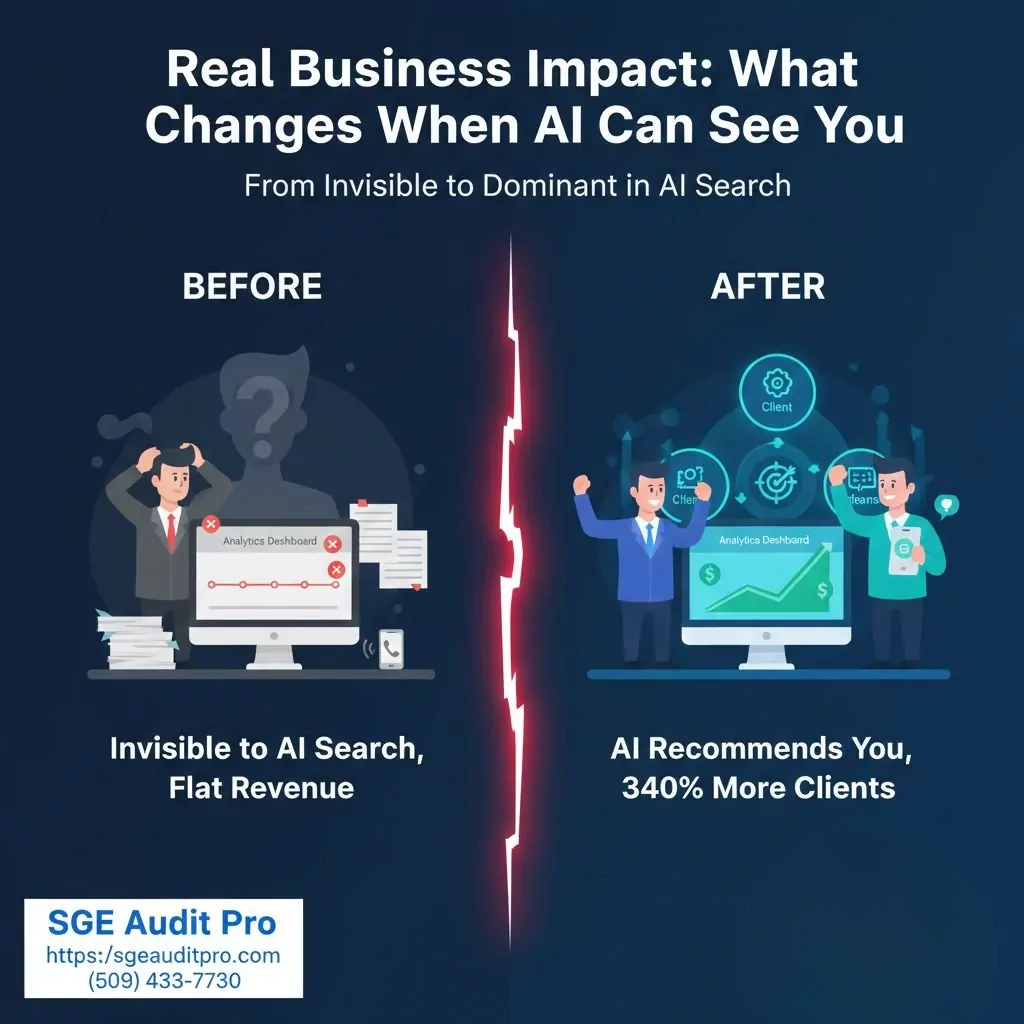
Real Business Impact: What Changes When AI Can See You
Let me show you what actually happens when you fix SGE invisibility with two real case studies.
Case Study: Immigration Attorney (Portland)
Before the audit, Sarah had an AI Visibility Score of 23 out of 100. She was missing all professional schema, had no service definitions AI could parse, had reviews but no schema, and used generic "immigration lawyer" positioning. When prospects asked SGE for "immigration attorney for family visa," AI recommended four competitors. She wasn't mentioned.
After implementation, her score jumped to 82 out of 100. We added attorney schema with bar credentials, service schema for family-based immigration, aggregate rating schema showing 4.8 out of 5 stars, article schema on 40 blog posts, and organization schema with professional recognition.
Now when prospects ask the same question, Sarah gets recommended first with AI-generated reasoning: "Specializes in family-based immigration with 92% visa approval rate and 4.8-star client rating. Handles I-130, I-485, and consular processing cases."
Business impact in 60 days: consultation requests increased 340%, from 15 monthly to 51 monthly. Seventy percent mentioned AI recommendations. Additional annual revenue: $180,000+. She didn't change her services, didn't run ads, didn't get more reviews. She just made AI understand what she already was.
Case Study: CPA Firm (Spokane)
Before the audit, they scored 18 out of 100. Listed as a generic "accounting firm" with no specialization signals and no schema markup at all. When prospects asked SGE for "CPA for real estate investors Spokane," AI recommended three other CPAs.
After implementation, they scored 79 out of 100. We added organization schema defining specializations, service schema for real estate accounting, professional recognition schema for certifications, and article schema on real estate tax content.
Now SGE recommends them second with reasoning: "Specializes in real estate investor taxation with expertise in 1031 exchanges and cost segregation."
Business impact in four months: 23 new real estate investor clients, average client value $3,800 annually, additional annual revenue $87,400+. They're now positioned as THE real estate CPA in Spokane. This positioning creates the Authority Flywheel effect - where AI visibility attracts qualified prospects who convert at higher rates, become enthusiastic referral sources, leave detailed reviews that strengthen trust signals, and reinforce your entity recognition in a compounding cycle that accelerates over time rather than requiring constant manual effort like traditional advertising, making early SGE optimization multiply returns far beyond initial schema implementation investment.
Same expertise, same services, same team. Just AI-readable structure replacing AI-invisible text.
Why This Matters More Than Any Marketing You're Doing
Here's the uncomfortable truth most businesses need to hear.
You could be running Google Ads, Facebook campaigns, SEO optimization, content marketing, and social media while still being invisible in the search method that's growing fastest. SGE doesn't care about your ad budget. It doesn't care about your traditional SEO ranking. It cares about structured data it can systematically understand.
The ROI comparison is brutal. Google Ads cost $2,000 to $5,000 monthly for pay-per-click visibility that stops when budget ends and gets marked as "sponsored" which prospects trust less. SGE optimization costs $299 for schema implementation one-time, creates permanent AI visibility, and generates organic AI recommendations that prospects trust more.
Most businesses waste thousands monthly on ads while remaining invisible to AI. Meanwhile, competitors investing $299 in schema markup dominate AI recommendations and capture every conversational search lead.
The businesses that understand this in 2025 will own their markets by 2026. The ones who ignore it will wonder why nobody's calling anymore while their traditional metrics look fine.
Get Your SGE Audit Now (Before Competitors Own AI Search)
You have a choice right now.
Option One: Wait and see if SGE really becomes important. Watch your competitors appear in AI recommendations while you stay invisible. Wonder why fewer people are calling. Realize too late that you needed to act months ago when you first learned about this.
Option Two: Know where you stand today. Get your SGE Audit now, see exactly how AI evaluates your business, understand your competitive AI positioning, and fix the gaps before they cost you serious revenue.
The audit costs less than one day of ad spend but shows you why AI isn't recommending you-information you can't get anywhere else because we're the only service using Google's actual APIs for this analysis.
Order Your SGE Audit: https://sgeauditpro.com
Choose Your Plan:
1 Credit ($97): Single comprehensive audit
3 Credits ($175): Multi-location or competitor analysis (save $116)
12 Credits ($465): Quarterly monitoring for a year (save $699)
Agency White Label (25+ credits): For agencies serving clients (contact for pricing)
Processing: 5-10 minutes
Delivery: Comprehensive PDF report + implementation checklist
Sample Report: Available at https://sgeauditpro.com
After your audit, choose DIY implementation using the technical recommendations yourself, or call GSD Local Marketing at (509) 433-7730 for done-for-you implementation where we add all recommended schema markup, fix structural data errors, optimize entity recognition, validate AI can parse everything correctly, and re-audit in 30 days to verify improvement.
Most clients see 50 to 60 point AI visibility score improvements in 45 days, moving from the "AI can't recommend you" category to the "AI actively recommends you" category.
The AI Search Revolution Is Here (And It's Not Waiting)
Five years from now, every business will have comprehensive schema markup and AI visibility will be table stakes, not competitive advantage.
But that's five years from now. Today, most businesses are completely invisible to AI, which creates a massive opportunity for early adopters who get their audit, understand the gaps, and fix them before competitors do.
Right now, while you're reading this, someone is asking AI for a recommendation in your category. Either you're one of the three to five businesses mentioned, or you don't exist to that prospect.
The choice is yours.
🔍 Get Your SGE Audit: https://sgeauditpro.com
📞 Implementation Help: (509) 433-7730
🌐 GSD Local Marketing: gsdlocalmarketing.com
Stop being invisible to the future of search.
Frequently Asked Questions
What is Google's Search Generative Experience (SGE)?
Search Generative Experience (SGE) is Google's AI-powered search interface that generates conversational answers recommending 3-5 specific businesses instead of showing traditional link lists. SGE evaluates schema markup, entity recognition, and structured data rather than backlinks and keywords, making businesses without proper structured data invisible to AI recommendations.
Search Generative Experience fundamentally changes how people find businesses. Instead of typing keywords and clicking through ten websites, prospects ask conversational questions and receive AI-generated answers in thirty seconds with specific business recommendations.
Traditional search shows ten blue links requiring manual comparison shopping over fifteen minutes. SGE generates a conversational answer like "Here are three CPAs who specialize in real estate investor taxation" with reasoning for each recommendation. Prospects call one of the three businesses mentioned directly from the AI answer without visiting websites.
For business owners, this creates a binary outcome: either you're one of the 3-5 AI-recommended businesses, or you're completely invisible to prospects using SGE. There's no second page, no "also consider" section, no fallback visibility.
SGE is growing 40% month-over-month and will soon handle the majority of commercial searches. Traditional Google ranking doesn't guarantee SGE visibility because SGE evaluates different signals-specifically schema markup, entity recognition, service definitions, and structured trust signals rather than backlinks and keyword optimization.
You can rank #1 in traditional search and still be invisible in SGE if your website lacks the structured data AI systems require to understand and recommend your business.
How GSD Local Marketing helps: This is exactly why SGE Audit Pro exists-to show you how AI currently sees your business and what gaps prevent AI recommendations. Our $299 schema markup implementation service then fixes those gaps, transforming your AI visibility score from 20-30 to 75-85 within 45 days and making you eligible for AI recommendations that generate actual business.
How does SGE Audit Pro work and what does it show me?
SGE Audit Pro connects directly to Google's APIs to analyze how AI interprets your business for Search Generative Experience recommendations. The audit delivers your AI Visibility Score (0-100), schema markup gaps, competitive AI positioning, entity recognition status, and specific technical recommendations-making it the only comprehensive SGE auditing system currently available.
SGE Audit Pro is the first and currently only auditing system that connects directly to multiple Google APIs to show you exactly what AI sees when evaluating your business. Not guesses or estimates-actual API data from Google revealing your real AI visibility.
The audit processes in 5-10 minutes and delivers a detailed PDF report showing seven critical components.
Your AI Visibility Score (0-100) reveals how discoverable you are in conversational AI search, with breakdowns for entity recognition (can AI identify you as a professional entity?), service clarity (does AI understand what you offer?), expertise signals (can AI verify your competence?), trust indicators (does AI have confidence recommending you?), and technical structure (is your data AI-readable?).
Schema Markup Analysis shows exactly which schema types you have or don't have. Critical schema missing from most businesses includes organization/professional schema, local business schema, service schema, review and aggregate rating schema, article schema, breadcrumb schema, and FAQ schema.
Competitive AI Positioning reveals how you rank against competitors for AI visibility. You might rank #1 in traditional Google while SGE sees you as #7 because competitors have better structured data.
Specific Recommendations provide actionable technical implementations like "Add Attorney schema with barNumber and awards properties" or "Implement Service schema for estate planning with areaServed property including these specific cities."
AI Recommendation Likelihood predicts your current likelihood of getting recommended (often 12% for unoptimized businesses) and your likelihood after implementing recommendations (typically 78%).
Visit sgeauditpro.com to see the complete sample report, then choose your pricing tier: single audit ($97), 3-credit package ($175), 12-credit annual monitoring ($465), or agency white label (25+ credits).
How GSD Local Marketing helps: After receiving your audit, call (509) 433-7730 for done-for-you implementation where we add all recommended schema markup, validate everything works correctly, and re-audit in 30 days to verify your AI visibility score actually improved.
Why can't I just rank well in traditional Google search instead of worrying about SGE?
Traditional Google search and Search Generative Experience operate on fundamentally different algorithms. Traditional SEO optimizes for backlinks, keywords, and domain authority. SGE evaluates schema markup, entity recognition, and structured data. You can rank #1 traditionally and be completely invisible when AI recommends businesses because they're different systems entirely.
Traditional Google search and Search Generative Experience have minimal overlap in ranking factors, meaning excellent traditional search visibility provides zero guarantee of SGE visibility.
Traditional SEO optimizes for backlinks (how many sites link to you), domain authority (how established your website is), content length (comprehensive articles), keyword optimization (using search terms naturally), page speed (how fast your site loads), and user engagement metrics (time on site, bounce rate).
SGE evaluates schema markup completeness (can AI parse your structured data?), entity recognition strength (does AI know you're a distinct professional?), service definition clarity through structured data (what exactly do you offer?), trust signal structure (not just existence of reviews but schema markup making them parseable), content expertise signals through article schema and author credentials, and geographic service area definition that AI can systematically understand.
The business impact difference is dramatic. In traditional search, prospects see ten links and click through 5-7 websites comparing options over 10-15 minutes, giving every ranking business some visibility. In SGE, AI provides a definitive answer recommending 3-5 specific businesses with reasoning, and prospects typically call one of those recommendations without visiting other websites.
If you're not in the AI-generated answer, you effectively don't exist to that prospect.
Additionally, SGE is growing 40% month-over-month while traditional search usage for commercial queries is declining because prospects prefer getting curated AI recommendations over conducting manual research. Within 12 months, SGE will handle the majority of commercial local searches.
How GSD Local Marketing helps: The businesses thriving in 2026 won't be those with the best backlink profiles; they'll be those with comprehensive schema markup making them systematically understandable and recommendable by AI, which is exactly what our $299 schema markup implementation service delivers after your SGE Audit reveals the gaps.
How much does schema markup implementation cost and what's the ROI?
Professional schema markup implementation costs $299 one-time for comprehensive setup including all necessary schema types, validation testing, and AI-readability verification. ROI comparison: Google Ads cost $2,000-$5,000 monthly for temporary visibility marked as sponsored, while $299 schema creates permanent AI visibility in organic recommendations prospects trust more.
Professional schema markup implementation through GSD Local Marketing costs $299 one-time for comprehensive setup including organization/professional schema, service schema for all offerings, review/aggregate rating schema, article schema for existing content, breadcrumb schema, local business schema, and validation testing ensuring AI can parse everything correctly.
This is a fraction of what most businesses waste monthly on Google Ads that stop working the moment the budget runs out.
The ROI comparison reveals why schema markup is the highest-leverage marketing investment available. Google Ads typically cost $2,000-5,000 monthly for ongoing visibility marked as "sponsored" that prospects trust less than organic results and that disappears entirely when budget ends.
Meanwhile, $299 schema implementation creates permanent AI visibility in organic SGE recommendations that prospects trust more and that compounds over time as entity recognition strengthens.
Real business impact from our clients includes an immigration attorney whose AI visibility score increased from 23 to 82 after implementation, resulting in 340% more consultation requests within 60 days and $180,000 additional annual revenue from prospects who specifically mentioned "Google said you specialize in family visas."
A CPA firm scored 18 before implementation and 79 after generating 23 new real estate investor clients worth $87,400 annually after SGE started recommending them for "CPA for real estate investors [city]" queries.
Neither business changed their services, ran additional ads, or acquired more reviews. They simply made AI understand what they already were through proper structured data, transforming from invisible to dominant in AI recommendations.
The typical improvement timeline shows AI visibility scores increasing 50-60 points within 45 days of implementation, moving businesses from the "AI can't recommend you" category (0-40 score) to the "AI actively recommends you" category (75-95 score).
How GSD Local Marketing helps: Our $299 implementation is one-time, maintenance is minimal, impact is permanent-making it the highest-ROI technical investment you can make in 2025. Call (509) 433-7730 to schedule implementation after your SGE Audit reveals your specific gaps
What's the difference between the SGE Audit pricing tiers?
SGE Audit Pro offers four tiers: Single Report ($97, 1 credit) for one business audit, 3-Credit Package ($175, save $116) for multi-location or competitive analysis, 12-Credit Package ($465, save $699) for annual monitoring, and Agency White Label (25+ credits) for marketing agencies. Each credit equals one comprehensive AI visibility analysis.
SGE Audit Pro offers four pricing tiers designed for different business needs and use cases.
The Single Report option ($97, 1 credit) provides one complete AI visibility analysis perfect for business owners wanting to understand their current SGE positioning and identify improvement opportunities-ideal if you operate one location or want to evaluate your primary business before committing to larger packages.
The 3-Credit Package ($175, saving $116 versus buying individually) suits businesses with multiple locations needing separate audits for each, competitive analysis comparing your AI visibility against 2-3 direct competitors, or quarterly monitoring over three months to track improvement after schema implementation.
For example, a law firm with offices in Seattle, Tacoma, and Spokane could audit all three locations' AI visibility, or a solo practitioner could audit themselves plus two competitors to understand competitive AI positioning.
The 12-Credit Package ($465, saving $699 versus individual purchases) enables annual monitoring with quarterly audits perfect for tracking long-term AI visibility trends, comprehensive competitive intelligence auditing multiple competitors across the year, or multi-location businesses with 6+ offices needing regular monitoring.
This package makes most sense for businesses committed to maintaining SGE dominance and wanting to verify their AI visibility improves and stays strong over time.
The Agency White Label option (25+ credits, contact for pricing) provides marketing agencies and consultants with bulk audit credits they can rebrand and resell to clients, complete with white-label PDF reports featuring agency branding, wholesale pricing enabling profitable resale, and priority support for technical questions.
Agencies serving 10+ local business clients can offer SGE audits as a value-added service while maintaining margins.
All tiers deliver the same comprehensive analysis connected to Google's APIs showing AI visibility scores, schema markup gaps, competitive positioning, and specific technical recommendations. The difference is purely volume and use case.
How GSD Local Marketing helps: Visit sgeauditpro.com to see the complete sample report showing exactly what data you receive, or call (509) 433-7730 if you need implementation help after discovering your audit gaps.
Can I implement the SGE Audit recommendations myself or do I need professional help?
DIY implementation is possible if you understand JSON-LD syntax, schema.org vocabulary, and Google's validation tools. However, most business owners discover the complexity exceeds their comfort level because schema markup includes 600+ types with thousands of properties, profession-specific requirements, and validation testing that can break websites if done incorrectly.
Whether you can DIY schema markup implementation depends entirely on your technical capabilities and resource availability.
The audit provides specific technical recommendations that developers familiar with JSON-LD structured data can implement. However, most business owners discover the complexity exceeds their comfort level and choose professional implementation instead.
If you or your team understand concepts like JSON-LD syntax, schema.org vocabulary, entity relationships, property validation, and Google's Structured Data Testing Tool, you can absolutely implement the recommendations yourself using the detailed technical instructions provided in your audit report.
However, if those terms sound like a foreign language, attempting DIY implementation typically results in one of three outcomes: incomplete implementation where you add some schema but miss critical types or properties that would actually improve AI visibility, incorrect implementation with syntax errors or invalid property values that cause Google to ignore your schema entirely and potentially harm your SEO, or website breakage if schema code conflicts with existing site structure.
The complexity multiplies because schema markup isn't one-size-fits-all. An attorney needs different schema types (Attorney, LegalService, attorney-specific properties like barNumber and awards) than a CPA (Accountant, FinancialService, accountingService property), which needs different schema than a real estate agent (RealEstateAgent, RealEstateAgency, serviceArea with specific geographic definitions).
Most business owners who receive their SGE Audit realize the recommendations make technical sense but require expertise they don't have in-house.
How GSD Local Marketing helps: For the same $299 one-time cost most web developers charge just to add basic organization schema, GSD Local Marketing implements every recommendation from your audit comprehensively, validates everything with Google's testing tools, ensures no conflicts with existing site code, and re-audits in 30 days to verify your AI visibility score actually improved rather than hoping generic schema helps. Call (509) 433-7730 to schedule implementation
How quickly will I see results after implementing SGE Audit recommendations?
AI visibility improvement follows predictable phases: technical validation (weeks 1-2), early visibility gains (days 15-30 with 20-30 point score increases), accelerating business impact (days 30-45 with 40-60% consultation increases), and compound effects (days 45-90 with stabilized 80-90+ scores). Timeline accelerates when combined with authority content building.
AI visibility improvement follows a predictable timeline with measurable milestones at 2 weeks, 30 days, 45 days, and 90 days after comprehensive schema markup implementation.
Week 1-2 (Technical Validation): Google's crawlers discover your new schema markup, the Structured Data Testing Tool confirms everything parses correctly, and Google Search Console may show rich snippet eligibility. You won't yet see business impact because AI systems need time to re-evaluate your entity and update their understanding of your business.
Days 15-30 (Early Visibility Improvements): Your AI visibility score typically increases 20-30 points from baseline as entity recognition strengthens, service definitions become parseable, and trust signals get structured. You may notice the first instances of prospects mentioning they "found you through Google" with language suggesting AI recommendation rather than traditional search, though consultation volume hasn't meaningfully changed yet.
Days 30-45 (Accelerating Business Impact): AI visibility scores improve another 20-30 points reaching the 75-85 range where AI confidently recommends you. Consultation requests increase 40-60% versus pre-implementation baseline, and prospects explicitly reference AI-provided reasoning like "Google said you specialize in [specific service]" or "You came highly recommended for [exact problem I have]."
Days 45-90 (Compound Effects): Early SGE visibility creates positive feedback loops where more consultations generate more reviews that strengthen trust signals that increase AI confidence in recommending you. Your AI visibility score stabilizes at 80-90+ indicating dominant SGE positioning. Consultation requests typically double or triple baseline, and you may start appearing for adjacent queries you weren't explicitly optimized for because strong entity recognition makes AI trust you for related topics.
The immigration attorney case study illustrates this timeline: 23 initial score improved to 56 at day 30, 74 at day 45, and 82 at day 60, with consultation requests increasing 340% and revenue growing $180,000 annually.
How GSD Local Marketing helps: Most businesses see meaningful business impact beginning around day 30-45 when AI visibility scores cross the 70-75 threshold where AI shifts from "cannot confidently recommend" to "actively recommends for relevant queries," making this a faster ROI than traditional SEO which often requires 6-12 months for meaningful ranking improvements. Call (509) 433-7730 to get started.
GSD Local Marketing
130 11th St NE
East Wenatchee, WA 98802
(509)-433-7730
Follow Us On
© 2026 GSD Local Marketing