NETENGINE
THE 70-80% WIN RATE SECRET
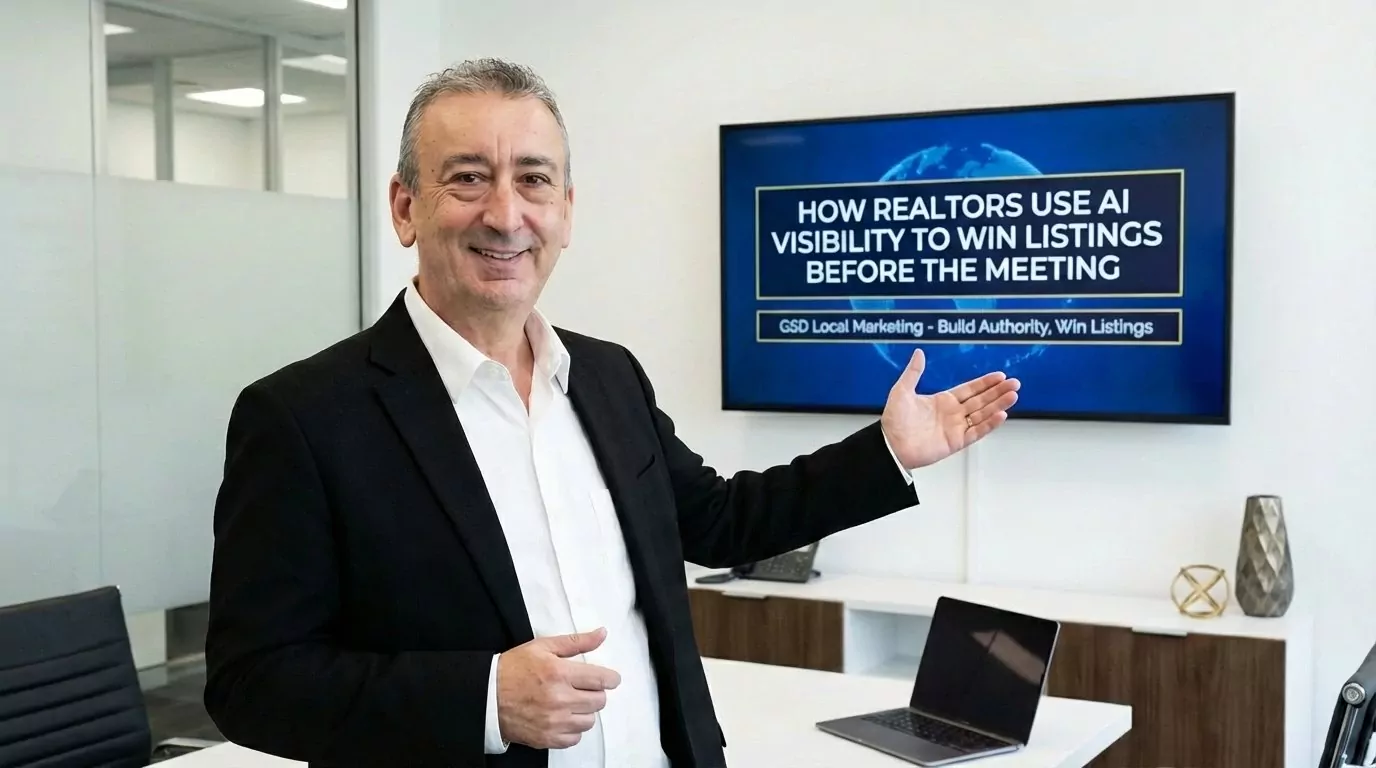
How Realtors Use AI Visibility to Win Listings Before the Meeting
Pre-sold sellers already decided to hire you - the listing appointment is just a formality. Here's how content marketing and AI visibility create listings that are won weeks before you sit at their kitchen table.
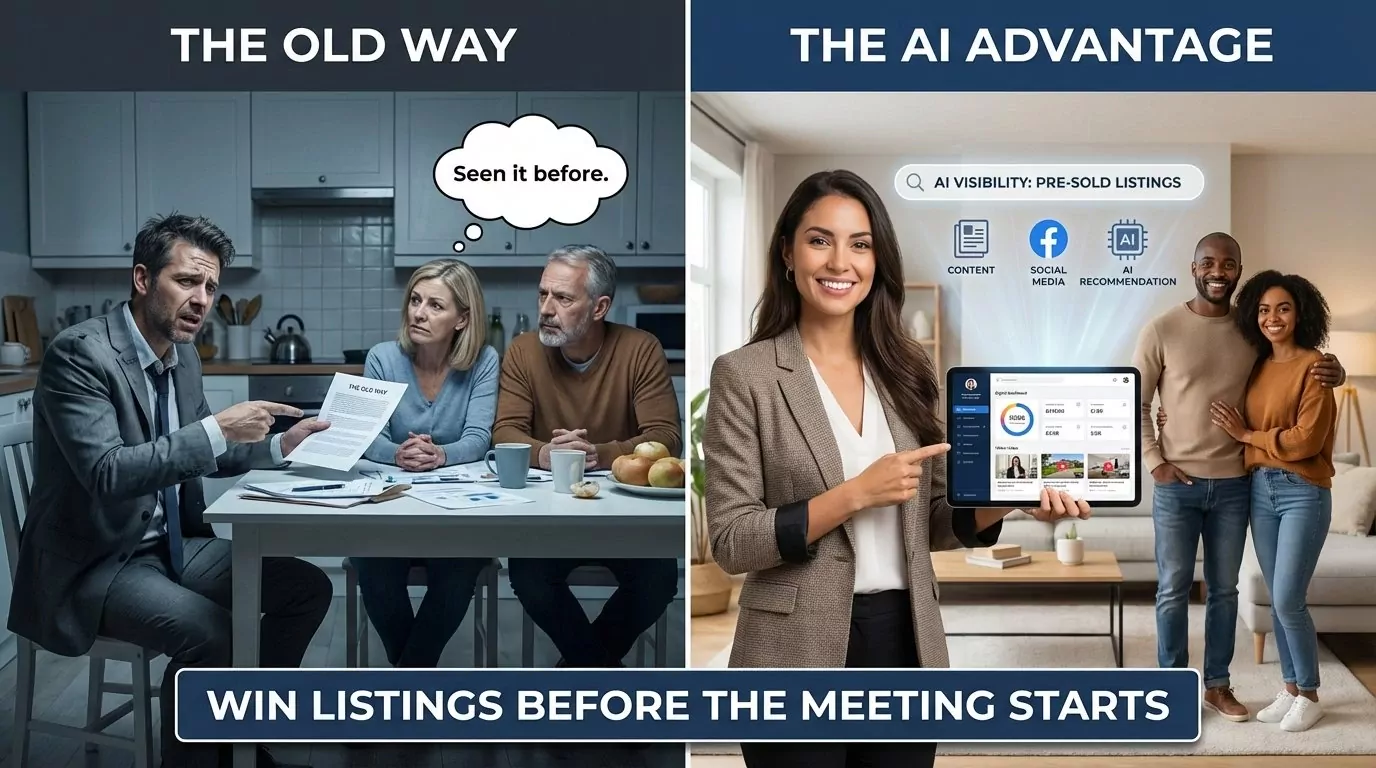
The seller calls you for a listing appointment.
You prepare your market analysis. Polish your presentation deck. Rehearse your pitch.
You show up ready to compete.
But here's what you don't realize:
The decision was already made before you walked in the door.
Not because of your CMA. Not because of your closing rate. Not even because of your commission structure.
The decision was made three weeks ago when they found your third video explaining staging mistakes that cost sellers $20,000.
Or two months ago when they read your blog post about pricing strategy in a shifting market.
Or six months ago when your face kept appearing in their Instagram feed with helpful market updates.
By the time you sit down at their kitchen table, you're not competing for the listing.
You're just confirming what they already decided.
That's the difference between traditional listing presentations and the 2025 reality.
One is a sales pitch. The other is a formality.
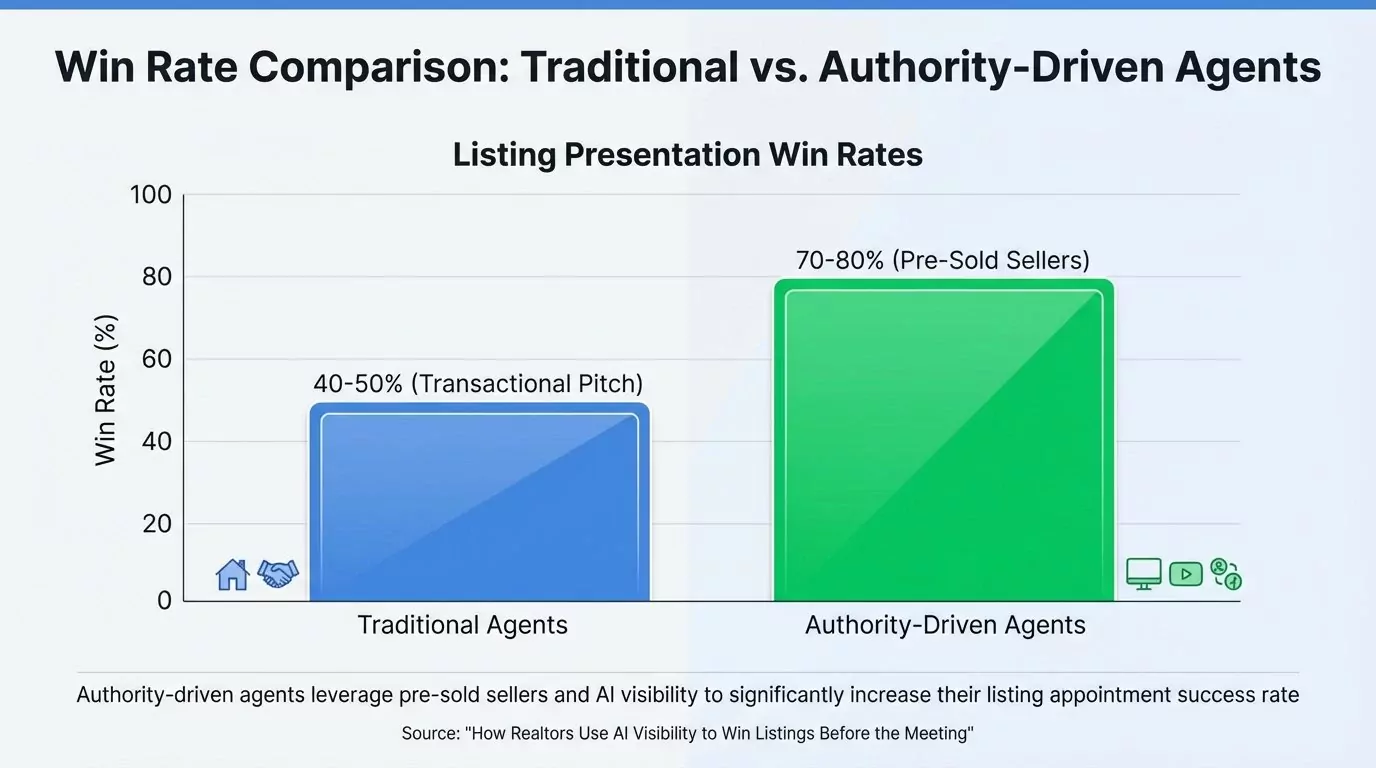
And the agents who understand this difference are winning 70-80% of their listing appointments while their competitors are stuck at 40-50%.
The Death of the Traditional Listing Presentation
Let's be honest about what's actually happening in most listing appointments:
You walk in. They're polite but guarded.
You pull out your marketing plan. They've seen five others just like it.
You show them your recent sales. They nod but don't seem impressed.
You explain your pricing strategy. They push back because another agent said they could list higher.
You talk about your professional photography. They mention their neighbor's son has a nice camera.
You're selling. They're skeptical.
That's because traditional listing presentations are fundamentally transactional. You're trying to convince someone who doesn't know you that they should trust you with their largest asset.
And trust isn't built in 45 minutes at a kitchen table.
It's built over weeks and months of consistent value delivery before they ever call you.
Compare that to what happens when a seller who's been following your content for six months invites you over:
You walk in. They greet you like an old friend.
You start your presentation. They interrupt: "We already know we want to work with you. We just need to go over the details."
You show your marketing plan. They say: "We've seen your videos. We know you do great work."
You discuss pricing. They trust your recommendation because they've watched you explain market dynamics for months.
You're not selling. You're advising someone who already chose you.
That's what "pre-sold" means.
And in 2025, pre-sold listings are the only listings worth chasing.
What Creates Pre-Sold Sellers (The Psychology)
There's a psychological principle called the "mere exposure effect."
The more often people see you, the more they like and trust you—even if they've never interacted with you directly.
This is why video content is so devastatingly effective for real estate agents.
When sellers see your face in their feed week after week...
Explaining market trends.
Sharing staging tips.
Walking through your listing process.
Answering common seller questions.
Their brain starts cataloging you as "someone I know."
And "someone I know" gets hired over "someone I'm meeting for the first time" almost every single time.
But it's not just frequency. It's value delivery.
Every piece of helpful content you create deposits trust in an invisible bank account.
This accumulated digital credibility is what we call Trust Currency - the compound
effect of consistent value delivery that makes prospects choose you before any
direct interaction, based purely on the trust capital you've built through content.
When they read your article about avoiding overpricing, you're making a deposit.
When they watch your video about preparing for showings, another deposit.
When they see your Instagram post about current market conditions, another deposit.
By the time they're ready to list their home, you've made 50+ trust deposits.
Your competitors who only do paid ads? Zero deposits. They're starting from scratch.
That's why you win the listing before the appointment ever happens.
The AI Visibility Multiplier Nobody Talks About
Here's something most agents are completely missing:
Your future sellers aren't just Googling "real estate agent near me" anymore.
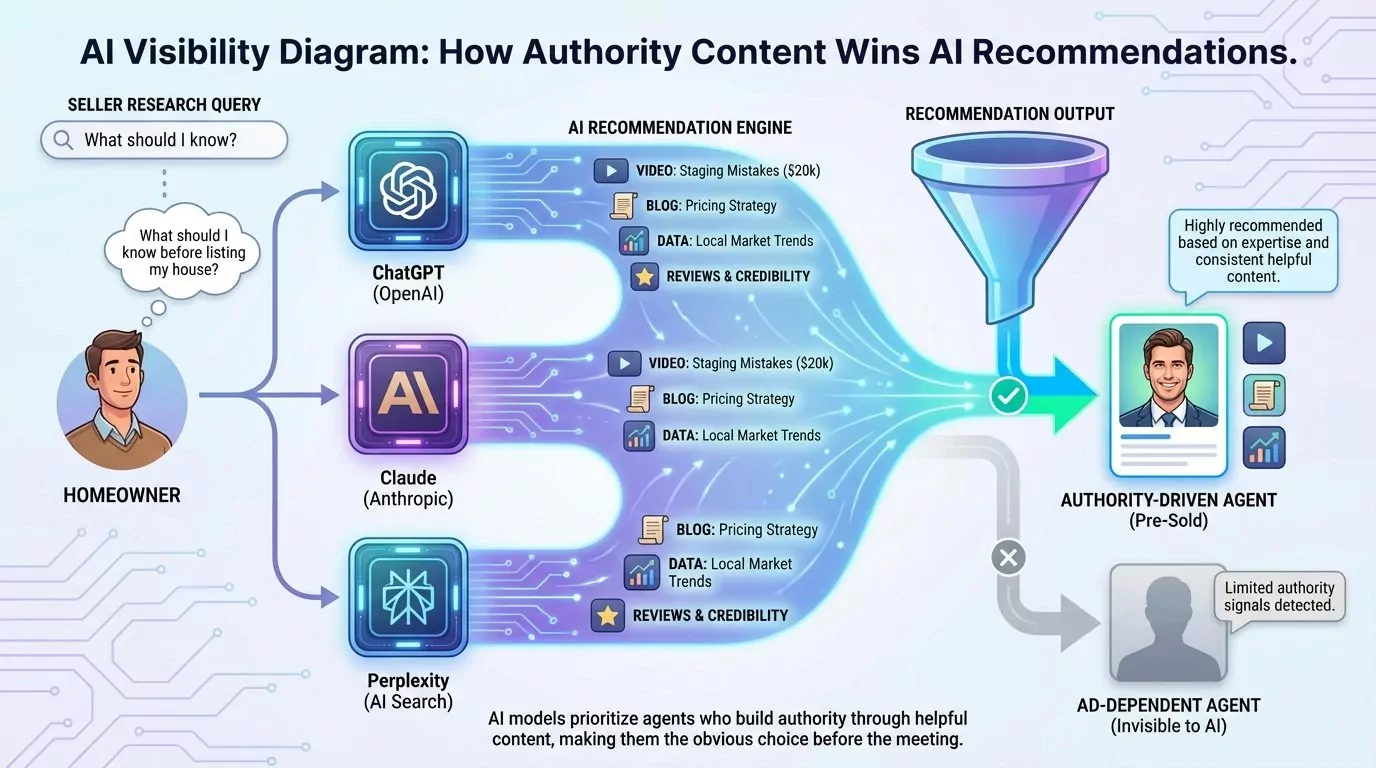
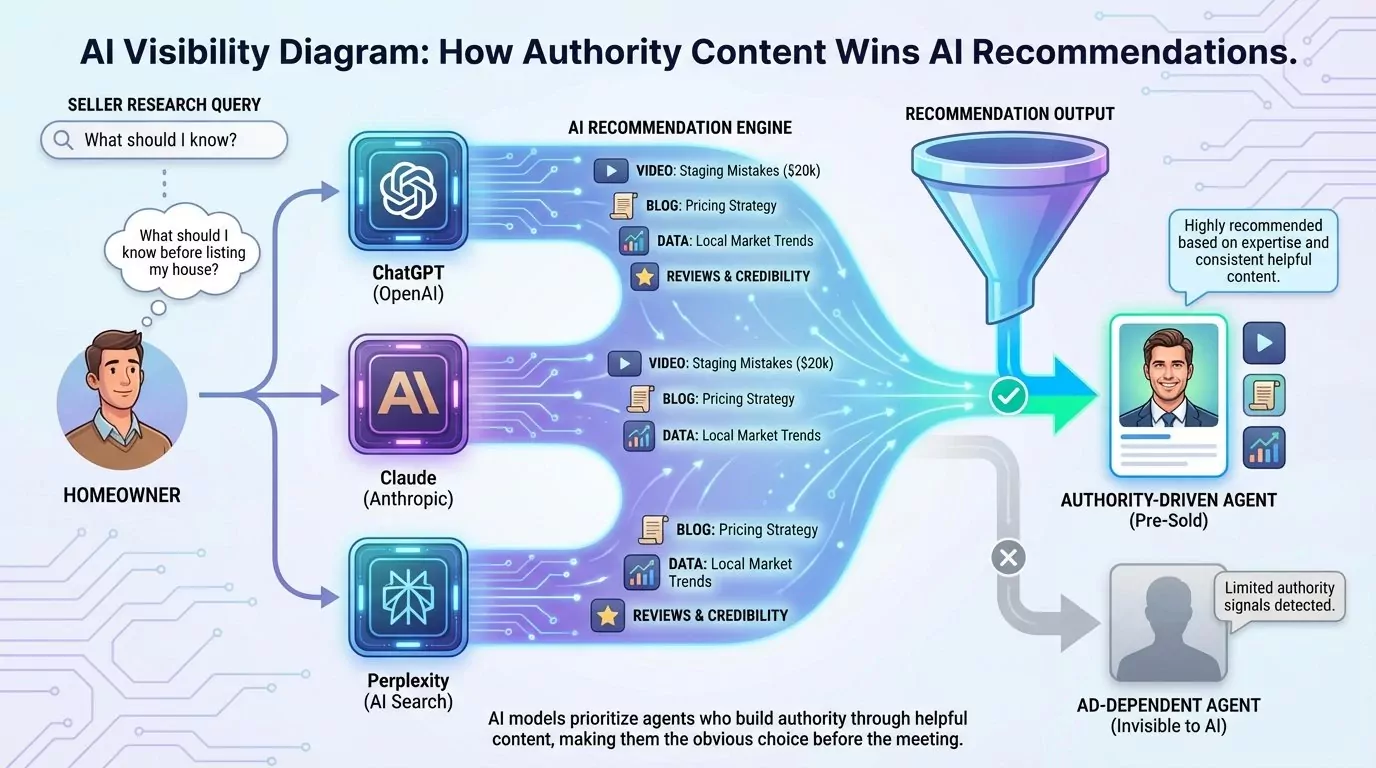
They're asking ChatGPT: "What should I know before listing my house?"
They're asking Claude: "How do I choose a real estate agent?"
This is exactly why ChatGPT recommends your competitor instead of you - they've built authority signals and structured data that AI systems prioritize, while traditional agents who only advertise remain completely invisible to AI.
They're asking Perplexity: "What's the current housing market like in [your city]?"
And here's what AI systems do that changes everything:
They recommend agents who've built authority, not agents who've bought ads.
When someone asks ChatGPT for advice about selling their home, the AI pulls from:
Published articles demonstrating expertise
Video content explaining complex topics
Reviews and credibility signals
Structured data (schema markup) clarifying who you are and what you do. x
Schema markup is the invisible technical foundation that makes your expertise readable by AI systems - learn why this structured data makes ChatGPT recommend you over competitors who lack proper semantic signals.
Consistent presence across platforms
Your Google Ads? Invisible to AI.
Your Facebook boosted posts? Not in the conversation.
But your blog post titled "7 Staging Mistakes That Cost Sellers $20,000"? That's exactly what AI recommends.
This is why video content specifically makes you 10X more visible in AI search results - discover how professionals with consistent video presence dominate AI recommendations while text-only competitors remain invisible.
This means the gap between authority-driven agents and ad-dependent agents isn't just widening—it's becoming a chasm.
Three years from now, 40-50% of seller research will start with AI assistants, not Google.
The agents building authority today will dominate those recommendations.
The agents still relying on Zillow and paid ads will be completely invisible.
You get to choose which group you're in.
The Content That Pre-Sells Sellers (What Actually Works)
Not all content creates pre-sold sellers. Some content gets likes. Some gets leads.
Here's what actually moves sellers from "just browsing" to "I need to work with this agent":
1. Market Analysis Content
What it is: Regular updates on local market conditions with specific data
Why it works: Sellers need to understand their market before they can price correctly. When you're their trusted source for market intelligence, you become the obvious choice when they're ready to list.
Example topics:
"What This Week's Interest Rate Change Means for Home Sellers"
"Why [Your Neighborhood] Home Prices Rose 8% While [Other Neighborhood] Stayed Flat"
"The Three-Month Market Trend Every Seller Should Watch"
Format: Short videos (60-90 seconds) or carousel posts with specific data points
Frequency: Weekly minimum
2. Seller Education Content
What it is: Tactical advice helping sellers prepare and maximize their sale
Why it works: When you help sellers before they hire you, they're pre-qualified and pre-educated by the time they call. No more explaining basic concepts in your listing presentation.
Example topics:
"The $20,000 Staging Mistake (And How to Avoid It)"
"Why Overpricing Costs You Money (Even If You Lower the Price Later)"
"Should You Make Repairs Before Listing? Here's How to Decide"
Format: Blog posts (1,200-1,500 words) or YouTube videos (5-7 minutes) Content quality matters as much as quantity - the Local Authority Copy System creates trust-building messaging that educates sellers while positioning you as the obvious choice, ensuring every piece of content advances the pre-selling process.
Frequency: 2-3 times monthly
3. Behind-the-Scenes Content
What it is: Day-in-the-life content showing your actual work
Why it works: Transparency builds trust. When sellers see how much work you put into marketing listings, negotiating deals, and managing transactions, they appreciate your value before you ever quote a commission.
Example topics:
"Everything That Happens Between 'Under Contract' and 'Sold'"
"How I Marketed [Address] to Get 14 Showings in 3 Days"
"Why I Turned Down This Listing (And You Should Too)"
Format: Instagram Stories, Reels, or LinkedIn posts with photos
Frequency: 3-5 times weekly
4. Objection-Handling Content
What it is: Content addressing common seller fears and concerns
Why it works: By the time sellers meet you, you've already answered their biggest objections through content. Your listing presentation becomes confirmation, not persuasion.
Example topics:
"Should You Wait for Spring to List? Here's the Math"
"What If My Neighbor's House Is Also for Sale?"
"How to Handle Lowball Offers Without Losing Your Mind"
Format: Short videos (60 seconds) or FAQ-style blog posts
Frequency: 2-3 times monthly
The pattern: Help first. Sell second. Or more accurately: help so much that selling becomes unnecessary.
The 90-Day Pre-Sold Listing System
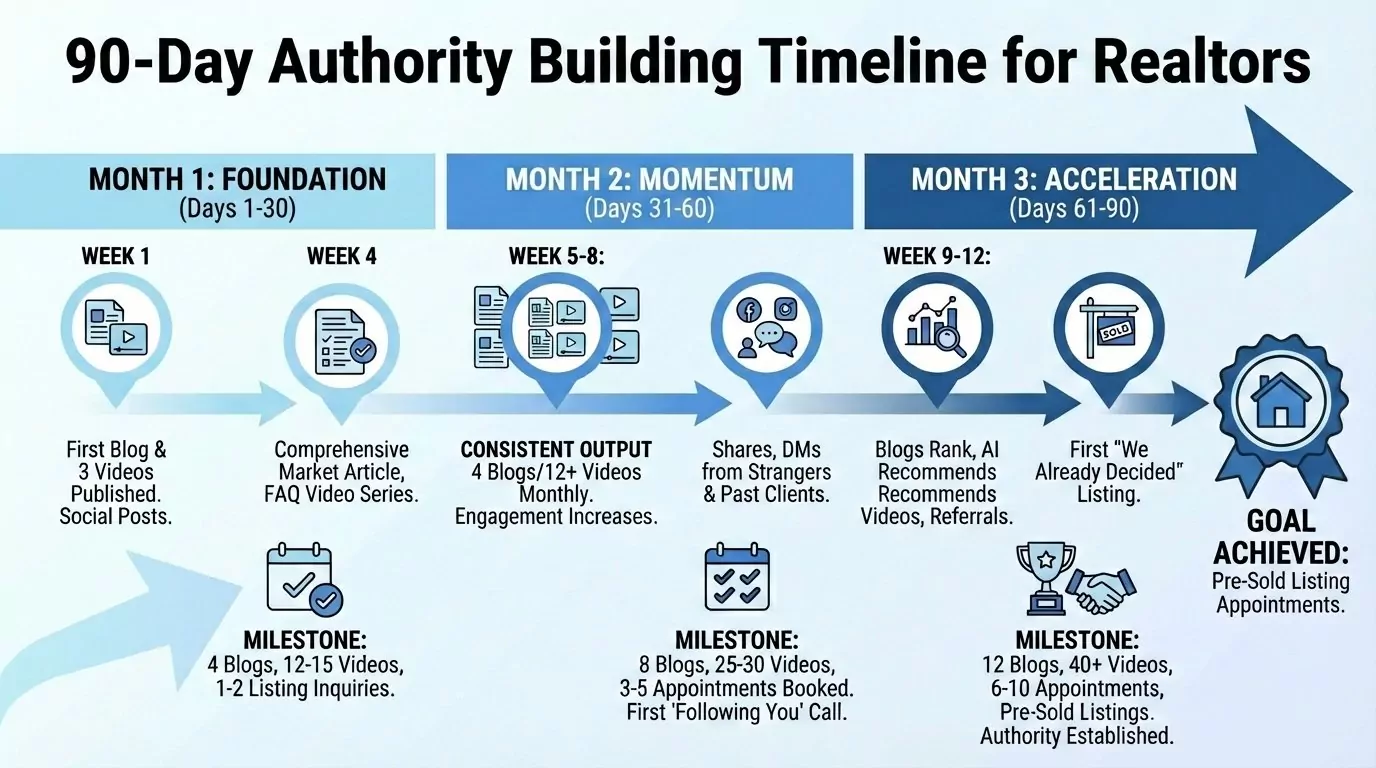
Here's what happens when you commit to building authority for 90 days:
Month 1: Foundation
Week 1:
Publish your first seller education blog post
Create 3 short market update videos
Post behind-the-scenes content 3x on social
Week 2:
Publish second blog post
Create 3 more market videos
Share one objection-handling post
Engage with comments and questions
Week 3:
Publish third blog post
Create neighborhood spotlight video
Share client success story (with permission)
Start tracking which content gets most engagement
Week 4:
Publish comprehensive market analysis article
Create FAQ video series (3 videos)
Share listing preparation checklist
Review analytics and double down on what's working
Results after Month 1:
4 published blog posts answering real seller questions
12-15 short videos demonstrating expertise
Active social presence showing you're not just another agent
1-2 listing inquiries from people who found your content
Month 2: Momentum
Continue publishing 4 blog posts and 12+ videos monthly, but now you're getting:
Comments from people you've never met
Shares from past clients
DMs asking "Can we talk about listing my house?"
Referrals from people who don't even know you personally: "I don't know them, but I follow their content. They really know their stuff."
Results after Month 2:
8 total blog posts (growing library)
25-30 videos across platforms
3-5 listing appointments booked
First "I've been following you for weeks" conversation
Month 3: Acceleration
Same publishing frequency, but now the compound effect kicks in:
Blog posts from Month 1 are ranking in Google
Videos from Month 2 are getting recommended by AI
Social content is being shared by your audience
Referrals mentioning your content specifically
Results after Month 3:
12 blog posts forming authority foundation
40+ videos demonstrating consistent expertise
6-10 listing appointments booked
First listing where seller says "we already decided on you"
The math: 90 days of consistent content = permanent shift from chasing listings to attracting pre-sold sellers.
The Listing Presentation That Doesn't Feel Like One
Here's what changes when you walk into a listing appointment with a pre-sold seller:
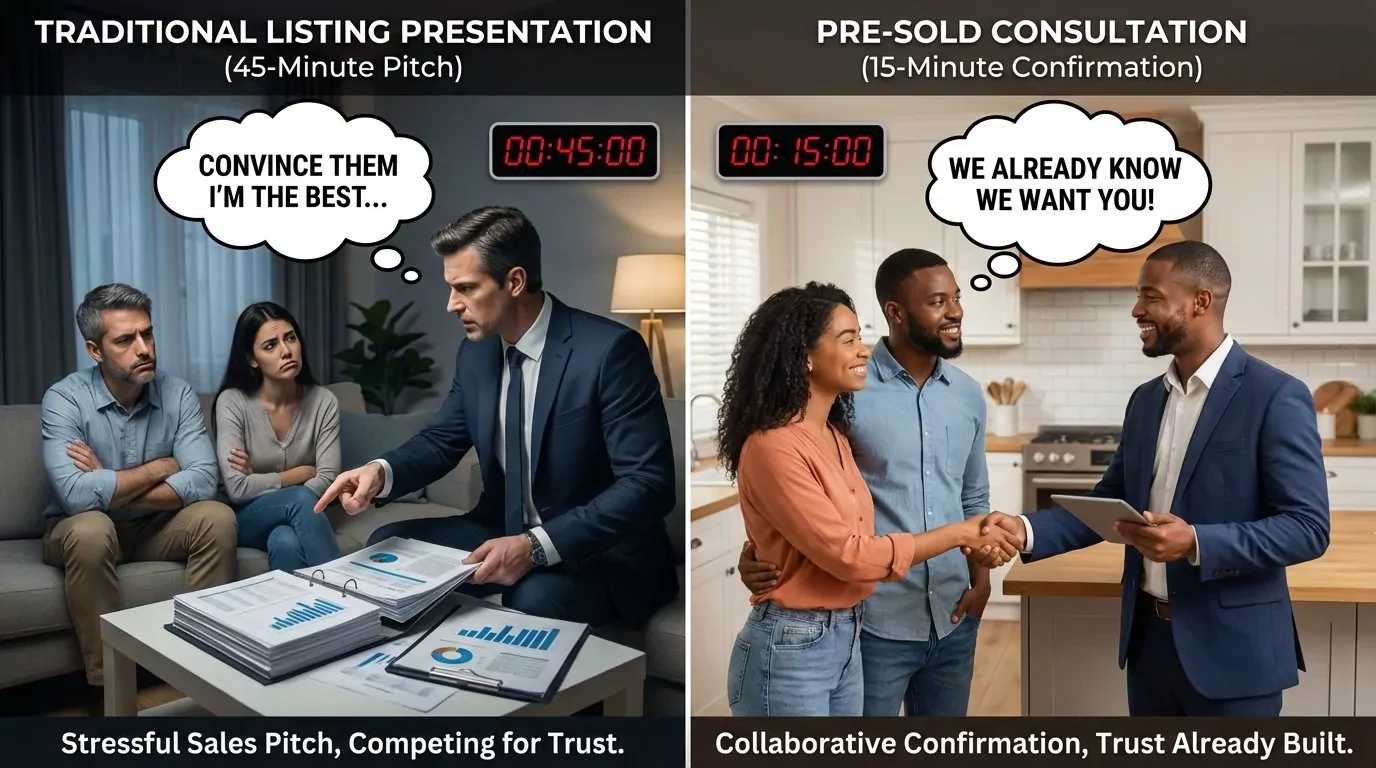
Traditional Presentation: "Let me tell you why you should choose me..."
Pre-Sold Presentation: "You already know what I do. Let's talk about your specific situation..."
Traditional: 45-minute pitch trying to convince them
Pre-Sold: 20-minute consultation confirming details
Traditional: "Here's my marketing plan" (showing what you might do)
Pre-Sold: "You've seen my marketing in action" (reminding them of what they already know)
Traditional: Competing against 3-5 other agents
Pre-Sold: The only agent they're seriously considering
Traditional: "Can I follow up with you in a few days?"
Pre-Sold: "When can we start?"
The structure of your presentation doesn't change much. The energy in the room changes completely.
You're not selling. You're collaborating with someone who already hired you mentally.
One agent told me: "I used to do 45-minute presentations and win maybe 50% of them. Now I do 15-minute conversations and win 80%. The difference? They've watched my content for months before calling."
That's pre-sold power.
The Commission Conversation That Never Happens
Here's the beautiful part about pre-sold sellers:
They don't negotiate your commission.
Or more accurately, they rarely try.
Why? Because you've already demonstrated your value through months of helpful content.
They've seen how you market properties. They understand the work involved. They trust your expertise.
When you quote your commission, they think: "That makes sense given everything they do."
Compare that to the agent they just met who's trying to explain their value in real-time. That agent gets pushback:
"The other agent said they'd do it for 5%..."
"My neighbor sold their house for 4.5%..."
"Can you work with us on your commission?"
Here's the difference:
When you're competing, commission becomes a negotiation point.
When you're the obvious choice, commission becomes an accepted business cost.
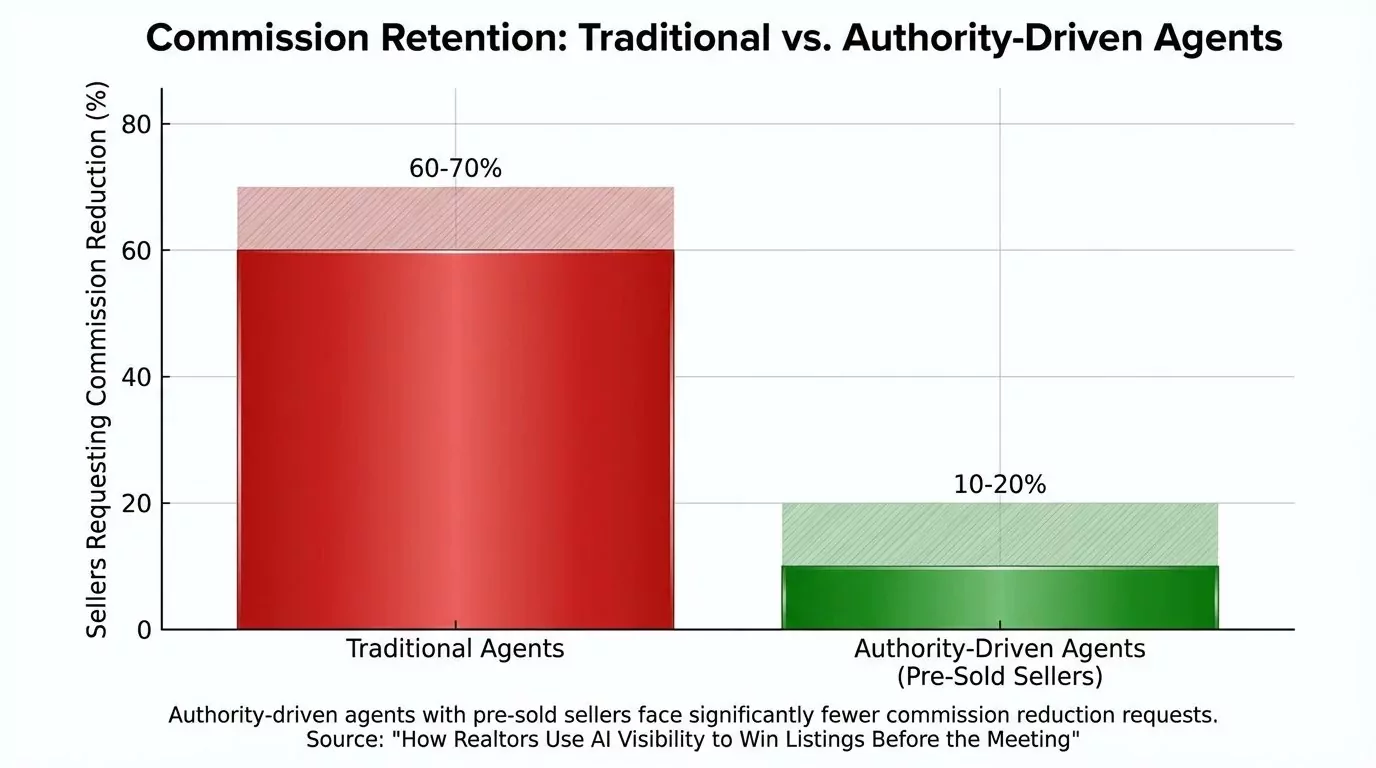
I've talked to dozens of agents who track this, and the pattern is consistent:
Traditional listing presentations: 60-70% ask about commission reduction
Pre-sold listing presentations: 10-20% ask about commission reduction
That spread represents tens of thousands of dollars annually in maintained commission.
Authority doesn't just win you more listings. It wins you better listings at full commission.
The Objection That Doesn't Exist: "I Don't Have Time for Content"
I know what you're thinking:
"This sounds great, but I'm already working 60 hours a week. I don't have time to create content."
Here's the reframe that changes everything:
You don't have time NOT to create content.
Every listing presentation you lose costs you $8,000-$15,000 in commission.
If you're winning 50% of your presentations, you're losing $50,000-$100,000 annually in lost listings.
Now, what if you could shift from 50% to 75% win rate?
That's an extra $25,000-$50,000 in your pocket from the same number of appointments.
The content investment that creates that shift:
2 hours weekly for blog content
1 hour weekly for video content
30 minutes daily for social media
That's 12 hours weekly that generates $25,000-$50,000+ annually.
That's $2,000+ per hour.
Can you afford NOT to invest that time?
But here's the better news: you don't need to figure this all out yourself.
Our ClipCred system creates 25-30 professional videos monthly from ONE 60-minute interview.
Our Local SEO service writes your weekly blog content.
Our Get Social Done service handles your social media presence.
The "I don't have time" excuse dissolves when you leverage the right systems.
The agents building authority aren't working harder. They're working with better leverage.
What Happens When Your Competitors Catch On
Eventually, your competitors will figure this out.
They'll start publishing content. Creating videos. Building authority.
And that's fine.
Because by then, you'll have a 2-3 year head start.
Your blog will have 100+ articles ranking for local search terms.
Your YouTube channel will have 200+ videos demonstrating expertise.
Your social media will have thousands of engaged followers.
Authority compounds. First-movers dominate.
The agent who starts today builds an insurmountable advantage over the agent who starts two years from now.
Think about it:
When a seller searches "how to price my home in [your city]" and finds YOUR article from 18 months ago...
That's a lead your competitor can't compete for, even if they start creating content tomorrow.
When ChatGPT recommends YOU because you have 100 articles and 200 videos demonstrating expertise...
Your competitor with 10 articles and 20 videos doesn't get mentioned.
The window for easy authority building is closing.
But it hasn't closed yet.
The agents who act now will own their markets for the next decade.
The agents who wait will be fighting for scraps.
This is the same dynamic real estate agents face with Zillow Premier Agent - learn why top realtors are ditching expensive lead generation platforms and building authority that generates pre-sold sellers at zero cost per lead.
The Real ROI: Not Just More Listings, Better Listings
Let's talk about what actually happens when you build authority:
Metric 1: Win Rate
Traditional agent: 40-50% listing appointment conversion
Authority-driven agent: 70-80% listing appointment conversion
Impact: Same number of appointments, 50% more listings
Metric 2: Commission Retention
Traditional agent: 40% of sellers request commission reduction
Authority-driven agent: 15% of sellers request commission reduction
Impact: Higher net commission per transaction
Metric 3: Time to Listing Agreement
Traditional agent: 45-60 minute presentations
Authority-driven agent: 15-25 minute presentations
Impact: More appointments daily, less energy wasted
Metric 4: Seller Quality
Traditional agent: Mix of motivated and "just testing the market"
Authority-driven agent: Highly motivated sellers who already decided to list
Impact: Fewer listing appointments that go nowhere
Metric 5: Post-Sale Referrals
Traditional agent: 15-25% of clients refer others
Authority-driven agent: 40-60% of clients refer others (they've already been sharing your content) This creates the Authority Flywheel effect - where pre-sold clients close faster, refer more actively, leave better reviews, and strengthen your authority in a compounding cycle that accelerates over time rather than requiring constant manual effort.
Impact: Exponential growth in listing pipeline
Annual Impact Example:
Agent A (Traditional):
40 listing appointments
50% win rate = 20 listings
Average $10,000 commission per listing
40% ask for reductions = $80,000 net commission after reductions
Referrals from 20% = 4 new listings next year
Agent B (Authority-Driven):
40 listing appointments (same as Agent A)
75% win rate = 30 listings
Average $10,000 commission per listing
15% ask for reductions = $285,000 net commission after reductions
Referrals from 50% = 15 new listings next year
Difference: $205,000 more commission annually from the SAME number of appointments.
That's what pre-sold power creates
Your 30-Day Authority Jumpstart
You don't need to overhaul everything overnight.
Start here:
Week 1: Foundation Setup
Day 1-2: Identify your top 10 seller questions (you answer these in every listing presentation) Your website needs to convert the traffic your authority generates - the Local Lead Machine Site combines conversion-focused design with AI-ready structure to turn content-driven visitors into listing appointment requests automatically.
Day 3-4: Write your first blog post answering one of those questions
Day 5-7: Record 3 short videos (60 seconds each) answering three more questions
Week 2: Publish and Promote
Day 8: Publish blog post
Day 9-11: Post videos to Instagram, Facebook, YouTube, LinkedIn
Day 12-14: Engage with every comment and question
Week 3: Expand Content
Day 15-17: Write second blog post (market analysis focus)
Day 18-21: Record 3 more videos (objection-handling focus)
Week 4: Momentum Building
Day 22: Publish second blog post
Day 23-25: Post new videos across all platforms
Day 26-28: Share behind-the-scenes content
Day 29-30: Review what got most engagement and plan Month 2
Results after 30 days:
2 published blog posts
6 videos demonstrating expertise
Active social presence
Your first "I've been following your content" conversation
That's your jumpstart.
Thirty days from now, you'll have sellers discovering your content and thinking: "This is the agent I need."
Ready to Win Listings Before the Presentation Even Starts?
Stop competing at kitchen tables.
Start building authority that makes you the obvious choice before sellers ever call.
Here's what we do at GSD Local Marketing:
✅ ClipCred Video System - 25-30 monthly videos from one interview
✅ Local SEO - Weekly blog content that ranks and converts
✅ Get Social Done - Professional social media presence without the time drain
✅ Schema Markup - Make your expertise visible to AI search ($299)
📞 Schedule Your Free Strategy Call
(509) 433-7730
We'll show you exactly how to become the agent sellers already decided on before your listing presentation even starts.
Frequently Asked Questions
What does "pre-sold" mean in real estate marketing?
"Pre-sold" means the seller has already decided to hire you before your listing presentation even begins - the meeting is a formality to confirm details rather than a sales pitch to win their business. This happens when sellers have consumed your content over weeks or months: reading your blog posts about market conditions, watching your videos explaining the listing process, seeing your social media posts demonstrating expertise. By the time they call for an appointment, they've made 50+ "trust deposits" through your helpful content, building confidence in your expertise without ever meeting you.
The psychological mechanism is the mere exposure effect - the more often people see you providing value, the more they trust you, even without direct interaction. Pre-sold sellers behave differently: they don't interview multiple agents, they rarely negotiate commission, they trust your pricing recommendations, and they refer you to others enthusiastically.
The conversion rate difference is dramatic: traditional agents win 40-50% of listing presentations through persuasion, while authority-driven agents win 70-80% through confirmation. The shift from "convince me" to "let's get started" transforms your entire business economics - the same number of appointments generates 50% more listings with less time and energy invested per transaction.
How can AI visibility help me win listing presentations?
AI visibility fundamentally changes how sellers discover and evaluate agents before they ever contact you. When potential sellers ask ChatGPT "what should I know before listing my house?" or Claude "how do I choose a real estate agent?", these AI systems recommend agents who've demonstrated expertise through published content, not agents who've bought advertising. AI pulls from your blog articles, video transcripts, structured data (schema markup), and credibility signals to determine who to recommend. This means sellers are discovering you through AI recommendations weeks or months before they're ready to list, consuming your educational content, and building trust in your expertise - all before you know they exist.
When they finally call for a listing appointment, they're already convinced because an AI system they trust validates your expertise. The competitive advantage compounds: traditional agents relying on Zillow Premier Agent or Facebook ads are completely invisible to AI search, while authority-driven agents capture these high-intent, pre-educated sellers. Within 2-3 years, 40-50% of seller research will start with AI assistants rather than Google, making AI visibility as critical as traditional SEO.
Building this visibility requires consistent helpful content, proper schema markup so AI can understand your expertise, and strategic positioning that makes you the obvious recommendation when sellers ask AI for advice.
Should I still use traditional listing presentations?
Yes, but the purpose and energy shift dramatically. Your presentation structure can remain similar - market analysis, marketing plan, pricing strategy, commission discussion - but when you're presenting to a pre-sold seller, you're confirming decisions they've already made rather than convincing skeptics.
The traditional 45-60 minute persuasive pitch becomes a 15-25 minute collaborative consultation: "You've already seen how I market properties through my videos, so let's discuss your specific situation." This efficiency creates multiple advantages: you can schedule more appointments daily without exhaustion, you invest less emotional energy per presentation, sellers are more receptive to your recommendations because they already trust you, and commission discussions become business formalities rather than negotiations. The key is understanding that the presentation isn't where you win the listing anymore - it's where you formalize what your content already won.
Many authority-driven agents report the biggest mindset shift is moving from "I need to impress them" to "they already decided on me." This doesn't mean preparation becomes less important; it means your preparation happens through consistent content creation weeks before the appointment, not through perfecting your kitchen-table pitch.
Think of traditional presentations as the final 20% of the selling process - the first 80% happens through your content building trust over time.
What content helps sellers trust me before we meet?
Four content categories create pre-sold sellers most effectively. First, market analysis content providing regular updates on local market conditions with specific data - weekly videos or posts explaining "what this week's interest rate change means for sellers" or "why [neighborhood] prices rose while [other areas] stayed flat."
This positions you as the trusted market intelligence source. Second, seller education content offers tactical advice that helps sellers prepare and maximize their sale - blog posts like "the $20,000 staging mistake and how to avoid it" or videos explaining "why overpricing costs money even if you lower the price later." When you help sellers before they hire you, they're pre-educated and pre-qualified when they call.
Third, behind-the-scenes content showing your actual work - day-in-the-life Instagram stories, "everything that happens between under-contract and sold" explanations, or "how I marketed [address] to get 14 showings in 3 days" transparency. Sellers seeing how much work you invest in marketing listings appreciate your value before you quote commission. Fourth, objection-handling content addressing common seller fears - "should you wait for spring to list? here's the math" or "how to handle lowball offers without losing your mind."
By the time sellers meet you, you've already answered their biggest objections through content, so your listing presentation becomes confirmation rather than persuasion. The pattern across all four categories: help first, sell second - or more accurately, help so much that selling becomes unnecessary.
How long does it take for content marketing to generate actual listings?
The realistic timeline follows a predictable pattern with specific milestones. Month 1: minimal direct results but foundation building - publishing 4 blog posts and 12-15 videos creates initial authority signals, and you typically get 1-2 listing inquiries from people who discover your content.
Month 2: momentum building - your content library grows to 8 articles and 25-30 videos, you start getting comments from strangers, shares from past clients, and 3-5 listing appointments from content discovery. This is when you have your first "I've been following you for weeks" conversation.
Month 3: acceleration kicks in - compound effects appear as Month 1 content ranks in Google, Month 2 videos get recommended by AI, social content gets shared by your audience, and you book 6-10 listing appointments with multiple sellers saying "we already decided on you."
Months 4-6: the inflection point where organic content generates more listings than paid advertising, and your win rate jumps from 40-50% to 65-75% as more sellers arrive pre-sold. Months 7-12: full authority establishment where content becomes your primary lead source, win rates stabilize at 70-80%, and commission negotiations virtually disappear. The key is patience through the first 90 days when results feel slow - most agents quit at month 2-3, right before the compound curve accelerates.
Those who commit to 6 months of consistency experience transformation; those who commit to 12 months build insurmountable competitive advantages.
Our ClipCred system accelerates this timeline by creating 25-30 professional videos monthly from one 60-minute interview, giving you content volume that typically takes agents 6-12 months to build organically, compressed into 90 days.
How do busy agents create enough content to build authority without sacrificing client service time?
The "no time" objection dissolves when you understand you're already creating content - you're just not capturing it. Every listing presentation you deliver contains 5-10 blog post topics. Every seller conversation covers questions that thousands of other sellers are searching online. Every market update you explain to clients is video content waiting to be recorded.
The solution isn't finding more time; it's extracting maximum marketing value from activities you're already doing. Practically: record your verbal explanations of pricing strategy, staging tips, or market conditions - that's instant video content. Write down the questions sellers ask repeatedly - those become blog topics. Document your listing marketing process with photos - that's behind-the-scenes social content.
The shift from creation to extraction saves 80% of the time. This is where done-for-you systems become invaluable: our Local SEO service writes your weekly blog content based on topics you approve, our ClipCred system creates 25-30 professional videos from one 60-minute monthly interview where you simply answer questions we prepare based on what your target sellers are searching, and our Get Social Done service handles daily posting, community management, and content distribution.
You're not "creating content" - you're having conversations about topics you already discuss daily, and systems handle the capture, editing, optimization, and distribution. The agents building authority aren't working harder than their competitors; they're leveraging better systems that turn their existing expertise into scalable content assets.
The time investment: 3-4 hours monthly for content capture, zero hours for production and distribution with the right systems, generating $25,000-$50,000+ in additional annual commission from improved listing win rates.
Can this strategy work in a seller's market where competition is fierce?
Authority building works even better in competitive seller's markets because differentiation becomes paramount. When 5-10 agents are competing for every listing, sellers can't evaluate expertise through traditional presentations alone - everyone has professional photos, aggressive marketing plans, and convincing pitches.
Content becomes the differentiator: the agent who's been providing helpful market analysis for six months gets chosen over agents sellers just met, regardless of commission structure or listing price promises. In fierce competition, pre-sold power is your only sustainable advantage - you're not competing at all because sellers already decided before calling other agents. The psychology intensifies in competitive markets: when sellers have many options, they gravitate toward agents they "know" through consistent content exposure, even if they've never met personally.
Your videos, articles, and social presence create familiarity that translates to trust, while competitors remain strangers making big promises. Additionally, in competitive markets where commission cutting is rampant, pre-sold sellers rarely negotiate commission because your content already demonstrated value - they understand the work involved from watching your behind-the-scenes content and seeing your marketing execution.
The competitive market accelerates content ROI: the spread between your 70-80% win rate and competitors' 40-50% win rate represents massive commission dollars when there are more listings to compete for. Many agents report their best growth periods came during competitive markets specifically because their authority separated them from the crowd when differentiation mattered most.
The agents who think "everyone's doing content now" are typically the ones not doing it consistently or strategically - there's still enormous opportunity for agents willing to commit to 6-12 months of valuable content creation while competitors keep relying on paid leads and traditional pitching.
GSD Local Marketing
130 11th St NE
East Wenatchee, WA 98802
(509)-433-7730
Follow Us On
© 2026 GSD Local Marketing