NETENGINE
THE $50,000 ADVERTISING GRAVEYARD...
Why Clients Don't Believe Your Google Ads (And What Works Instead)
Prospects don't trust paid ads - they trust demonstrated expertise. Here's how to generate organic legal leads without wasting another dollar on clicks that don't convert.

You spent $3,000 on Google Ads last month.
The clicks came in. The numbers looked good. Your dashboard showed activity.
But your phone? Silent.
Your consultation calendar? Empty.
Your bank account? Lighter by three grand.
Here's the uncomfortable truth nobody in the advertising world wants to tell you:
Your prospects don't trust your ads. They never did. They never will.
Not because they're stupid. Not because your ad copy is weak. Not even because your landing page needs work.
They don't trust your ads because nobody trusts ads anymore.
And in 2026, that trust deficit is costing attorneys hundreds of thousands of dollars in lost business.
The Psychology Behind Why Legal Ads Fail
Let's start with what's actually happening in your prospect's brain when they see your ad.
They're sitting at home, late at night, searching "DUI lawyer near me" because they got pulled over last weekend and just got a court date in the mail.
They're scared. Embarrassed. Worried about losing their license, their job, maybe even their freedom.
Your ad pops up at the top of Google: "Expert DUI Defense | Free Consultation | Call Now!"
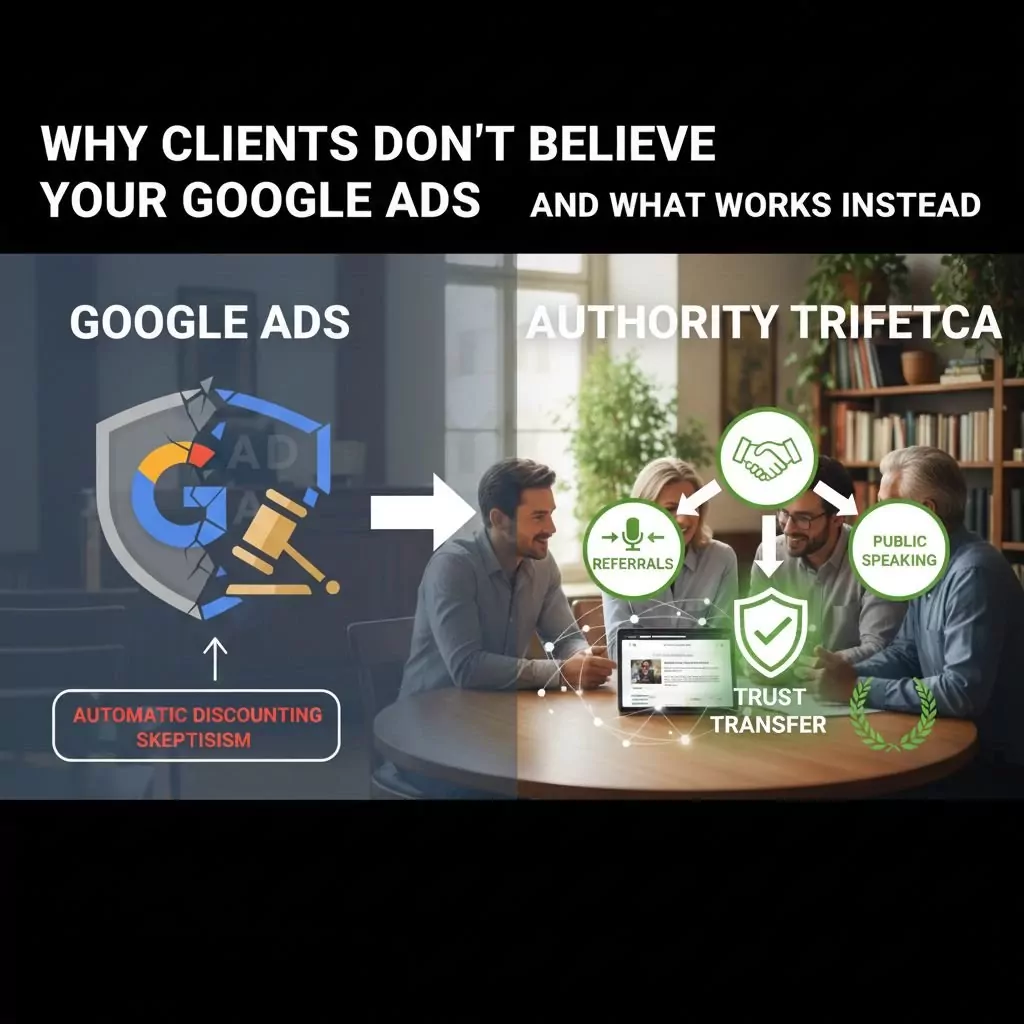
And their brain immediately does something called automatic discounting.
They think: "Of course they say they're experts. Everyone says that. It's an ad."
The ad sits in the "paid promotional content" box at the top of search results - literally labeled as advertising. Google might as well put a flashing sign: "THIS PERSON PAID TO BE HERE. SKEPTICISM RECOMMENDED."
Compare that to what happens when they scroll down and see an organic result - a blog post titled "What Actually Happens at Your First DUI Hearing in [Your State]."
Same attorney. Same firm. Different positioning.
But this time, their brain thinks: "This person is teaching me something valuable. They're not selling. They're helping."
That's the trust difference.
One looks like a transaction. The other looks like authority.
One triggers skepticism. The other triggers gratitude.
And gratitude, not clicks, is what turns prospects into retained clients.
The $50,000 Google Ads Graveyard
Let me show you the math on what this trust deficit actually costs.
Average criminal defense attorney spending on Google Ads: $2,000-$5,000 monthly.
Average cost-per-click in competitive legal markets: $40-$150.
Average conversion rate from ad click to consultation: 2-4%.
Average conversion rate from consultation to retained client: 30-50%.
Let's be generous and say you're on the better end of those ranges:
$3,000 monthly spend
$75 average CPC = 40 clicks
4% conversion rate = 1.6 consultations
40% retention rate = 0.64 clients
You paid $3,000 for 0.64 clients.
If your average case value is $5,000, you just spent $3,000 to generate $3,200 in revenue. That's a 6.7% profit margin before overhead, staff costs, or your time.
This is the hidden cost of cheap marketing - what looks "affordable" at $3,000/month costs you $250,000+ in lost opportunities because low-trust clicks never convert into high-value clients.
Now let's look at the attorney down the street who quit Google Ads two years ago and invested in authority building instead:
$0 monthly ad spend
200 monthly organic website visitors from content
12% conversion rate (pre-sold from content) = 24 consultations
65% retention rate (they already trust you) = 15.6 clients
Zero ad spend. 15-16 retained clients monthly.
Same market. Same services. Wildly different results.
The difference? Trust.
One is renting attention through ads. The other owns authority through content.
Why Referrals Work and Ads Don't (The Trust Transfer)
Think about the last time you hired an attorney.
Chances are, you didn't click on an ad. You asked someone you trusted.
Your cousin. Your neighbor. Your coworker. Someone who said: "I used this lawyer. They were great."
That's called trust transfer.
Your cousin's credibility transfers to the attorney they're recommending. You inherit their confidence. The sale is made before you ever visit the website.
Now, here's what most attorneys miss:
You can engineer trust transfer at scale without waiting for word-of-mouth.
How? By building visible authority that makes you the de facto referral - even from people who've never used your services.
When you create consistent, helpful content - articles, videos, social posts that actually solve problems - something interesting happens:
People who've never hired you start recommending you.
"I haven't used them personally, but I follow their stuff online. They really know their stuff."
That's an authority-driven referral. And it's more powerful than any ad you'll ever run.
Here's why:
Ads say: "I'm good. Hire me."
Authority says: "Let me help you understand this. By the way, I'm available if you need more help."
One is self-promotion. The other is service.
And in legal marketing, service builds trust faster than any paid click ever could.
The AI Search Problem That Makes Ads Even Less Effective
Here's something that's making the trust deficit exponentially worse:
Your prospects aren't just using Google anymore.
They're asking ChatGPT: "What should I know before hiring a DUI lawyer?"
They're asking Claude: "How do I find a good immigration attorney in my area?"
They're asking Perplexity: "What's the difference between a public defender and a private criminal defense attorney?"
This is exactly why ChatGPT recommends your competitors instead of you - they've built the authority signals and structured data that AI systems use to make recommendations, while your paid ads remain completely invisible to these platforms.
And here's what none of these AI tools do: recommend attorneys who advertise.
AI systems pull from authority signals: content, reviews, structured data, expertise demonstrations, media mentions.
Your Google Ads? Completely invisible to AI.
So while you're spending $3,000 monthly to show up at the top of Google searches, your prospects are getting recommendations from AI assistants - and you're not even in the conversation.
The platforms are shifting. The trust signals remain the same.
AI recommends attorneys who demonstrate expertise consistently. Who publishes helpful content. Who build reputations through value, not volume.
That's why the attorneys who invested in authority three years ago are now dominating AI search results - while the attorneys still running ads are wondering why their leads dried up.
The market didn't disappear. It moved to platforms where ads don't work.
What Actually Builds Trust (The Authority Trifecta)
So if ads don't work and AI is eating traditional search, what does work?
Three things. That's it.
1. Consistent, Helpful Content
Not promotional. Not salesy. Actually helpful.
Blog posts answering the exact questions your prospects are Googling at 2 AM.
Videos breaking down complex legal processes in plain language.
Social media posts that demonstrate you understand their situation - not just that you want their money.
Consistency matters more than volume - Get Social Done ensures professional presence across all platforms without consuming your time, handling content creation, posting schedules, and community management while you focus on serving clients.
When someone finds your content, reads it, gets value from it, and then sees you're a local attorney... the sale is already made.
This accumulated digital credibility is what we call Trust Currency - the compound effect of consistent expertise demonstration that makes prospects choose you before they ever pick up the phone.
But content needs to be written with conversion in mind - the Local Authority Copy System creates trust-building messaging that educates prospects while positioning you as the obvious choice.
They're not looking for more options. They're looking for your phone number.
That's the power of educational authority.
You've already proven you can help them. Hiring you is the obvious next step.
2. Social Proof That AI Can Read
Reviews matter. Everyone knows that.
But in 2026, how you present reviews matters more than ever.
Because it's not just humans reading them anymore.
When you implement proper schema markup on your reviews, AI systems can parse and understand:
How many reviews you have
What your average rating is
What people specifically appreciate about your services
How consistently you deliver results
Schema markup is the invisible code that makes AI visibility possible - learn why this technical foundation makes ChatGPT recommend you over competitors who lack proper structured data.
This is why schema markup is no longer optional.
It's the difference between AI seeing you as "an attorney in the area" versus "the 4.9-star criminal defense attorney with 87 reviews and a track record of reduced charges."
One is generic. The other is recommendable.
And AI systems don't recommend generic.
3. Visible, Consistent Presence
Here's the psychological trigger most attorneys miss:
Mere exposure effect.
The more often people see you, the more they trust you - even if they've never interacted with you directly.
This is why video content is so powerful.
When prospects see your face in their LinkedIn feed, their Instagram stories, their YouTube recommendations week after week...
Their brain starts thinking: "I know this person."
Video content amplifies AI visibility exponentially - discover why professionals with consistent video presence get 10X more visibility in AI search results and recommendations than those relying solely on text.
And "I know them" translates to "I trust them" faster than any logical argument ever could.
This is the ClipCred advantage - 25-30 videos monthly from one interview, distributed across every platform, creating omnipresence without overwhelming your schedule.
You show up everywhere. They feel like they know you. Trust builds automatically.
ClipCred transforms one 60-minute monthly interview into 25-30 professional videos posted daily across all platforms - building the consistent visibility that creates trust without overwhelming your schedule or requiring video expertise.
The Conversion Rate Multiplier Nobody Talks About
Let's talk about something most attorneys never measure: pre-qualification quality.
When someone clicks your Google Ad, you have no idea who they are or what they actually need.
They might be:
A serious prospect ready to hire
Someone just "researching" with no intent
A price shopper calling 15 attorneys
Someone in the wrong jurisdiction
Someone with a case type you don't even handle
Your conversion rate suffers because you're starting from zero.
Now compare that to someone who found you through content:
They've read your blog posts. They've watched your videos. They've seen your social media presence. They understand your approach, your values, your expertise.
By the time they call, they're not asking "Are you qualified?"
They're asking "Are you available?"
That's a pre-sold client.
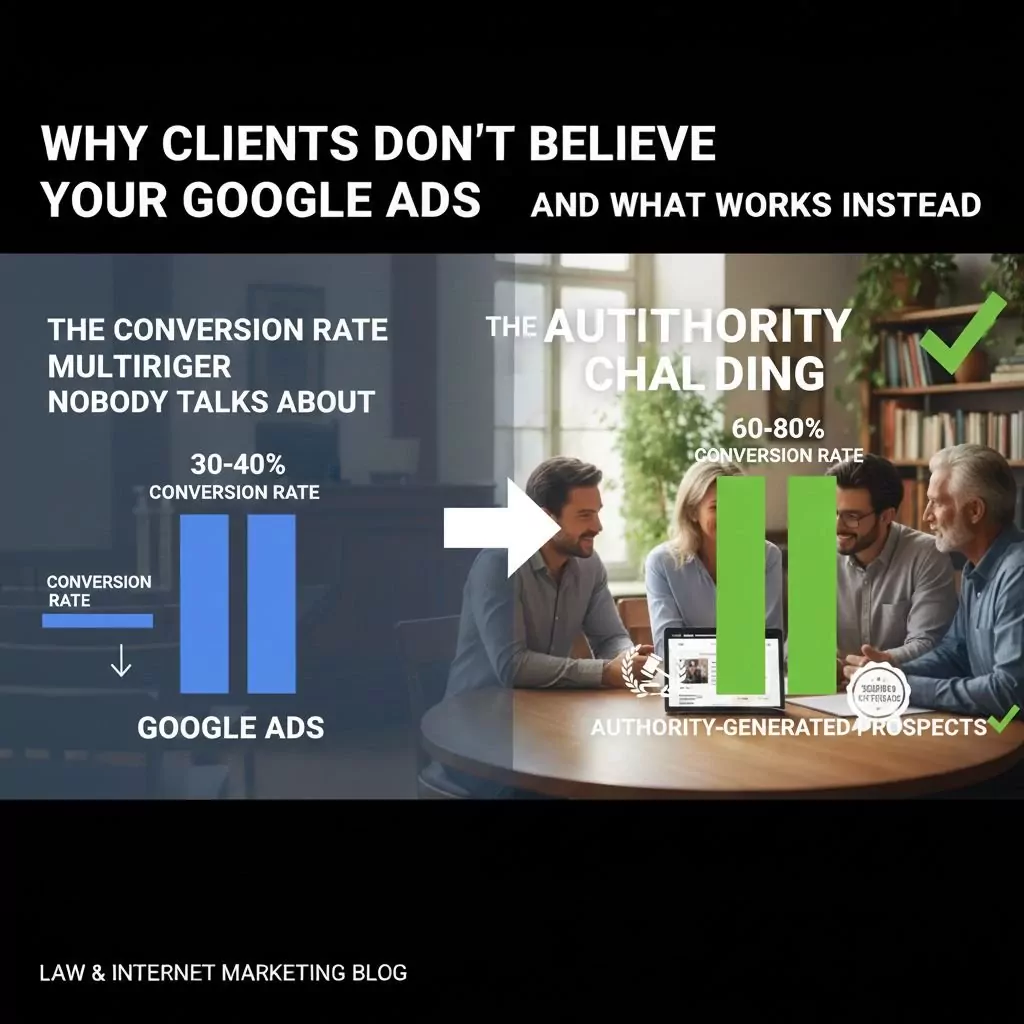
And pre-sold clients convert at 60-80% instead of 30-40%.
Same consultation. Half the effort. Double the retention rate.
The math isn't just better. It's transformative.
One attorney told me: "I used to do 10 consultations to get 3 clients. Now I do 10 consultations and get 7-8 clients. Same practice. Different marketing."
That's what authority building does.
It doesn't just generate leads. It generates qualified, pre-sold leads who already trust you.
The "But I Need Clients Now" Objection
I know what you're thinking:
"This sounds great for the long term. But I have bills to pay now. I can't wait six months to build authority."
Fair.
Here's the truth:
Authority building and paid advertising aren't mutually exclusive.
The smart play isn't "ads or content." It's "ads while building content."
Use Google Ads for immediate lead flow while you're building your authority foundation.
But - and this is critical - reduce your ad spend every quarter as your organic authority grows.
Month 1-3: $3,000 monthly on ads + start publishing weekly content
Month 4-6: $2,000 monthly on ads (organic leads starting to flow)
Month 7-9: $1,000 monthly on ads (organic leads now majority)
Month 10-12: $0-$500 monthly on ads (testing only, not reliant)
This is the transition strategy that protects your income while building sustainable growth.
But most attorneys never make the transition. They stay stuck in the ad dependency cycle because they never invested in the alternative.
Don't be that attorney.
The Real ROI Comparison
Let's do the math over 12 months.
Ad-Dependent Attorney:
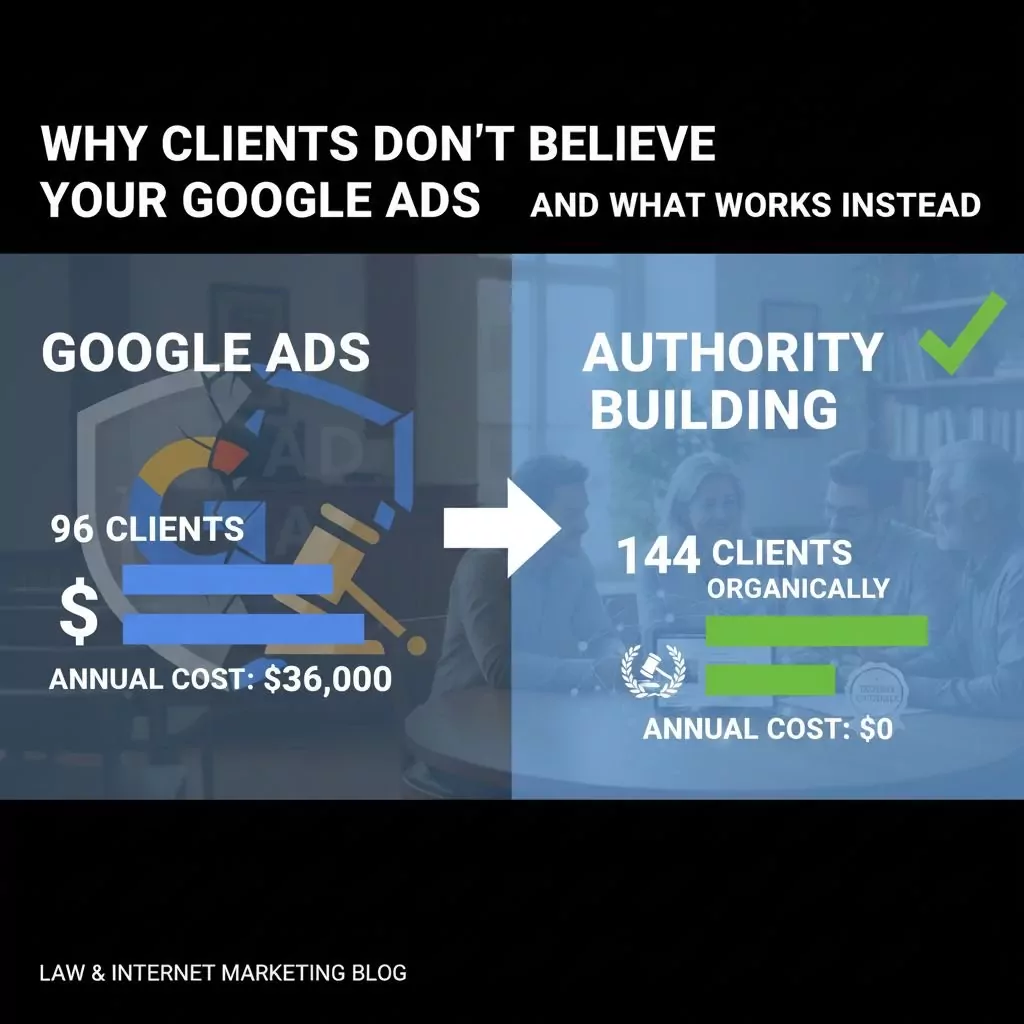
$3,000 x 12 months = $36,000 annual ad spend
~8 clients monthly = 96 annual clients
At $5,000 average case value = $480,000 revenue
$36,000 ad spend = 7.5% of revenue
Stop paying? Leads stop immediately.
Authority-Building Attorney:
$6,000 one-time website optimization (schema, SEO, conversion focus)
$2,000/month content creation (articles, videos, social) = $24,000 annually
First 6 months: 3-5 clients monthly from organic (slower ramp)
Months 7-12: 12-15 clients monthly from organic (compounding effect)
Year 1: ~70 clients from organic (lower than ads initially)
Year 2: 144+ clients from organic (no additional ad spend, momentum building)
At $5,000 average = $360,000 Year 1, $720,000+ Year 2
Stop creating content? Momentum continues for 12-18 months.
The Compounding Difference:
Year 1: Ads win on total clients (barely).
Year 2: Authority wins by 50%+.
Year 3: Authority wins by 200%+.
Year 5: It's not even close.
Because authority compounds. Ads don't.
Every blog post you write works forever. Every video you publish keeps generating views. Every piece of content builds on the last.
This creates the Authority Flywheel effect - where content generates clients, who leave reviews and refer others, which strengthens your authority, attracting even better clients in a compounding cycle that accelerates over time.
Meanwhile, ads stop the second you stop paying.
That's the difference between renting attention and owning authority.
How to Start Building Trust Today
You don't need to overhaul everything overnight.
Start with these three steps:
Step 1: Stop Apologizing for Not Running Ads
Ads aren't a prerequisite for success. They're one tactic among many - and increasingly, not even the best one.
But your website needs to convert the traffic your authority generates - the Local Lead Machine Site combines conversion-focused design with AI-ready structure to turn visitors into consultation requests automatically.
Step 2: Publish Your First Educational Article
Pick the question you answer most often in consultations. Write 1,500 words explaining it clearly. Publish it on your blog.
That's your trust foundation.
Step 3: Add Schema Markup to Your Site
If AI can't read your credibility signals, you're invisible in AI search.
Schema markup costs $299-$600 one-time. It works forever.
Stop losing AI-generated referrals because your site speaks the wrong language.
Our Local SEO service includes schema implementation, weekly blog content, and technical optimization that gets attorneys found when prospects search - without paying per click.
That's it. Three actions. No massive budget. No agency retainer.
Just a commitment to building authority instead of renting attention.
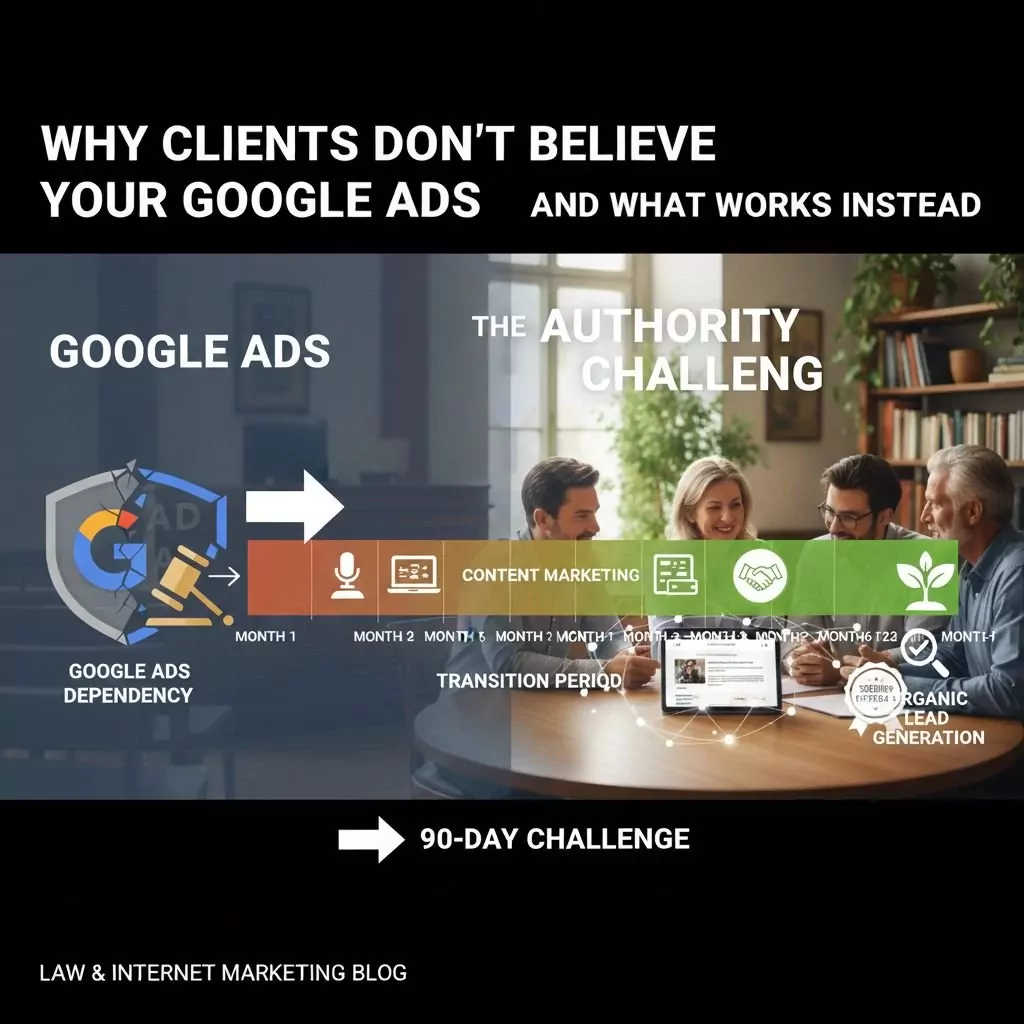
The 90-Day Authority Challenge
Here's what happens when you commit to authority building for 90 days:
Week 1-4:
Publish 4 blog posts (one weekly)
Optimize site with schema markup
Start one social media platform consistently
Week 5-8:
Publish 4 more blog posts
Add 2-4 short videos (if comfortable)
Engage with comments and questions
Week 9-12:
Publish 4 more blog posts
Increase video consistency (or consider ClipCred for scale)
Start seeing organic consultation requests
Results after 90 days:
12 published articles answering real client questions
8-16 video assets (if pursued)
2-5 organic consultation requests
Foundation built for compounding growth
Most importantly: You've created assets that work forever. Not ad spend that evaporates.
When Ads Actually Make Sense (Yes, Sometimes)
I'm not anti-advertising. I'm anti-dependency.
There are legitimate scenarios where Google Ads make strategic sense:
1. New Practice Launch
You just opened. You have zero organic presence. You need cash flow now.
Ads can bridge the gap while you build authority. Just don't stay dependent.
2. Seasonal Services
If you handle specific case types with seasonal demand (tax fraud during tax season), targeted ad campaigns make sense.
But only as a supplement to year-round authority.
3. Competitive Testing
Want to test messaging before creating content around it? Ads give you fast feedback.
But once you know what works, shift to organic content creation.
4. Retargeting Warm Traffic
If someone visited your site from organic search, retargeting ads can be effective.
You're not buying cold traffic - you're staying visible to people who already showed interest.
The rule: Use ads strategically, not dependently.
The moment ads become your only lead source, you're in a dangerous position.
The Future Is Authority, Not Advertising
Here's where legal marketing is headed:
AI search will dominate within 3-5 years. Google's market share is already declining.
ChatGPT, Claude, Perplexity - these are where prospects research now.
And none of them prioritize paid advertising. All of them prioritize demonstrated authority.
The attorneys who see this shift coming and invest in authority today will own their markets tomorrow.
The attorneys who keep dumping money into ads will wake up in 2028 wondering where all their leads went.
You get to choose which attorney you want to be.
The trust deficit isn't going away. It's getting worse.
But it's also creating the biggest opportunity in legal marketing in 20 years.
Because while everyone else is still renting attention, you can own authority.
And in a world where prospects don't trust ads, authority is the only currency that matters.
Ready to Build Authority That Replaces Your Ad Budget?
You don't need to figure this out alone.
Here's what we do at GSD Local:
✅ Schema Markup ($299 one-time) - Make your expertise visible to AI search
✅ Local SEO - Get found when prospects search (without paying per click)
✅ ClipCred Video System - 25-30 monthly videos from one interview
✅ Strategic Copywriting - Website copy that builds trust and converts
Stop renting attention. Start owning authority.
📞 Schedule Your Free Strategy Call
(509) 433-7730
We'll show you exactly where you're losing trust - and how to rebuild it without depending on ads.
Frequently Asked Questions
Why does paying for Google Ads make prospects trust me less instead of more?
Google Ads trigger automatic discounting - a psychological defense mechanism where your brain immediately questions credibility when someone paid to appear. When prospects see "Sponsored" or "Ad" labels, they think "of course they claim expertise, they paid to say that," creating skepticism before they read a single word of your message. This isn't conscious distrust; it's subconscious pattern recognition protecting them from promotional manipulation after years of exposure to exaggerated advertising claims.
The psychological mechanism works like this: paid placement signals "this person needed to buy attention rather than earn it through merit," while organic placement signals "enough people found this valuable that it rose naturally to the top." Your prospect's brain evolved to distinguish authentic signals from manipulated ones, and ads scream manipulation regardless of your actual competence or intentions.
Research in behavioral economics shows consumers discount advertised claims by 40-60% compared to identical claims from editorial sources. When your ad says "expert DUI defense," prospects mentally translate that to "they claim expertise but who knows if it's true." When organic content demonstrates expertise through helpful explanation, prospects think "they just helped me understand something complex, they must actually know this."
The trust deficit compounds in legal services where stakes are extraordinarily high - prospects aren't buying shoes they can return, they're choosing representation affecting their freedom, finances, or family. High-stakes decisions trigger maximum skepticism toward paid promotional messages while rewarding demonstrated competence through helpful content that proves expertise rather than claiming it.
This explains why your $3,000 monthly ad spend generates minimal consultations despite decent click volume - clicks measure curiosity, not trust. Prospects click to see what you say, then immediately discount it because you paid to say it. Meanwhile, competitors publishing helpful blog posts generate fewer total visitors but convert 3-5X better because educational content builds trust while ads destroy it.
How GSD Local Marketing helps: Our authority building approach eliminates ad dependency through systematic expertise demonstration - weekly blog content answering real prospect questions, ClipCred video system creating 25-30 monthly videos from one interview showing genuine knowledge, and schema markup making your demonstrated expertise visible to AI systems prospects increasingly use for recommendations. This generates pre-sold consultation requests from prospects who already trust you rather than skeptical clicks from people who discount everything you say.
What's the actual cost per client when factoring in consultation-to-retention conversion rates most attorneys ignore?
Most attorneys calculate Google Ads ROI using cost-per-click or even cost-per-consultation, but the real metric determining profitability is cost-per-retained-client when you account for consultation-to-retention conversion rates that drop dramatically with ad-generated leads versus authority-generated leads. Ad clicks convert to consultations at 2-4%, then those consultations convert to retained clients at 30-40%, creating compound inefficiency that explodes your true acquisition cost far beyond what dashboards show.
Here's the brutal math: $3,000 monthly spend ÷ $75 average CPC = 40 clicks. Those 40 clicks × 3% consultation rate = 1.2 consultations. Those 1.2 consultations × 35% retention rate = 0.42 retained clients monthly, or roughly 5 clients annually per $3,000 monthly spend. That's $36,000 annual ad spend generating 5 clients, equaling $7,200 cost-per-retained-client before counting your consultation time with the 95% who didn't retain you.
If your average case value is $5,000, you spent $7,200 acquiring a $5,000 client - you're losing money on every ad-generated client before accounting for case costs, overhead, or your time. The dashboard shows clicks and conversions looking decent, but the business math shows you're funding a loss leader hoping volume compensates for negative unit economics.
The hidden cost nobody tracks: low-trust ad clicks generate price-shopping consultations from prospects calling 8-10 attorneys comparing costs, not evaluating fit. You spend 30-45 minutes on consultations that were never going to retain because they're optimizing for cheapest, not best. That's 15-20 hours monthly of uncompensated consultation time with tire-kickers - another $3,000-$5,000 opportunity cost if you value your time at $200/hour.
Compare this to authority-generated leads: organic content attracts 8-12% consultation conversion (prospects self-qualify before calling), then 60-80% retention rates (they already trust you from content). Same $3,000 invested in content creation generates 15-20 monthly consultations converting to 12-15 retained clients - $200-$250 cost-per-retained-client, a 97% reduction in acquisition cost while generating 3X more clients.
How GSD Local Marketing helps: We implement complete cost-per-retained-client tracking showing your actual acquisition economics, not vanity metrics like clicks or impressions. Our Local SEO service with weekly blog content generates qualified consultation requests from pre-sold prospects who convert at 60-80% instead of skeptical ad clicks converting at 30-40%, reducing your true client acquisition cost by 90%+ while eliminating uncompensated consultation time with tire-kickers who were never going to retain anyway.
Why do prospects who find me through content convert better than prospects who click my ads?
Content-sourced prospects arrive pre-sold through educational consumption that demonstrated your expertise before they ever contacted you, creating asymmetric trust where they already believe you're competent while ad-sourced prospects arrive skeptical requiring you to prove competence during consultation rather than just discussing their case. This pre-qualification difference means content prospects show up thinking "will they take my case" while ad prospects show up thinking "are they actually any good."
The psychological journey differs completely: ad-click prospects see your paid message, feel skepticism, click anyway out of curiosity or desperation, arrive at your website still questioning credibility, submit contact form while researching 5-10 other options simultaneously. They're interviewing you, not hiring you. Content-discovery prospects find your blog post answering their exact question, read 1,200 words of helpful explanation demonstrating expertise, click through to see what else you've written, consume 2-3 more pieces proving consistent knowledge, then submit contact form thinking "I want this person representing me."
The conversion rate gap is massive: ad prospects convert at 30-40% because two-thirds still doubt your competence despite the consultation. Content prospects convert at 60-80% because they've already decided you're credible - the consultation just confirms fit, answers specific questions, and formalizes engagement. This isn't small optimization; it's the difference between struggling to convince skeptics versus welcoming pre-sold clients who chose you before calling.
Beyond conversion rates, content-sourced clients are better clients: they're less price-sensitive because they value expertise over cost, they're more compliant with your process because they trust your guidance, they leave better reviews because they arrived with high expectations you easily meet, and they refer more frequently because consuming your content made them feel smart - they want friends to benefit from "their attorney who publishes all this helpful stuff."
The compounding effect: ad-sourced clients generate transactional relationships focused on immediate problem resolution. Content-sourced clients generate relational partnerships where they view you as trusted advisor, leading to repeat business, referrals, positive reviews, and testimonials - all of which strengthen your authority attracting more content-sourced clients in a positive flywheel while ad-sourced clients provide one-time revenue requiring constant ad spending to replace.
How GSD Local Marketing helps: ClipCred creates the content depth that pre-sells prospects before they contact you - 25-30 monthly videos from one interview demonstrating expertise through natural Q&A, published across all platforms prospects search. This builds the educational trust foundation that converts at 60-80% instead of 30-40%, while premium copywriting services structure your website content to accelerate trust-building for prospects in research mode, transforming skeptical browsers into pre-sold consultation requests.
How does AI search change the paid advertising equation for attorneys in 2026?
AI search platforms like ChatGPT, Claude, and Perplexity generate recommendations based on demonstrated expertise signals—published content, reviews, credentials, structured data - making your Google Ads completely invisible because AI systems don't monetize through advertising and prioritize editorial credibility over paid promotion. When prospects ask "who's the best DUI attorney near me," AI analyzes content authority, review velocity, schema markup, and expertise demonstration to generate confident recommendations, and paid advertising provides zero signals in any of those categories.
The market shift is already measurable: Google search volume declining 15-20% year-over-year as AI chat interfaces capture research queries. Prospects no longer Google "what happens at DUI hearing" - they ask ChatGPT, which generates comprehensive answers and recommends attorneys based on who published helpful content explaining those processes. Your $3,000 monthly Google Ads budget becomes worthless for this growing segment of prospect research happening entirely outside Google's ecosystem where ads exist.
AI recommendation requirements fundamentally differ from ad visibility requirements: ads need keywords, bids, and daily budgets. AI needs structured data through schema markup proving your credentials are verifiable, published content demonstrating expertise through helpful explanation, review velocity showing recent client satisfaction, and entity recognition making you discoverable as "criminal defense attorney" not just "lawyer." These are one-time optimization investments providing permanent AI visibility, not recurring costs providing temporary ad placement.
The invisible competition: while you buy Google Ads at $75-$150 per click, competitors optimized for AI search capture prospects asking conversational questions to AI assistants who recommend based on expertise signals. Those prospects never see your ads because they never used Google - they got answers and recommendations from AI, called the recommended attorney, and became clients without your practice ever entering consideration despite your ad spend.
Strategic adaptation: attorneys dominating 2026-2027 markets are those who shifted ad budgets toward AI optimization investments in 2024-2025, building the content libraries, review systems, and technical infrastructure that makes AI confidently recommend them. Attorneys still dependent on Google Ads are experiencing declining ROI without understanding why - their target market moved to platforms where they're invisible regardless of ad spending.
How GSD Local Marketing helps: Our schema markup implementation makes your expertise visible to AI systems through structured data they can parse and cite, while ClipCred content library gives AI the demonstrated expertise signals required for confident recommendations. We track AI visibility separately from Google visibility, showing you exactly where prospects are finding competitors through AI recommendations while your ad budget captures diminishing Google-only traffic, then systematically close that gap before your market share evaporates to AI-optimized competitors.
What happens to my lead flow if I stop Google Ads before building alternative lead sources?
Immediate lead flow collapse - consultation requests drop 70-90% within 30 days because you've created complete dependency on rented attention that evaporates the moment you stop paying, leaving zero organic discovery mechanisms to sustain lead generation while you scramble to rebuild pipeline. This is the trap of ad dependency: ads produce immediate but fragile results, creating the illusion of successful marketing while preventing investment in durable lead generation that would make ads unnecessary.
The panic cycle works like this: you stop ads to "test" organic performance, leads dry up immediately, revenue stress forces you to restart ads within 2-3 months, you conclude "ads are essential" when the real conclusion is "I have no alternative lead sources so ads are my only option." This prevents you from ever escaping the expensive dependency cycle because you never commit long enough to build the alternative.
The financial math is punishing: $36,000 annual ad spend generates consistent lead flow but zero equity - you own nothing, build nothing permanent, create nothing that works when you stop paying. Compare this to $24,000 invested in content creation over 12 months: first 3-6 months generate minimal leads (painful but predictable), months 6-9 show organic leads emerging as content compounds, months 9-12 deliver majority lead flow from content while ads become optional, and months 13+ generate superior lead volume from content that cost nothing additional because the content works perpetually.
The strategic mistake: treating this as either/or rather than transition. Smart attorneys don't stop ads cold turkey - they reduce gradually while building authority systematically. Month 1-6: full ad budget ($3,000) + content investment ($2,000) = $5,000 monthly, generating leads from ads while content builds. Month 7-12: reduced ads ($1,500) + content investment ($2,000) = $3,500 monthly, generating 50/50 split between ad and organic leads. Month 13-18: minimal ads ($500 retargeting only) + content investment ($2,000) = $2,500 monthly, generating 80% organic leads. Month 19+: zero ads, $2,000 content investment, 100% organic leads plus compounding referrals from satisfied content-sourced clients.
The commitment requirement: you must fund both simultaneously for 9-12 months to execute the transition successfully. Most attorneys won't or can't, keeping them trapped in ad dependency forever. But attorneys who make the 12-month commitment emerge with permanent lead generation infrastructure that improves monthly rather than expensive ad dependency that costs the same forever while generating declining returns.
How GSD Local Marketing helps: We implement the proven transition strategy protecting your lead flow while building durable authority - phased ad reduction coordinated with content publication schedules, monthly tracking showing organic lead volume increasing as you reduce ad spend, and clear milestones showing exactly when you've built sufficient organic momentum to eliminate ads completely. This prevents panic reversals while ensuring you don't stay ad-dependent longer than necessary, systematically moving you from rented attention to owned authority over 12-18 months.
Why does "set it and forget it" Google Ads management fail compared to active authority building?
Google Ads require constant optimization, bid adjustments, keyword refinement, negative keyword additions, ad copy testing, and landing page improvements to maintain even mediocre performance, making "set it and forget it" management a recipe for wasted budget as competitors optimize aggressively and platform algorithms change monthly. Meanwhile, authority content provides compounding returns with minimal ongoing optimization - one well-written blog post generates leads for years without touching it again, creating asymmetric effort-to-value where content rewards initial quality while ads punish maintenance neglect.
The degrading returns problem: your ad campaign performs decently month one because you optimized it initially. Month two, a competitor raises their bids and your ad position drops without you noticing. Month three, Google changes algorithm priorities and your previous optimization becomes counterproductive. Month six, you're paying 40% more per click for 60% fewer conversions because the competitive landscape evolved while your "set it and forget it" campaign stayed static, bleeding budget without anyone actively monitoring and adjusting.
Ad platforms intentionally create maintenance dependency - they profit when you constantly optimize and test, so they've built systems requiring ongoing attention to prevent performance collapse. Google Ads dashboards hide true profitability by showing vanity metrics (impressions, clicks) rather than business metrics (cost-per-retained-client, lifetime value). You think performance is stable because clicks stay consistent, not realizing your cost-per-client doubled because conversion rates tanked from changing prospect behavior or increased competition.
Authority building works inversely: more effort upfront, minimal maintenance forever. Writing one comprehensive 2,000-word blog post takes 4-6 hours initially. But that post ranks in Google, gets shared socially, attracts organic links, generates consultation requests, and compounds value monthly for years with zero additional optimization. After 12 months, that one post generated 15-20 consultation requests worth $75,000-$100,000 in retained clients, while the $3,000 you spent on ads that month generated 0.4 clients worth $2,000 - content delivered 40X better ROI for the same effort.
The psychological trap: ads feel active because you're constantly spending and seeing activity in dashboards. Content feels passive because you publish once and move on. But "active" doesn't equal "effective" - constantly burning budget on declining-ROI ads is expensive busy work, while "passive" content compounds quietly in the background generating better leads at lower cost forever. Most attorneys conflate activity with progress, staying trapped in expensive ad maintenance cycles while competitors build content libraries that work perpetually.
How GSD Local Marketing helps: Our Local SEO service with weekly blog content eliminates the false choice between active ad management and passive content - we handle ongoing content creation maintaining publication consistency while each piece works perpetually, and ClipCred automates video content creation from monthly interviews distributing 25-30 videos without ongoing effort from you. This gives you compounding content returns without the maintenance burden, while we simultaneously analyze your ad performance identifying degrading returns before they devastate your budget, systematically transitioning you from expensive active maintenance to profitable passive compounding.
How do I know if content marketing will actually work for my specific practice area and market?
Content marketing works universally for professional services where prospects make high-stakes decisions requiring trust - which describes every legal practice area - because the higher the stakes, the more research prospects conduct, and the more research they conduct, the more opportunities you have to demonstrate expertise through helpful content they discover during that research process. The question isn't "will it work" but "how long until it generates majority lead flow" which varies by market competitiveness and content consistency.
The stake-to-research correlation is direct: traffic ticket defense (low stakes) prospects do minimal research and often choose based on price and convenience, making ads relatively effective. DUI defense (medium-high stakes) prospects research extensively because consequences are severe, making content extremely effective for demonstrating expertise. Immigration (very high stakes) prospects research obsessively because outcomes determine their entire future, making comprehensive content the only way to build trust justifying $10,000+ retainers from people who've never met you.
Market competitiveness affects timeline but not effectiveness: saturated markets (10+ attorneys targeting same prospects) mean content takes 12-18 months to dominate because you're competing with established content libraries. Underserved markets (2-3 attorneys targeting same prospects) mean content dominates in 6-9 months because minimal competition exists. But both markets eventually deliver superior ROI versus ads - competitive markets just require patience and consistency to overcome established competitors while underserved markets reward early movers with market dominance.
The validation framework: track three metrics monthly over 12 months. (1) Organic website traffic - should increase 15-25% monthly once content reaches critical mass around month 5-6. (2) Consultation source - prospects saying "I found you through your article about X" should appear by month 3-4 and increase monthly. (3) Consultation conversion rate - should improve from 30-40% (ad-sourced baseline) to 60-80% (content-sourced target) by month 9-12. If these three metrics trend correctly, content is working even if absolute lead volume hasn't replaced ads yet - you're building momentum that will eventually dominate.
The failure modes are always execution, never strategy: content marketing fails when attorneys publish inconsistently (monthly instead of weekly), write promotional content instead of helpful content (selling instead of teaching), stop after 4-6 months before reaching compounding phase, or never implement schema markup making content invisible to AI systems. Content marketing succeeds when attorneys commit to 52 blog posts minimum (one weekly for one year), focus on answering real prospect questions, persist through the 6-9 month valley where effort exceeds results, and optimize technically for both traditional and AI search.
How GSD Local Marketing helps: We eliminate execution risk through systematic done-for-you content creation - our writers research your practice area identifying exact questions prospects ask, create weekly SEO-optimized articles answering those questions helpfully, and publish consistently regardless of your availability. ClipCred handles video content through monthly interviews requiring just 60 minutes of your time monthly. Schema markup optimization makes everything discoverable to AI systems. This removes "will it work" uncertainty by guaranteeing the execution consistency that makes content marketing deliver results, letting you focus on serving clients while we handle the authority building that eliminates your ad dependency.
GSD Local Marketing
130 11th St NE
East Wenatchee, WA 98802
(509)-433-7730
Follow Us On
© 2026 GSD Local Marketing