NETENGINE
YOUR COMPETITOR SCORES 84, YOU SCORE 23 (AND YOU'RE MORE QUALIFIED)
Why AI Recommends Your Competitor (Even Though You're Better)
Close the 5 Verification Gaps Before Competitors Lock Up Your Market
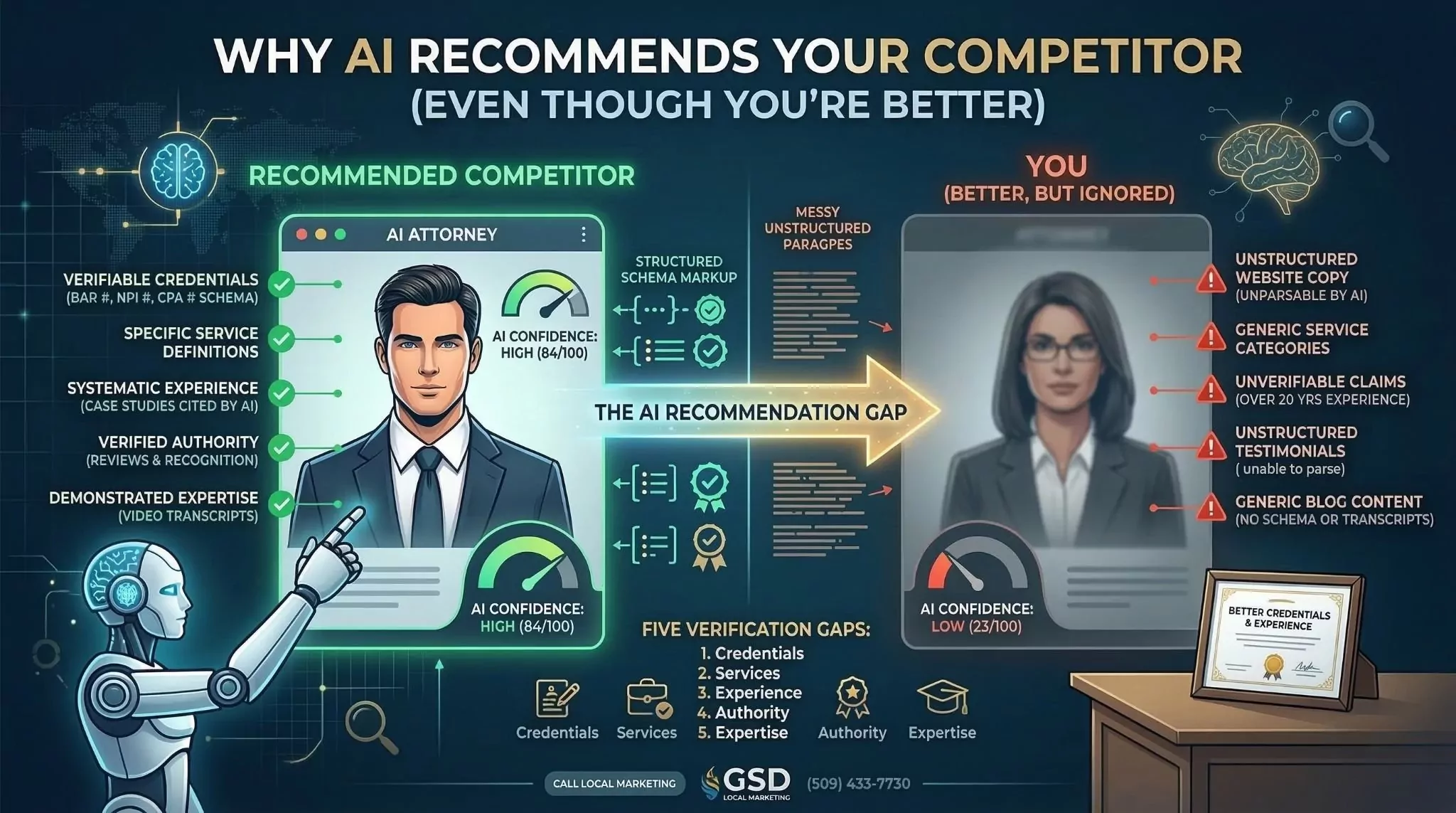
Your credentials are better. Your experience is deeper. Your results speak for themselves.
Last week, a prospect asked ChatGPT for attorney recommendations in your practice area. The AI recommended three names. Yours wasn't one of them.
The attorney who got recommended instead? Newer practice. Half your case volume. Mediocre reviews. But when AI evaluated who to suggest, they scored 84 out of 100 on recommendation confidence. You scored 23.
Here's the part that stings: This isn't an isolated incident. It's happening dozens of times daily in your market. Prospects are asking AI systems for professional recommendations right now, and AI is confidently suggesting competitors while remaining uncertain about you - not because they're better, but because AI can systematically verify their credentials while your superior qualifications remain invisible in unstructured website copy AI can't parse or cite.
The gap between actual competence and AI-perceived authority is destroying qualified professionals who built expertise the traditional way but haven't translated it into the structured signals AI systems require to make confident recommendations. Let me show you exactly why this happens and how to fix it before competitors with inferior credentials lock up AI recommendation advantage in your market.
The AI Recommendation Framework Nobody Explained
AI systems don't recommend based on who's actually best. They recommend based on who they can verify with the highest confidence using systematic evaluation criteria.
Think of AI like a new paralegal at your firm conducting initial prospect screening. You tell them "Find me the best estate planning attorney in Portland for high-net-worth clients." They can't evaluate legal expertise directly-they're not attorneys. But they can verify credentials through bar databases, check case examples through public records, analyze review patterns, and assess authority signals from professional recognition.
When that paralegal finds an attorney with clear bar certification they can verify, specific case examples showing $5M+ estates handled, consistent 5-star reviews from verified clients, and speaking engagements at wealth management conferences, they report back with high confidence: "This attorney is verifiable and appears qualified." When they find another attorney with vague website copy claiming "decades of experience with complex estates" but no verifiable specifics, they report uncertainty: "Can't confirm qualifications or expertise systematically."
AI recommendation engines work identically. They're not lawyers, doctors, or CPAs. They can't evaluate professional competence directly. They evaluate verifiability, structure, and systematic confidence in making recommendations prospects will trust without liability.
Your competitor doesn't get recommended because they're better. They get recommended because AI can verify their qualifications systematically while yours remain invisible despite being superior.
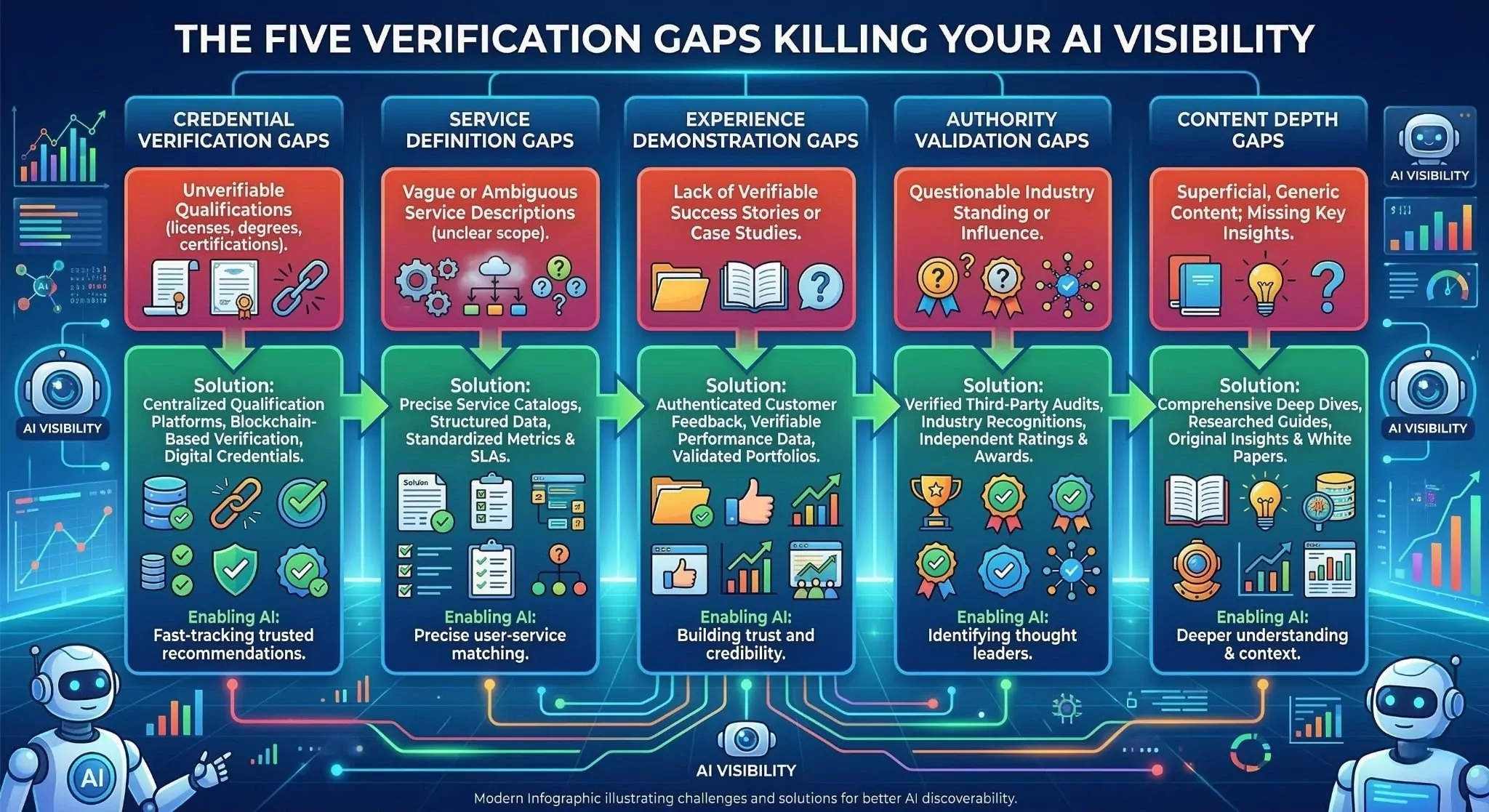
The Five Verification Gaps Killing Your AI Visibility
Gap 1: Credential Verification (The Foundation)
Your website says "Board Certified Estate Planning Attorney with extensive experience in high-net-worth estate administration."
AI sees: Unverifiable claim requiring manual investigation.
Your competitor's website has an attorney schema with bar number, certification dates, jurisdiction listings, and structured credentials linking to a state bar database.
AI sees: Verifiable credentials confirmed through external authoritative sources. Recommendation confidence: High.
The difference isn't actual credentials-you likely have identical or better certification. The difference is verifiability through structured data AI can systematically confirm. Without schema markup providing bar numbers and jurisdiction details, AI treats your credentials as marketing claims requiring manual verification it won't perform. Your competitor's structured credentials get instantly verified through database cross-referencing, establishing a foundation for confident recommendation.
How to fix: Implement professional schema markup with verifiable credential details. Attorney schema includes bar number and jurisdictions. Physician schema includes NPI number and board certifications. CPA schema includes license number and certifications. AI verifies these through external databases automatically, establishing credential foundation required for any recommendation consideration.
Gap 2: Service Definition Specificity (The Matching)
Your services page lists "Estate Planning, Trust Administration, Probate Services, Asset Protection."
AI sees: Generic service categories matching 40+ local competitors. Unable to differentiate or match to specific prospect needs.
Your competitor has service schema defining "High-Net-Worth Estate Planning" with minimum estate value ($3M+), specific trust types offered (revocable living trusts, irrevocable life insurance trusts, charitable remainder trusts), tax planning services included (estate tax minimization, generation-skipping transfer tax planning), and typical client profile (business owners, executives, inherited wealth recipients).
AI sees: Specific service matching prospect's exact needs with defined scope and client profile. Recommendation confidence: High for matching prospects.
The difference isn't services offered-you handle identical cases. The difference is AI's ability to match prospect needs to your specific expertise. Generic service listings force AI to guess whether you handle their specific situation. Structured service definitions with scope, client profile, and expertise details let AI confidently match prospects to your exact specialization.
How to fix: Implement service schema with specific definitions including client profile, scope parameters, typical case characteristics, and expertise details. Instead of "Estate Planning" use "High-Net-Worth Estate Planning for Business Owners and Executives" with structured details AI can match to prospect queries about specific situations and needs.
Gap 3: Experience Demonstration (The Proof)
Your about page says "Over 20 years handling complex estate planning matters for high-net-worth individuals and families throughout the Pacific Northwest."
AI sees: Unverifiable experience claim with no specific examples or measurable outcomes. Trust level: Low.
Your competitor has case study schema showing "Estate Planning for $8.5M Business Owner Estate" with challenge description (complex business succession with three children and charitable giving goals), solution approach (combination irrevocable life insurance trust with charitable lead trust), outcome achieved (estate tax liability reduced from estimated $2.8M to $340K while preserving family business control), and timeframe (18-month implementation). No names, no confidential details, just structured proof of capability.
AI sees: Verifiable experience handling specific case types with measurable outcomes. Trust level: High. Citation-worthy for similar prospect needs.
The difference isn't experience-you've handled dozens of similar cases. The difference is demonstrated proof AI can cite when recommending you. Generic experience claims are marketing copy. Structured case examples with challenge-solution-outcome format provide AI with citable evidence supporting confident recommendations for similar situations.
How to fix: Create case study schema for representative client situations (anonymized, no confidential information). Structure: Challenge faced, solution approach, outcome achieved, timeframe. Three to five case studies covering your core service areas provide AI with specific citation-worthy examples demonstrating proven capability instead of unverifiable claims.
Gap 4: Authority Validation (The Endorsement)
Your website has testimonials page with 15 client reviews averaging 4.9 stars with comments like "Excellent attorney, very knowledgeable and professional."
AI sees: Unstructured testimonials without verification, dates, or systematic rating data. Unable to systematically evaluate or cite as authority signals.
Your competitor has review schema with aggregate rating (4.8 stars from 43 verified reviews), individual review schema including reviewer role (business owner, retiree, family executor), review date, specific outcome mentioned ("Reduced estate tax burden by $1.2M compared to initial estimate"), and verification status. Additionally, professional recognition schema lists speaking engagements at wealth management conferences with dates, published articles in estate planning journals with links, and bar association leadership roles with terms.
AI sees: Systematically verifiable authority from multiple independent sources. Client satisfaction confirmed through structured reviews. Professional recognition validated through external sources. Recommendation confidence: Very high.
The difference isn't reputation-you have equally satisfied clients and professional recognition. The difference is structured validation AI can systematically evaluate and cite. Unstructured testimonials are marketing copy. Structured review schema with verification, dates, and specifics provides AI with systematically evaluable authority signals. Professional recognition schema with external validation creates multi-source authority AI trusts for confident recommendations.
How to fix: Implement review schema for client testimonials with aggregate rating, individual reviews with dates and reviewer context, and verification where possible. Add professional recognition schema for speaking engagements, published articles, bar association roles, and awards with dates and external validation links. Transform unstructured reputation into systematically verifiable authority AI cites when recommending you.
Gap 5: Content Depth and Expertise Signals (The Knowledge)
Your blog has 8 articles about estate planning topics written in a professional marketing tone explaining general concepts for potential clients.
AI sees: Generic educational content indistinguishable from 50 other estate planning attorney blogs. No unique expertise signals or citation-worthy insights.
Your competitor has 25 video transcripts from ClipCred interviews with article schema, each addressing specific client questions ("What happens to my business if I die without estate plan?", "How do irrevocable trusts reduce estate taxes?", "When should I update my estate plan after divorce?"). Content includes specific examples, technical terminology demonstrating expertise, natural conversational tone showing genuine knowledge, and unique frameworks for thinking about estate planning decisions. Author schema links to bar profile. FAQ schema provides quick answers with detailed explanations.
AI sees: Deep expertise demonstrated through natural explanation, specific examples showing hands-on experience, unique insights citation-worthy for prospect queries, and systematic content structure enabling easy extraction and citation. Expert knowledge verified through tone, terminology, and demonstrated understanding. Recommendation confidence: Very high with specific citation ability.
The difference isn't knowledge-you know everything your competitor knows and probably more. The difference is demonstrated expertise AI can process, evaluate, and cite. Marketing blog posts are generic content. Video transcripts with natural Q&A demonstrate real expertise through conversational explanation AI processes as authentic knowledge. Structured content with article schema, author attribution, and FAQ format provides AI with extractable citation-worthy insights instead of generic information available everywhere.
How to fix: Launch ClipCred creating monthly video content with transcripts demonstrating expertise through natural Q&A format. Implement article schema with author attribution linking to professional profile. Add FAQ schema to content providing structured answers AI can extract and feature. Transform generic marketing content into citation-worthy expertise demonstration AI processes as verifiable knowledge supporting confident recommendations.
The Compound Effect: Why Small Gaps Become Insurmountable Advantages
Here's what makes the AI recommendation gap devastating: It compounds in both directions.
Your competitor gets AI-recommended once based on structured signals. That recommendation generates 3-5 qualified prospect consultations. Two become clients leaving detailed reviews you can't match because they chose your competitor. Those reviews strengthen authority signals making the next AI recommendation even more confident. Video content from consultations with those clients creates additional citation-worthy expertise demonstrations. Professional recognition from speaking about successful cases creates external validation. Six months later, your competitor's AI recommendation score increased from 84 to 94 while yours stayed at 23.
Meanwhile, prospects asking AI for recommendations never hear your name. You get zero AI-driven consultations. Your review volume stays flat. Your content library doesn't grow. Your authority signals remain weak. The gap widens monthly through compound effects favoring early movers who structured their authority signals correctly while penalizing professionals who waited.
This is the Authority Flywheel effect in reverse. Competitors getting AI-recommended early build compounding advantages through increased consultation volume generating more reviews, more case examples, more content opportunities, and more professional recognition creating stronger authority signals making future recommendations even more confident while you remain invisible regardless of superior actual competence.
The window to close this gap shrinks daily. Prospects searching today get recommendations based on current authority signals. Every consultation going to competitors instead of you is revenue lost permanently and authority gap widening through compound effects working against you.
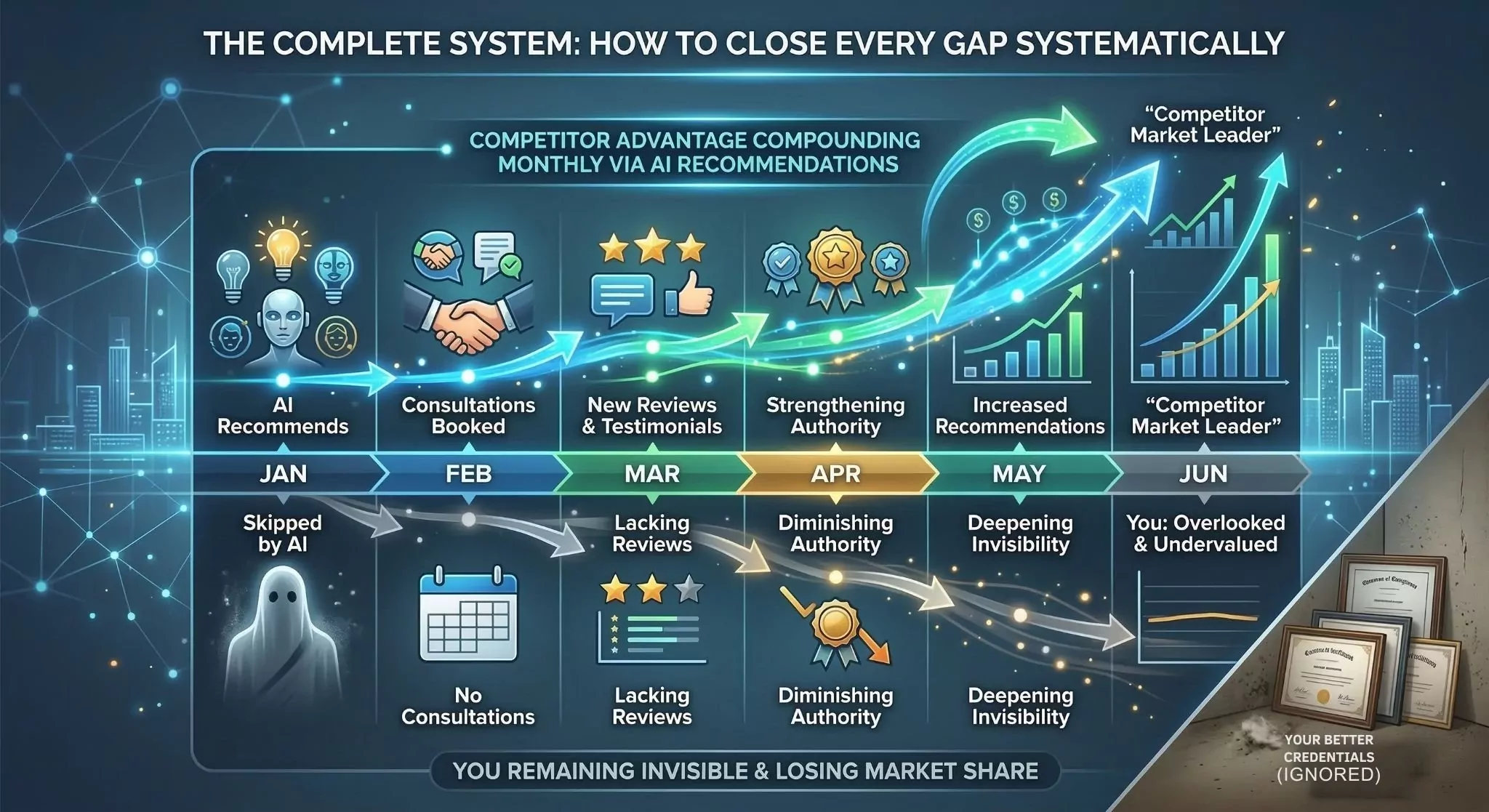
The Complete System: How to Close Every Gap Systematically
Most professionals see five gaps and feel overwhelmed. Where do you start when everything seems equally important and you're running a practice full-time?
Here's the integration approach that works.
Foundation Layer (Week 1): Technical Infrastructure
Implement professional schema markup covering credentials, services, and business information. This single technical implementation closes Gap 1 (credentials) and Gap 2 (services) simultaneously. Cost: $299 one-time. Impact: Immediate improvement in AI's ability to verify and match you to prospect needs. Without this foundation, nothing else matters because AI can't confidently verify you're qualified.
Authority Layer (Weeks 2-4): Proof and Validation
Create 3-5 case study schemas demonstrating experience with specific client situations (Gap 3). Implement review schema for existing testimonials and establish systematic review collection process (Gap 4). Add professional recognition schema for speaking engagements, publications, and bar association involvement (Gap 4). This layer transforms unverifiable claims into structured proof AI cites when recommending you.
Expertise Layer (Ongoing): Content and Demonstration
Launch ClipCred creating monthly video content with transcripts demonstrating expertise through natural Q&A (Gap 5). Each monthly interview generates 25-30 videos with structured content AI can process, evaluate, and cite. Over 60-90 days, video library accumulates creating depth AI recognizes as genuine expertise instead of marketing copy. This layer separates you from competitors through demonstrated knowledge AI processes as authority signals.
Integration Effect: Compound Advantages
Schema markup enables AI verification. Verified credentials generate first recommendations. Recommendations create consultations. Consultations generate reviews strengthening authority. Reviews increase recommendation confidence. Video content demonstrates expertise making citations easier. Citations drive more recommendations. The flywheel accelerates in your favor instead of working against you.
Three months after complete implementation, professionals typically see AI recommendation scores improve from 20-30 range to 75-85 range. That translates to going from never recommended to regularly recommended for relevant prospect queries. Real business impact: 5-10 additional qualified consultations monthly from AI-driven prospects who already trust you based on AI's confident recommendation before first contact.
How GSD Local Marketing helps: We implement the complete system starting with SGE Audit Pro ($97) showing your current gaps across all five verification factors, comprehensive schema implementation ($299) closing technical gaps immediately, strategic case study and review schema development closing proof gaps, and ClipCred launch building ongoing expertise demonstration closing content depth gap. Call (509) 433-7730 for systematic gap closure before competitors lock up AI recommendation advantage in your market permanently.
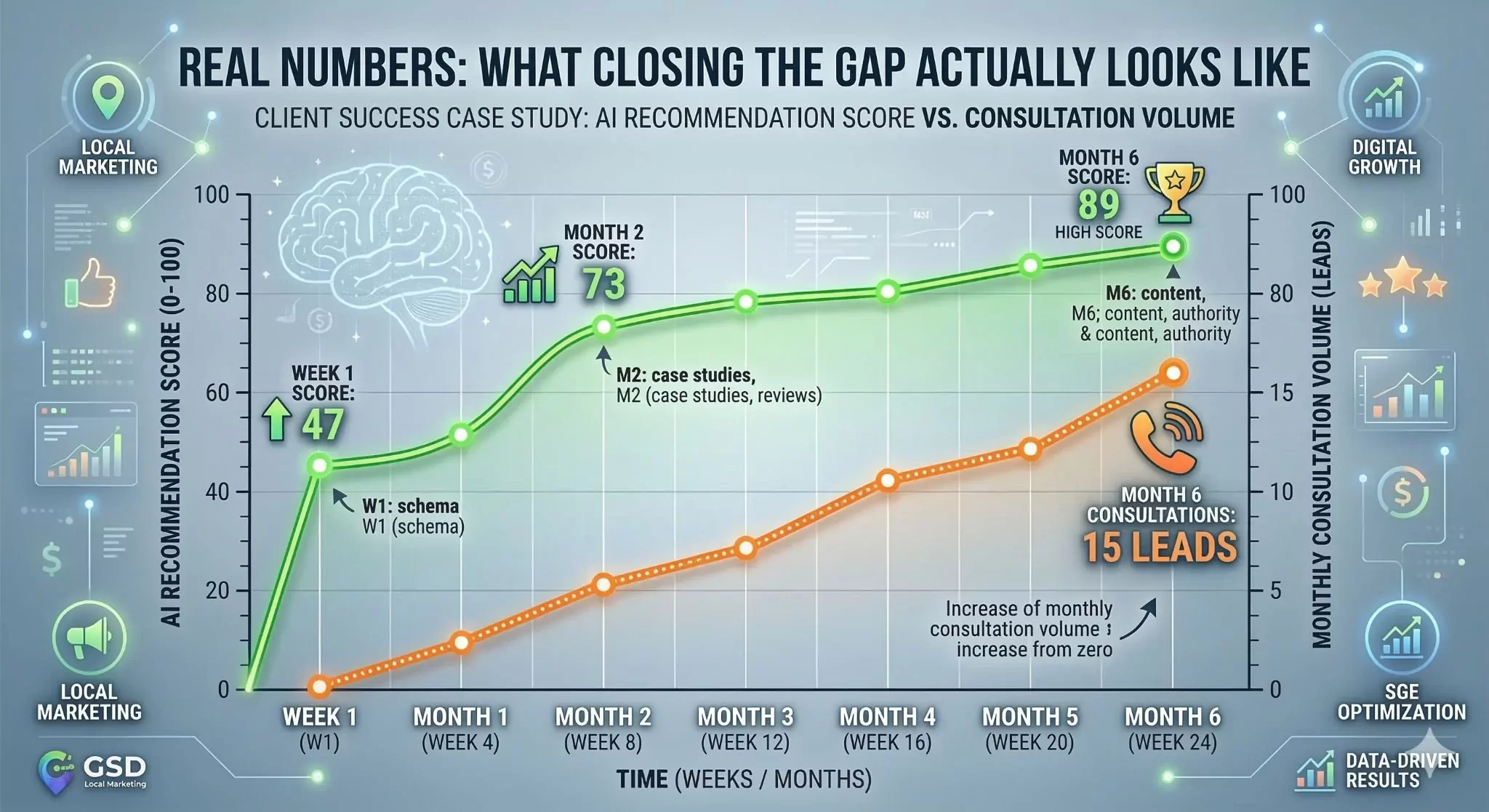
Real Numbers: What Closing the Gap Actually Looks Like
Estate planning attorney, 15 years experience, excellent credentials, strong local reputation. AI recommendation score: 28/100. Zero AI-driven consultations in 90 days before implementation.
Week 1: Schema implementation (credentials, services, business information). The score increased to 47. First AI-driven consultation inquiry within 5 days.
Week 3: Case study schema added (4 representative client situations), review schema implemented (existing testimonials structured), professional recognition schema added (speaking engagements, bar leadership). The score increased to 61. Three additional AI-driven consultations that month.
Month 2: First ClipCred interview completed, 28 videos published with transcripts and structured markup. The score increased to 73. Six AI-driven consultations that month, four became clients.
Month 3: Second ClipCred interview, video library growing, reviews from new clients added with schema. Score increased to 82. Nine AI-driven consultations that month.
Month 6: Score stabilized at 89. Averaging 12-15 AI-driven consultation requests monthly. Closing 60% into clients. Revenue from AI recommendations: $187,000 over six months from channels that previously generated zero.
The competitor who started with an 84 score? Still at 87. Their early advantage was structural, not insurmountable. Strategic systematic gap closure overcame their head start within four months. Now both get AI-recommended regularly, but the attorney who closed gaps systematically actually has a higher confidence score based on more recent authority building and content depth.
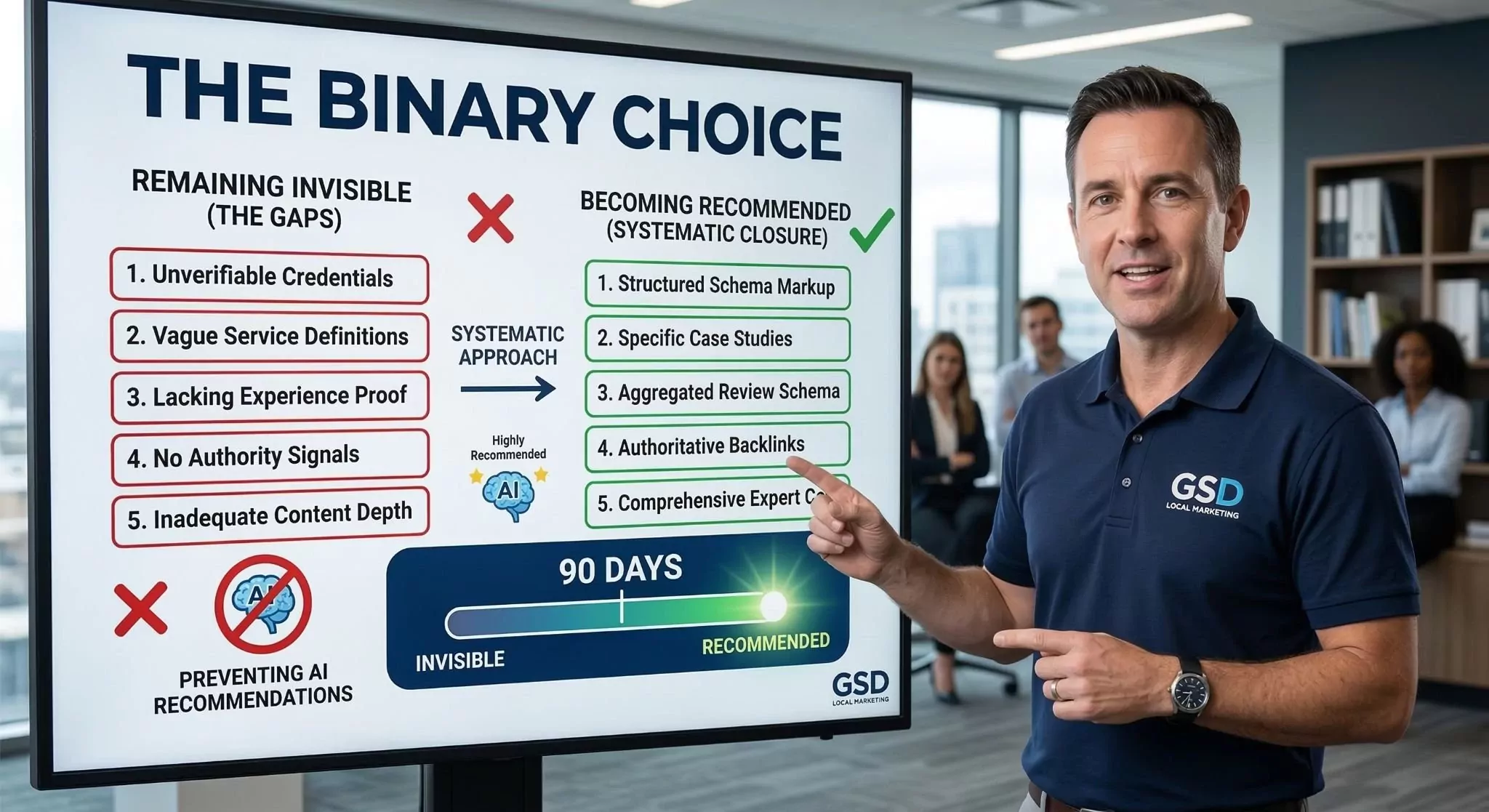
The Binary Choice
Every day prospects in your market ask AI systems for professional recommendations. Right now, while you're reading this, someone is asking ChatGPT, Claude, or Perplexity who they should hire for exactly what you do.
AI is recommending competitors. Not because they're better. Because AI can verify them systematically while you remain invisible despite superior qualifications.
You have two options.
Option 1: Continue operating as if credentials and experience alone matter. Watch as AI-driven prospects-the highest-intent, most qualified leads in your market-go to competitors AI recommends confidently. See your consultation volume stagnate while competitors' calendars fill with AI-referred clients who arrive pre-sold and ready to hire. Experience the compound effect working against you as competitors build authority advantages that become harder to overcome monthly.
Option 2: Close the five verification gaps systematically. Transform invisible credentials into AI-verifiable authority. Structure your expertise so AI can process, evaluate, and cite it confidently. Build the proof signals AI requires to recommend you with high confidence. Create the compound effect working in your favor as AI recommendations generate consultations creating reviews building authority making future recommendations even more confident.
The gap between your actual competence and AI-perceived authority isn't permanent. It's fixable through systematic implementation of structured signals AI requires. But the window shrinks daily as competitors build compounding advantages through early AI recommendation volume.
Prospects are searching today. AI is making recommendations right now. Your competitors are getting recommended while you remain invisible.
How much longer can you afford to be the better professional AI never suggests?
🔍 Get Your AI Recommendation Audit: https://sgeauditpro.com
📞 Close Every Gap Systematically: (509) 433-7730
🌐 GSD Local Marketing: gsdlocalmarketing.com
Stop being better in ways AI can't see.
Start being verifiable in ways AI confidently recommends.
Because in 2026, credentials without structure equal invisibility.
And invisibility equals zero consultations regardless of how qualified you actually are.
Frequently Asked Questions
Why does AI recommend my competitor instead of me even though I'm more qualified?
AI recommends based on verification confidence, not actual competence. Your competitor has structured data AI can systematically verify-attorney schema with bar number, service schema with specific definitions, case study schema with measurable outcomes, review schema with aggregate ratings, and content demonstrating expertise. You have superior credentials in unstructured website copy AI can't parse, verify, or cite confidently.
AI systems function like a paralegal conducting initial screening-they can't evaluate professional expertise directly, so they evaluate what they can verify systematically. When AI finds structured credentials it can confirm through external databases, specific service definitions matching prospect needs, case examples with measurable outcomes, verified reviews from real clients, and demonstrated expertise through natural content, it reports high confidence recommending that professional.
When AI encounters your website with generic marketing copy claiming expertise without verifiable structure, it reports uncertainty: "Can't confirm qualifications systematically, recommendation would be speculative." The gap isn't your actual competence-it's AI's ability to verify you confidently using systematic evaluation criteria.
Five verification gaps create this problem: credential verification through professional schema, service definition specificity through structured scope, experience demonstration through case study schema, authority validation through review and recognition schema, and content depth through video transcripts with article schema. Your competitor closed these gaps systematically. You haven't, making you invisible despite being better.
The business impact is immediate. Prospects asking AI for recommendations receive confident suggestions listing competitors with structured authority. You're never mentioned. Zero AI-driven consultations monthly while competitors' calendars fill with pre-sold prospects arriving ready to hire based on AI's confident recommendation they trust implicitly.
How GSD Local Marketing helps: SGE Audit Pro at sgeauditpro.com reveals your exact AI recommendation score and shows which of the five verification gaps prevent confident AI recommendations. Our schema implementation ($299) closes technical gaps immediately, case study development structures your experience into AI-verifiable proof, and ClipCred creates ongoing expertise demonstrating AI processes as authority signal transforming you from never recommended to regularly suggested for relevant prospect queries.
What is the difference between actual credentials and AI-verifiable credentials?
Actual credentials are your real qualifications-bar certification, board certification, CPA license, years of experience, cases handled, specializations mastered. AI-verifiable credentials are those same qualifications structured with schema markup providing bar numbers, license numbers, jurisdiction details, and certification dates AI can confirm through external authoritative databases.
You and your competitor have identical actual credentials. But your website says "Board Certified Estate Planning Attorney with extensive experience." AI sees unverifiable marketing claims requiring manual investigation it won't perform. Your competitor's website has attorney schema with bar number linked to state bar database, board certification schema with certification date and issuing body, jurisdiction schema listing specific states and courts, and practice area schema defining specializations with scope.
AI verifies your competitor's credentials automatically by cross-referencing the bar number against a state bar database, confirming certification through issuing body records, and validating jurisdiction claims through court records. Verification takes milliseconds returning confidence level: High. Your credentials require manual investigation AI doesn't conduct. Result: Your competitor gets recommended despite identical actual qualifications because AI can verify them systematically.
This applies across all professions. Physicians need NPI numbers and board certification details in schema. CPAs need license numbers and certification types. Specialists need credential verification linking to authoritative databases. Without structured verifiable credentials, AI treats your qualifications as unconfirmed marketing claims regardless of their actual legitimacy.
The fix is straightforward but essential: Implement professional schema markup appropriate to your field with specific credential details AI can verify. Attorney schema, physician schema, accountant schema, or professional schema with credential properties all enable AI verification transforming invisible qualifications into confidently recommendable authority.
How GSD Local Marketing helps: Our schema implementation service handles profession-specific credential structuring with bar numbers, license numbers, certification details, jurisdiction listings, and verification links ensuring AI can confirm your qualifications systematically. This single implementation closes the credential verification gap preventing AI from recommending you despite having identical or superior actual credentials compared to competitors AI suggests confidently.
How do case studies help AI recommend me more confidently?
Case studies transform unverifiable experience claims into structured proof AI cites when recommending you for similar prospect situations. Generic experience statements like "20 years handling complex matters" are marketing copy AI can't verify or cite. Structured case studies with challenge-solution-outcome format provide AI with specific citation-worthy examples demonstrating proven capability.
Case study schema structures your experience into systematic components of AI processes: client situation or challenge (no names, no confidential details-just scenario type), solution approach you implemented showing methodology and expertise, measurable outcome achieved demonstrating results, and timeframe showing realistic implementation expectations. This structure lets AI match prospect situations to your proven experience with specific relevant examples.
When a prospect asks AI "Who handles high-net-worth estate planning for business owners?" and your competitor has a case study showing "$8.5M Business Owner Estate-reduced estate tax liability from $2.8M to $340K using combination irrevocable life insurance trust and charitable lead trust," AI confidently cites this example recommending your competitor for similar situations. You have handled identical cases but without structured proof, AI can't cite specific relevant experience making recommendations speculative instead of confident.
Three to five case studies covering your core service areas provide AI with diverse citation-worthy examples. Choose representative client situations (most common scenarios you handle), structure with challenge-solution-outcome format, include measurable results where possible, and implement proper case study schema. AI processes these as demonstrated expertise proof rather than unverifiable claims.
The compound effect matters: Case studies generate initial AI recommendations for matching situations. Those recommendations create consultations with similar clients. New clients generate additional case examples strengthening your authority for that scenario type. AI recommendation confidence increases making future suggestions even more likely creating a positive flywheel effect.
How GSD Local Marketing helps: We develop strategically chosen case study schemas covering your core service areas with proper challenge-solution-outcome structure, measurable results, and schema implementation AI can process and cite. This transforms vague experience claims into specific citation-worthy proof AI uses when confidently recommending you for prospect situations matching your demonstrated expertise rather than guessing whether you handle their specific needs.
Why does a review schema matter more than just having good reviews?
Review schema transforms unstructured testimonials into systematically verifiable authority signals AI evaluates and cites when determining recommendation confidence. Good reviews on your website are marketing content from your perspective. Structured review schema with aggregate ratings, individual reviews, verification status, and reviewer context are authority signals from independent third parties AI trusts.
Your testimonials page has 15 five-star reviews with comments like "Excellent attorney, very professional, highly recommended." AI sees text on your website with no verification, no dates, no systematic rating data, and no way to evaluate authenticity or significance. Your competitor has a review schema with aggregate rating (4.8 stars from 43 reviews), individual review schema including dates, reviewer role (business owner, retiree, family executor), specific outcomes mentioned, and verification status linking to third-party platforms.
AI processes your competitor's structured reviews as verifiable authority signals-43 independent evaluations averaging 4.8 stars with specific outcomes and verified sources. AI processes your testimonials as unverified marketing content-could be real, could be fabricated, no systematic way to evaluate credibility. When making recommendations, AI weights verifiable authority signals heavily while essentially ignoring unstructured testimonials.
Review schema requirements: Aggregate rating showing overall score and review count, individual reviews with dates and reviewer context, specific outcomes or benefits mentioned where relevant, verification status or links to third-party platforms, and proper schema markup AI can parse systematically. This transforms testimonials from marketing copy into authority signals AI trusts.
Beyond reviews, professional recognition schema matters equally: Speaking engagements at industry conferences with dates and topics, published articles in professional journals with links, bar association or professional organization leadership roles with terms, awards and recognition from credible sources with dates. Multiple independent authority signals from external sources create verification confidence AI requires for strong recommendations.
How GSD Local Marketing helps: We implement comprehensive review schema for existing testimonials with aggregate ratings, individual reviews, dates, and verification links, plus develop systematic review collection process generating ongoing authority signals. We also structure professional recognition schema for speaking engagements, publications, and industry involvement creating multi-source authority validation AI evaluates as strong recommendation confidence indicators across all authority verification factors.
What makes ClipCred video content better for AI recommendations than written blog posts?
ClipCred video transcripts demonstrate genuine expertise through natural conversational explanation AI processes as authentic knowledge rather than marketing copy. Written blog posts are crafted marketing content AI evaluates skeptically. Video transcripts show real-time expertise demonstration through unscripted Q&A AI processes as verifiable knowledge signals.
When you write a blog post about estate planning, every word is a carefully chosen marketing copy optimized for search engines. AI recognizes this as intentional marketing content-potentially accurate but fundamentally promotional. When ClipCred records you answering actual client questions in natural conversation, the transcript captures genuine expertise through spontaneous explanation, specific examples showing hands-on experience, technical terminology used naturally demonstrating deep knowledge, conversational flow proving authentic understanding, and unique frameworks revealing how you actually think about problems.
AI processes these signals differently. Marketing copy gets evaluated as promotional content requiring verification. Natural conversation gets processed as demonstrated expertise-the way you explain concepts, the examples you choose spontaneously, the terminology you use naturally, and the frameworks you apply reveal actual knowledge AI can't fake or fabricate. This generates higher authority confidence for AI recommendations.
Additionally, video content serves multiple verification purposes simultaneously: transcripts provide traditional SEO content, natural Q&A demonstrates expertise for authority evaluation, specific examples create citation-worthy insights for GEO, conversational format matches voice search patterns for VSO, and visual demonstration builds E-E-A-T trust signals. One monthly ClipCred interview generates 25-30 videos optimizing across five AI search types while written blog posts serve maybe two.
The compound library effect matters critically. Your first ClipCred interview creates 25-30 citation-worthy pieces. Month two adds 25-30 more. Month six shows 150+ videos demonstrating consistent expertise depth across your practice area. AI processes this accumulated content library as comprehensive authority signal competitors with occasional blog posts can't match regardless of individual post quality.
How GSD Local Marketing helps: ClipCred transforms one monthly 60-minute interview into 25-30 platform-optimized videos with AI-parseable transcripts, article schema, author attribution, and systematic distribution. This creates ongoing expertise demonstrating AI processes as strong authority signals while building a permanent content library that compounds monthly strengthening your AI recommendation confidence across multiple search types simultaneously rather than isolated blog posts serving limited purposes.
How long does it take to close the AI recommendation gap with a competitor?
Timeline depends on gap size and implementation consistency, but systematic closure typically shows measurable improvement within 30 days and competitive parity within 90-120 days for most professionals implementing the complete system.
Week 1: Schema implementation (credentials, services, business information). Immediate improvement in AI's ability to verify you exist and match prospect needs. Typical score increase: 15-25 points. First AI-driven consultation inquiry often appears within 5-7 days as verification confidence crosses the minimum recommendation threshold.
Weeks 2-4: Case study schema and review schema implementation. Authority signals strengthen through structured proof. Professional recognition schema adds external validation. Typical score increase: Additional 10-20 points. Consultation inquiries increase to 2-4 monthly as AI begins recommending you for matching scenarios with moderate confidence.
Months 2-3: ClipCred content library building. The first interview generates 25-30 videos demonstrating expertise. Second interview doubles library. AI processes growing content depth as increasing expertise signals. Typical score increase: Additional 10-15 points. Consultation volume increases to 5-8 monthly as content citations strengthen recommendations.
Months 4-6: Compound effects accelerate. Growing video libraries, accumulating reviews from AI-driven clients, expanding case study examples, and strengthening authority signals create positive feedback loops. Score stabilizes in competitive range (75-90). Monthly consultation volume from AI recommendations reaches 10-15+ as you achieve recommendation parity with established competitors.
Competitors with 6-12 month head start had structural advantage, not insurmountable lead. Systematic gap closure with complete implementation overcomes early mover advantage within 4-6 months. After that, ongoing content creation and authority building maintain competitive positioning preventing new gap formation.
How GSD Local Marketing helps: We implement the complete system on a proven timeline starting with immediate schema implementation closing technical gaps week one, strategic case study and review schema development weeks 2-4, ClipCred launch creating ongoing content depth months 2+, and continuous optimization maintaining competitive positioning. Call (509) 433-7730 for systematic gap closure transforming you from never recommended to regularly suggested within 90-120 days proven timeline.
Can I close the AI recommendation gap myself or do I need professional help?
Technical implementation requires professional schema expertise and AI optimization knowledge most professionals lack, but strategic content creation (case studies, reviews, video topics) benefits from your direct involvement ensuring authenticity and accuracy.
DIY challenges: Professional schema markup requires understanding profession-specific schema types (attorney schema, physician schema, accountant schema), correct property implementation for AI verification, validation testing ensuring AI can parse correctly, conflict resolution with existing markup, and ongoing maintenance as schema standards evolve. Most professionals attempting DIY implementation make critical errors preventing AI verification despite effort invested.
Case study schema requires structured format AI can process (challenge-solution-outcome), measurable results without confidential information, proper markup enabling citation, and strategic selection covering core service areas. Review schema needs aggregate rating calculation, individual review structuring, verification status implementation, and third-party platform integration. These requirements exceed a typical professional's technical knowledge.
ClipCred video creation requires professional editing, platform optimization, transcript accuracy, schema implementation, and systematic distribution. DIY video efforts typically produce amateur content lacking professional quality and technical optimization AI requires for authority signal processing.
Professional implementation advantages: Proven schema templates tested across hundreds of professionals, validation ensuring AI can actually parse and verify, strategic case study selection maximizing citation opportunities, review schema optimization for authority signal strength, ClipCred professional production quality, and ongoing optimization as AI systems evolve.
Timeline difference: DIY implementation typically takes 3-6 months of trial-and-error with uncertain results and frequent technical errors requiring rework. Professional implementation delivers proven results in 30-90 days with guaranteed technical correctness and strategic optimization. Cost difference: DIY requires your time valued at professional hourly rate plus opportunity cost of delayed results. Professional implementation costs less than DIY time investment while delivering faster verified results.
How GSD Local Marketing helps: We handle complete technical implementation (schema markup, validation, conflict resolution) requiring specialized expertise you shouldn't learn, while involving you strategically in content decisions (case study selection, review collection, video interview topics) ensuring authenticity and accuracy. This combination delivers professional technical quality with authentic professional expertise creating optimal AI verification confidence within a proven 90-120 day timeline rather than uncertain DIY experimentation.
GSD Local Marketing
130 11th St NE
East Wenatchee, WA 98802
(509)-433-7730
Follow Us On
© 2026 GSD Local Marketing