NETENGINE
THE INVISIBLE CRISIS DESTROYING PROFESSIONAL SERVICES MARKETING...
Your #1 Google Ranking Is Worthless (And Your Competitors Know It)
Why AI Recommends Your Competitors While Your #1 Ranking Stays Invisible
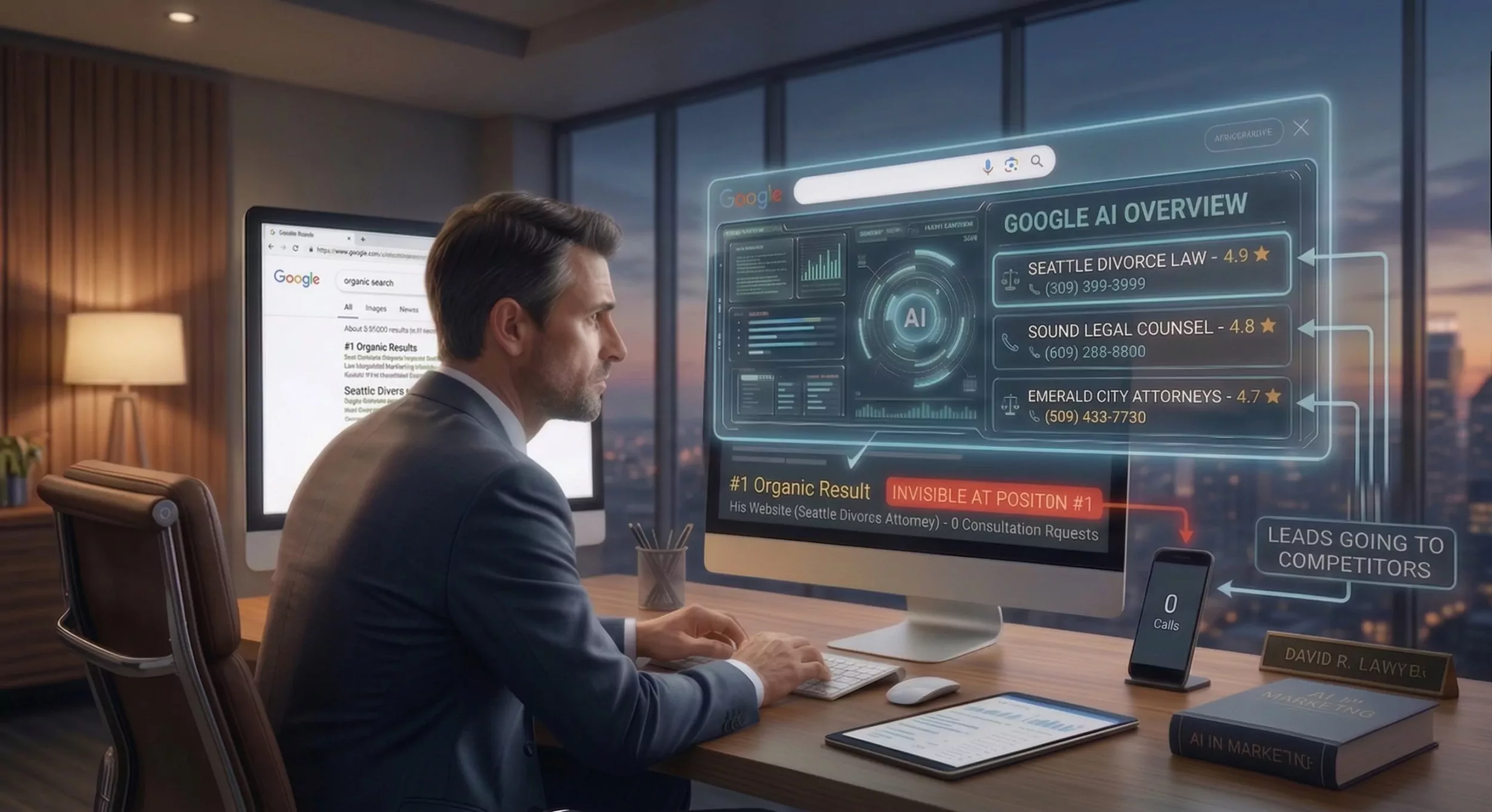
A divorce attorney in Seattle ranks #1 for "high-asset divorce lawyer."
Last month, she got zero consultation requests from Google.
Not zero clients. Zero consultation requests from her top ranking.
When she called us, she was furious. "I'm paying $800/month for SEO. I rank #1. Where are my clients?"
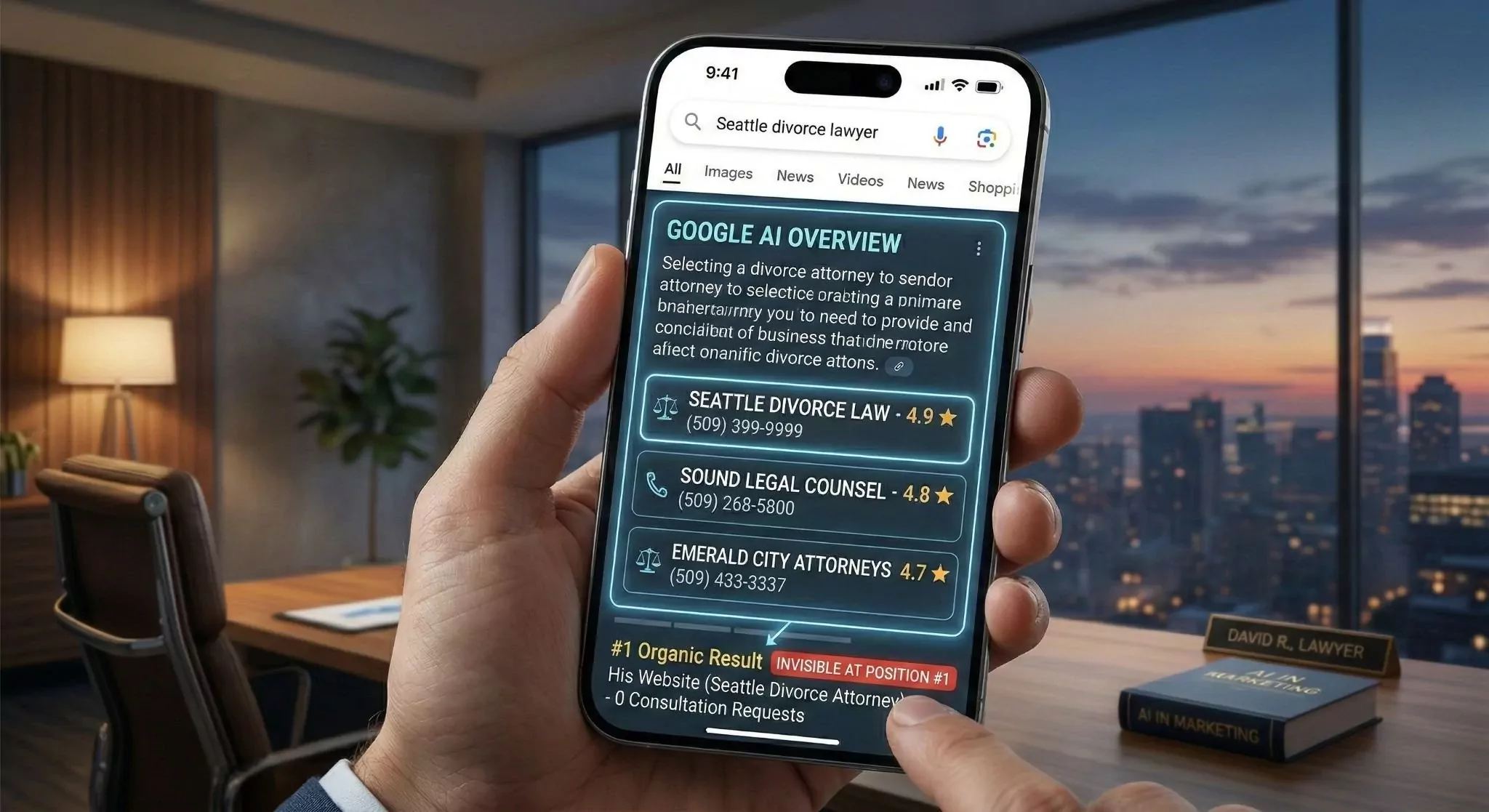
Here's what we discovered: Google's AI was answering her prospects' questions about high-asset divorce without ever mentioning her website. Worse, when AI did recommend attorneys, it listed three of her competitors-none of whom ranked in the top 5 organically.
She was invisible at position #1. Her competitors were getting AI-recommended at positions #4, #7, and #11. They were getting the consultations. She was getting the ranking.
This is the invisible crisis destroying professional services marketing in 2026, and if you don't understand what changed in the last 90 days, you're about to lose your market to competitors who do.
What Changed: The AI Takeover Nobody Warned You About
Between January and February 2026, something fundamental shifted in how prospects find professionals.
Google stopped being a search engine that sends traffic to websites. It became an answer engine that keeps prospects on Google while recommending specific businesses. The difference isn't semantic-it's the difference between getting phone calls and watching your competitors' calendars fill while yours stays empty.
Here's what appears before your #1 organic ranking now: AI Overview with a complete answer to the prospect's question, three paid ads from competitors, featured snippets pulled from someone else's website, "People Also Ask" boxes with four more questions answered, local map pack with three businesses, video results, and image carousel. Your #1 organic result? It's six scrolls down on mobile, below eight other elements competing for attention.
Most prospects never see it. They got their answer from AI, saw three recommended businesses in the AI Overview, and called one of them. Your ranking is technically perfect. Your phone stays silent.
The Zero-Click Search Epidemic
Let me show you what's actually happening with four real professional service searches.
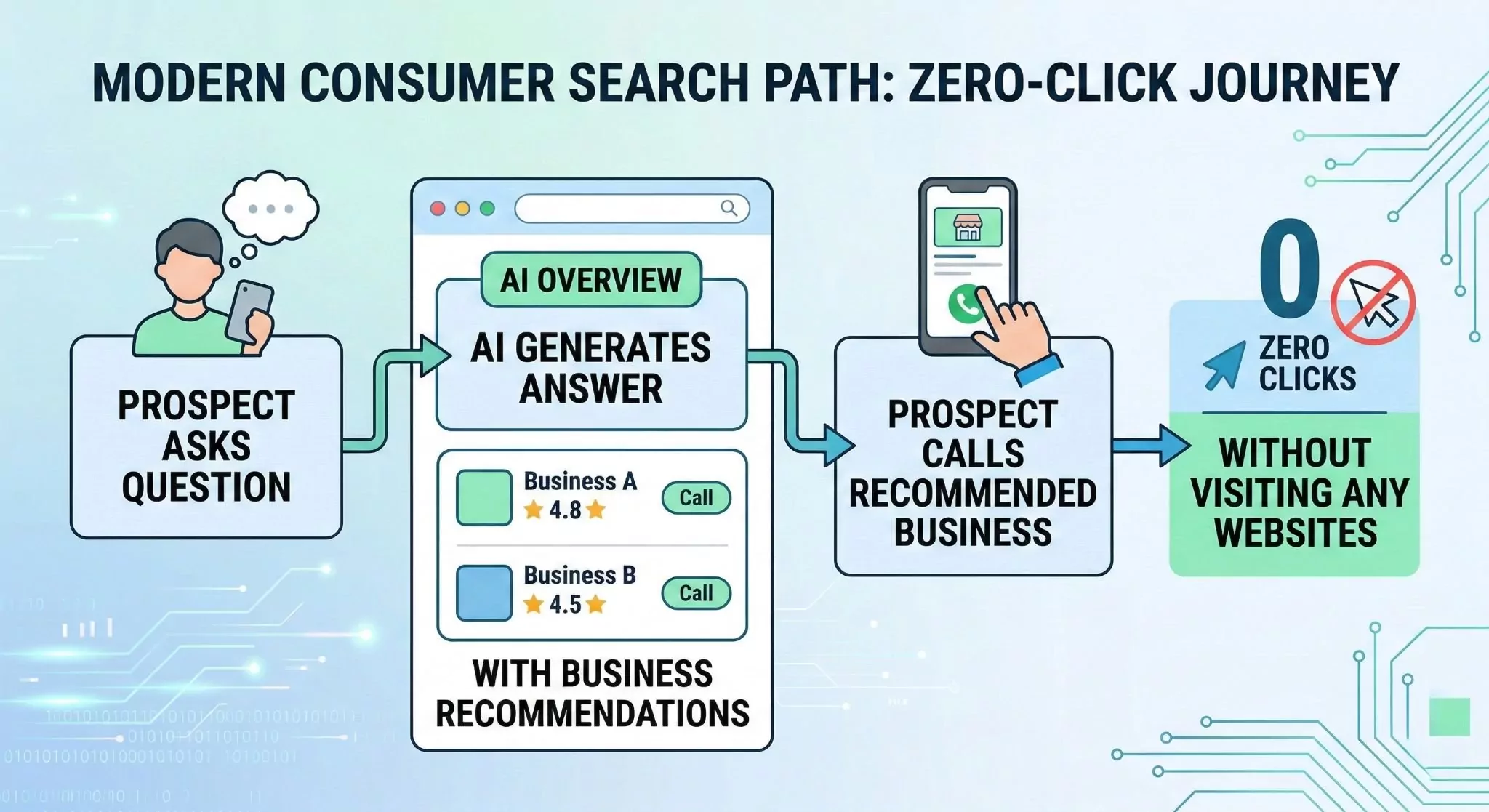
Someone searches "Do I need a CPA for my small business taxes?" Traditional search used to show ten links. Prospects clicked through five websites, read content, compared options, chose someone. Now AI Overview generates a 200-word answer explaining when CPAs are necessary, what they cost, and what to look for. Below that, AI specifically mentions "Local CPAs specializing in small business taxation" with three names and phone numbers.
The prospect calls one of the three. They never visit a single website. Your #1 ranking for "small business CPA" delivered zero traffic because AI answered the question and provided recommendations without needing your site.
Someone asks "What should I know before filing for divorce in Washington?" AI Overview provides a comprehensive answer covering community property, division of assets, and child custody factors. At the end, AI states "Consult with an experienced family law attorney" and recommends three specific divorce lawyers with explanations of their specializations. Those three attorneys didn't rank #1. They had something your #1 ranking doesn't have-structured data AI could parse and cite.
A homeowner searches "How much does a kitchen remodel cost?" AI Overview breaks down costs by project scope, materials, and labor. Then it recommends "Licensed contractors in your area" with three specific companies, average project costs, and years in business. The homeowner calls the second recommended contractor. The #1 ranking for "kitchen remodeling contractor" never loads on their screen.
A patient googles "Is knee replacement surgery right for me?" AI Overview provides medical information, recovery timelines, and alternative treatments. It concludes with "Schedule a consultation with an orthopedic surgeon specializing in knee replacement" and lists three surgeons with their credentials, patient ratings, and availability. The #1 ranking orthopedic practice gets zero calls from this search.
This is happening thousands of times per day in your market. You're not losing rankings. You're losing visibility in the AI answer layer that sits above rankings.
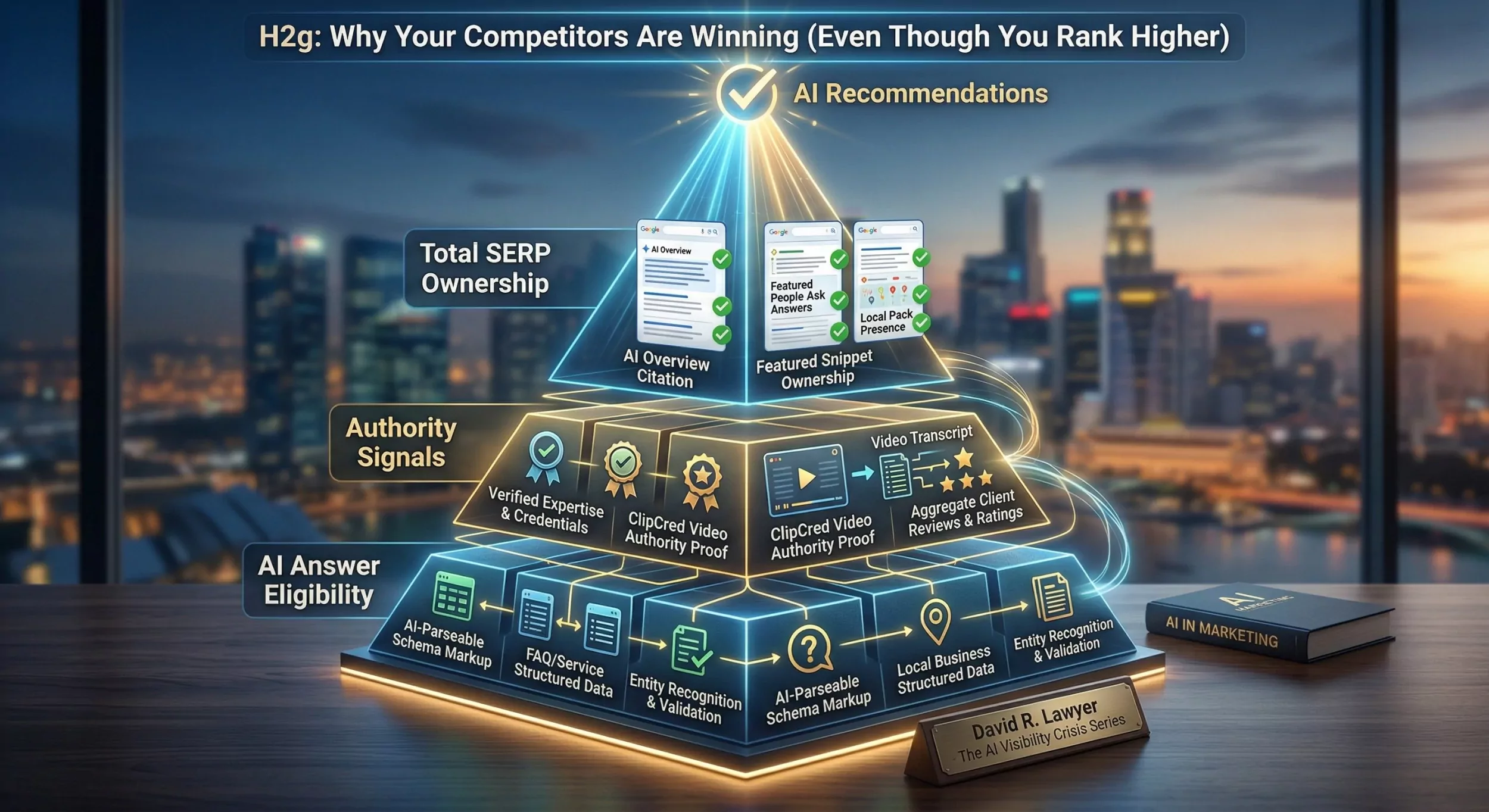
Why Your Competitors Are Winning (Even Though You Rank Higher)
The attorney ranking #4 is getting AI-recommended while you rank #1 because of three specific differences.
First, they have structured data AI can understand. Understanding schema markup is critical for professionals in 2026-discover the complete guide to professional schema types, implementation best practices, and validation testing that makes your expertise systematically discoverable by Search Generative Experience and other AI systems evaluating businesses for recommendations rather than remaining invisible despite superior credentials.. Their website includes an attorney schema with bar number, practice areas, and awards. Service schema defining "high-asset divorce" with specific service details. Review schema making their 47 five-star ratings parseable by AI. FAQ schema answering common divorce questions in AI-readable format. You have the same credentials, the same experience, better reviews. But your website is plain HTML that looks great to humans and reads like gibberish to AI.
Second, they create content in formats AI citations require. Every blog post has clear question-based headings AI can extract. Concise 50-60 word answers to common questions in the first paragraph. Bullet points and structured lists AI can summarize. Author credentials explicitly stated with schema markup. Your content is comprehensive and well-written. But it's unstructured prose. AI can't easily parse for citations.
Third, they understand the new visibility hierarchy. They don't optimize for one ranking-they optimize for five simultaneous placements. AI Overview citation as a trusted source. Featured snippet ownership for key questions. "People Also Ask" answers for related queries. Local pack presence with optimized Google Business Profile. Traditional organic ranking as the foundation. You're fighting for one position while they're dominating the entire search experience.
The gap compounds daily. Every AI citation builds authority that makes the next citation more likely. Every prospect who calls them because AI recommended them leaves a review that strengthens their AI visibility. You're in a race where your competitors have a three-month head start, and the distance grows every day you don't realize the race exists.
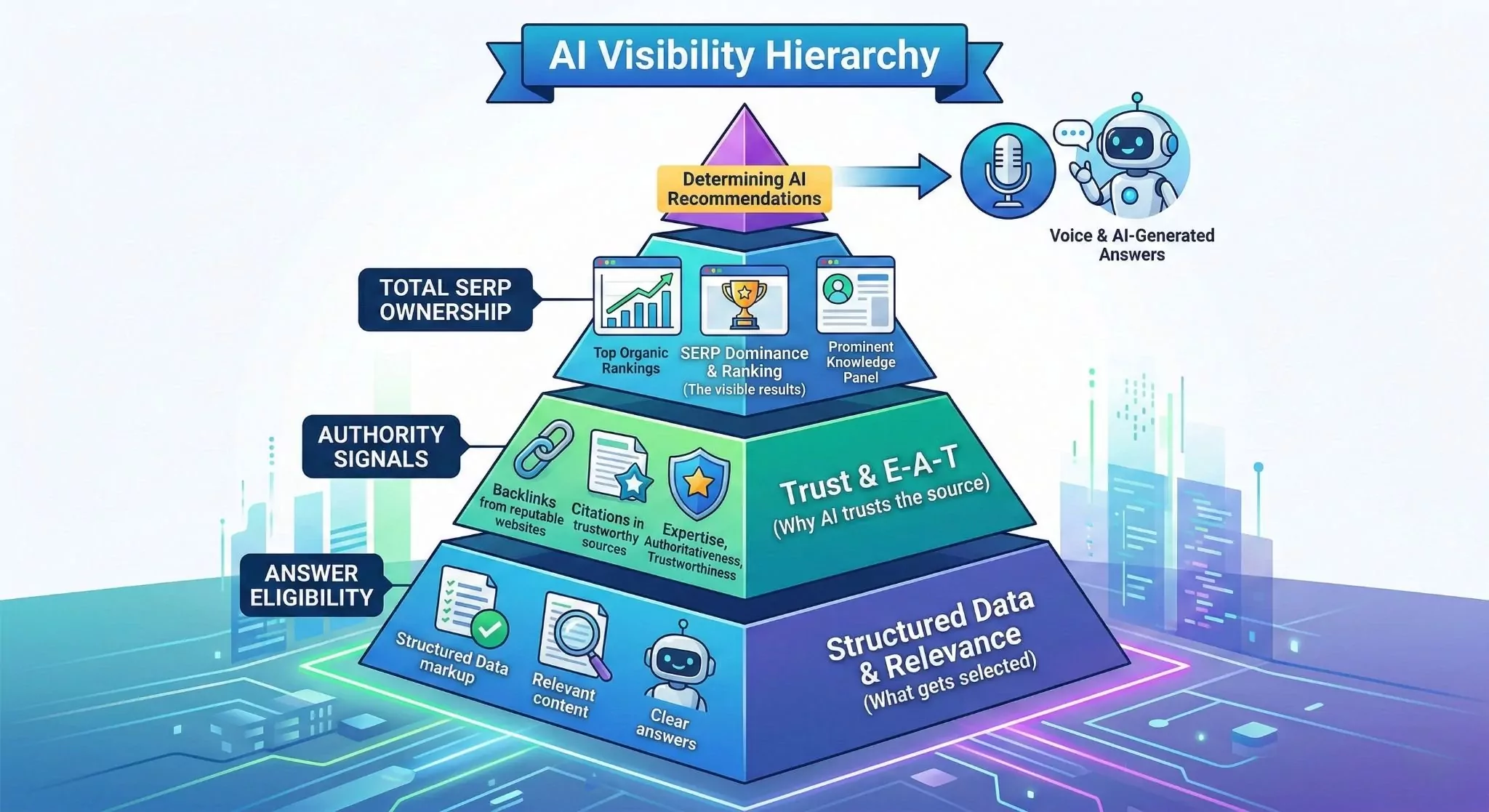
The AI Visibility Hierarchy: What Actually Matters Now
Here's the framework that determines whether AI recommends you or ignores you.
Level 1: AI Answer Eligibility
AI can only recommend what it can systematically understand. Your expertise, credentials, and experience exist on your website in paragraphs and marketing copy. AI reads that as unstructured text it can't reliably extract or cite. Your competitor has the same information in structured schema markup that AI parses like a database.
This isn't about being better. It's about being interpretable. A less experienced attorney with proper schema markup gets AI-recommended over a 20-year veteran with an unstructured website because AI has confidence in the structured data and uncertainty about the prose.
SGE Audit Pro reveals your current AI eligibility score-a 0-100 rating showing how well AI can understand and cite your business. Most professionals we audit score 15-35 out of 100. The ones getting AI-recommended score 75-95. The difference isn't quality or credentials. It's structure.
Discover why Google's Search Generative Experience represents the biggest shift in how prospects find businesses since Google launched, why you can rank number one traditionally and still be completely invisible when AI recommends businesses to prospects, and how the first and only SGE auditing system connected to Google's actual APIs shows exactly what AI sees when evaluating your business for recommendations.
Visit sgeauditpro.com to see exactly where you stand before your competitors lock up AI visibility in your market.
Level 2: Authority Signals AI Trusts
AI doesn't recommend businesses. It recommends authorities. The difference is provable expertise versus marketing claims.
Your website says "experienced immigration attorney" in the bio. AI interprets that as a generic claim with no verification. Your competitor's website has attorney schema stating bar number, admission dates, and jurisdictions. Published article schema on 40 blog posts with author credentials. Professional recognition schema listing speaking engagements and publications. Review schema with aggregate 4.8 rating from 52 clients. AI interprets that as verified, citable authority.
This is where ClipCred becomes essential. AI needs content it can parse for expertise demonstration. Written blog posts work if properly structured. But video transcripts are gold for AI because they capture natural expertise demonstration in conversational language AI easily processes.
One 60-minute interview per month becomes 25-30 short videos, each with a transcript AI can analyze for topical expertise, natural authority signals, and question-answer patterns AI citations require. Your expertise stops being an invisible marketing copy and becomes parseable proof AI confidently cites.
Level 3: Total SERP Ownership
Ranking #1 organically is the baseline, not the goal. The new goal is simultaneous presence across every element AI and Google use to answer queries.
This means having content eligible for AI Overview citation because it's structured, factual, and authoritative. Owning featured snippets for key questions in your practice area. Appearing in "People Also Ask" answers for related queries. Dominating local pack results with optimized Google Business Profile. Maintaining strong organic rankings as the foundation.
Each placement feeds the others. Featured snippet ownership increases AI citation likelihood. AI citations build authority that improves local pack ranking. Local pack visibility generates reviews that strengthen all other placements. It's not five separate tactics-it's one integrated system where each element amplifies the others.
Premium copywriting ties this together by creating content that works across all placements. Question-based structure for featured snippets. Concise answers for AI citations. Structured lists for PAA boxes. Local signals for map pack optimization. Conversion-focused language for the prospects who do visit your site. One content strategy, five simultaneous visibility channels
How to Start This Week: The 7-Day Diagnostic Sprint
You can't fix what you can't measure, and most professionals have no idea whether AI can even see their business, much less recommend it.
Day 1: Get Your AI Visibility Score
Visit sgeauditpro.com and order your SGE Audit. This isn't a generic SEO audit-it's the only diagnostic tool connecting directly to Google's APIs to show exactly how AI interprets your business for recommendations.
You'll receive your 0-100 AI visibility score, schema markup gaps showing which critical types you're missing, competitive AI positioning revealing how you rank against competitors in AI's eyes, entity recognition status indicating if AI can identify you as a distinct professional, and specific technical recommendations for implementation.
Processing time is 5-10 minutes. Cost is $97 for a single comprehensive audit. This is the diagnostic that reveals your invisible problem.
Day 2: Identify Your AI Answer Gaps
The audit shows which AI answer types you're missing. Most professionals discover they're eligible for zero AI placements because they're missing all critical schema types, have unstructured content AI can't parse, lack authority signals AI trusts, and aren't optimized for any SERP feature beyond organic ranking.
Your competitors who are getting AI-recommended? They fixed these gaps months ago. The longer you wait, the wider the authority gap becomes and the harder it is to catch up.
Day 3: Audit Competitor AI Visibility
Use the same prospect searches you want to appear in. Notice how AI Overview answers questions, which businesses AI recommends, what featured snippets appear, and who owns "People Also Ask" answers.
Your competitors already optimizing for this are getting every prospect AI steers their direction while you fight for crumbs from prospects still clicking organic results-a shrinking minority every week.
Day 4: Prioritize Quick Wins
Some AI visibility improvements take weeks. Others take hours. Quick wins include adding FAQ schema to your existing content, implementing local business schema with proper service areas, creating question-based content for featured snippet opportunities, and optimizing your Google Business Profile for AI parsing.
These don't require developer work. They don't require complete website redesigns. They're tactical improvements that immediately increase your AI eligibility score.
Day 5: Plan Authority Content Strategy
AI recommends authorities, not advertisers. If your content demonstrates expertise through proper structure, you become eligible for AI citations. If it's marketing copy about how great you are, AI ignores it.
This is where ClipCred becomes your AI visibility engine. Transform one monthly interview into 25-30 videos with AI-parseable transcripts demonstrating your expertise naturally. Not promotional. Not scripted. Just you answering real client questions in your own words-exactly what AI needs to verify expertise and build citation confidence.
Day 6-7: Decision Point
You now know where you stand, what you're missing, and what's possible. You have two paths forward.
Path A is DIY implementation using your audit's technical recommendations. Best for businesses with developer resources and technical understanding of schema markup, JSON-LD, and AI optimization principles. The timeline is typically 4-8 weeks depending on complexity.
Path B is a done-for-you implementation with GSD Local Marketing.
Our schema markup implementation service handles everything from profession-specific schema types to complete validation testing, transforming your AI visibility score from invisible to AI-dominant within 45 days for one-time investment rather than ongoing ad spend that stops working when budget ends.
We implement every recommendation from your audit-professional schema, service schema, review schema, article schema, complete validation and testing. Cost is $299 one-time for comprehensive setup. Timeline is 7-10 days for implementation, 30 days for re-audit showing improvement.
Call (509) 433-7730 to schedule implementation. Most clients see AI visibility scores improve from 20-30 to 75-85 within 45 days. That's the difference between invisible and AI-recommended.
The Urgency You Can't Ignore
While you're reading this, a prospect in your city just asked AI for a recommendation in your category.
AI analyzed the query, identified intent, evaluated structured data from businesses in your market, assessed authority signals and trust indicators, and generated an answer recommending three specific professionals.
Were you one of them? Or did your competitor who implemented proper schema markup three months ago get mentioned while your #1 ranking stayed invisible?
This is happening hundreds of times per day in competitive markets. Every prospect AI steers to a competitor is a prospect you'll never know existed. They don't show in your analytics. They don't visit your website. They just call the business AI recommended and become someone else's client.
The first-mover advantage in AI visibility is massive and compounding. The professionals who fix this in February 2026 will own March, April, and May. They'll build authority that makes each subsequent AI citation more likely. They'll capture the prospects that would have gone to you if you'd acted sooner.
The ones who wait until June will spend a year catching up to February's early adopters. The gap doesn't narrow. It widens.
Right now, most professionals in your market don't know this is happening. That window closes in 60-90 days. After that, you're not early-you're late. You're not capturing opportunity-you're fighting to stop the bleeding.
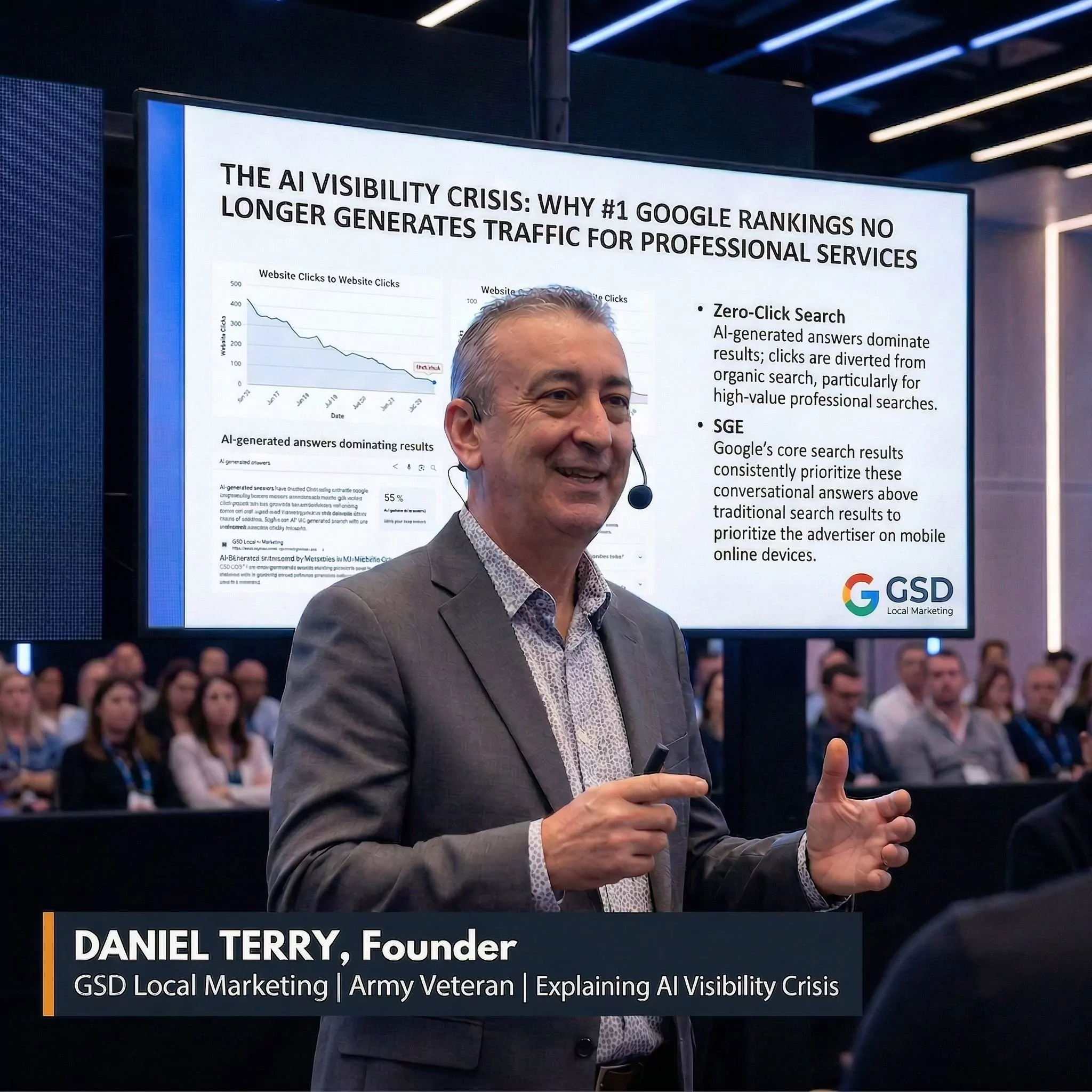
The Choice Is Binary
You can keep paying for SEO that delivers rankings without phone calls, watching your #1 position generates zero consultations while wondering what changed. Or you can get your SGE Audit today, see exactly why AI isn't recommending you, and fix the invisible problem before your competitors own AI visibility in your market.
The shift from ranking to being AI-recommended is the biggest change in professional services marketing since Google launched. The businesses that understand this now will dominate the next 24 months. The ones who figure it out later will wonder why nobody's calling anymore while their traditional metrics look fine.
Your ranking didn't stop working. The game changed. AI is choosing winners now, and it's choosing businesses with proper structure over businesses with better credentials.
Get your audit. See where you stand. Fix your AI visibility before the window closes.
🔍 Get Your SGE Audit: https://sgeauditpro.com
📞 Implementation Help: (509) 433-7730
🌐 GSD Local Marketing: gsdlocalmarketing.com
Stop being invisible at #1. Start getting AI-recommended
Frequently Asked Questions
Why does my #1 ranking gets zero traffic now?
Your #1 ranking gets zero traffic because Google's AI Overviews answer prospect questions without sending them to websites. AI generates complete answers, recommends 3-5 specific businesses with structured data, and keeps users on Google. Prospects call AI-recommended competitors without ever seeing your #1 organic result below the fold.
Your #1 Google ranking no longer appears where prospects look because Google's search results changed fundamentally in 2026. Before your organic result appears, prospects see AI Overview with a complete answer to their question, three to four paid ads from competitors, featured snippet pulled from another website, "People Also Ask" boxes with additional questions answered, local map pack showing three businesses, video results, and image carousel.
Your #1 organic position appears six or seven scrolls down on mobile, below eight other elements competing for attention. Most prospects never scroll that far because AI Overview already answered their question and provided specific business recommendations.
Here's the invisible loss pattern: Someone searches "Do I need a CPA for my small business taxes?" AI Overview generates a 200-word answer explaining when CPAs are necessary and what to look for. Below the answer, AI specifically mentions "Local CPAs specializing in small business taxation" with three names, credentials, and contact information. The prospect calls one of the three AI-recommended CPAs. They never visit a single website, and your #1 ranking for "small business CPA" delivered zero traffic.
This is happening thousands of times daily across all professional services. You're not losing rankings—you're losing visibility in the AI answer layer that sits above organic results and captures prospects before they reach traditional rankings.
The businesses getting those AI recommendations have structured data your website lacks: schema markup defining services AI can parse, author credentials verified through professional schema, review signals AI interprets as trust indicators, and FAQ content structured for AI citation. Same expertise as you, better structure for AI understanding.
How GSD Local Marketing helps: SGE Audit Pro at sgeauditpro.com reveals your current AI visibility score showing exactly why AI isn't recommending you, which schema types you're missing, how competitors rank in AI's evaluation, and specific implementations that transform invisible rankings into AI-recommended authority. Our $299 schema implementation then fixes every gap the audit reveals.
What is the difference between Google ranking and AI visibility?
Google ranking measures where your link appears in organic results. AI visibility measures whether AI search engines can understand your business well enough to cite and recommend it. You can rank #1 organically but score 15/100 in AI visibility if you lack structured data, making you invisible to AI recommendations.
Google ranking and AI visibility operate on completely different evaluation systems with minimal overlap.
Traditional Google ranking evaluates backlinks from other websites, domain authority and site age, keyword optimization and relevance, content comprehensiveness and quality, page speed and technical SEO, and user engagement signals like time on site. This determines your position in the blue link list-whether you're #1, #5, or #20 organically.
AI visibility evaluates schema markup completeness and accuracy, entity recognition showing you're a distinct professional, structured service definitions AI can parse systematically, trust signals like review schema and credentials, content format and AI extractability, and author authority through proper schema markup. This determines whether AI can understand your business well enough to cite and recommend it.
The disconnect creates the invisible #1 ranking problem. An attorney can rank #1 organically with excellent backlinks, domain authority, and keyword optimization while scoring 18 out of 100 in AI visibility because their website lacks schema markup, has unstructured content AI can't parse, contains no entity recognition signals, and provides no review or credential schema AI trusts.
Meanwhile, a competitor ranking #7 organically scores 82 in AI visibility because they implemented attorney schema with bar credentials, service schema defining practice areas, aggregate rating schema for reviews, article schema on blog content, and FAQ schema answering common questions. AI confidently cites and recommends the #7 ranking because it has structure to work with, while your #1 ranking stays invisible because AI can't systematically extract and verify information.
How GSD Local Marketing helps: SGE Audit Pro measures both metrics-showing your Google ranking AND your AI visibility score. Most professionals discover they're dominating one while failing the other. Our schema implementation service brings AI visibility to match your ranking strength, or if your ranking needs work, our complete SEO + AI visibility system handles both simultaneously. Call (509) 433-7730 for diagnostic and implementation.
How quickly are competitors stealing my AI traffic?
Competitors optimizing for AI visibility capture 100-300 additional prospects monthly in competitive markets. These prospects never appear in your analytics because AI answers their questions and recommends competitors without sending website traffic. The gap compounds as AI citations build authority making subsequent recommendations more likely.
The speed of competitive loss depends on market competitiveness and how many competitors are already optimized for AI visibility, but the pattern is consistent and accelerating.
In a competitive market like family law, divorce attorneys, or cosmetic surgery, one competitor implementing proper AI visibility captures an estimated 10-15 prospects daily who would have been distributed among all providers. That's 300-450 prospects monthly calling the AI-recommended business instead of discovering alternatives through traditional research.
You never see these prospects in your analytics because they don't visit your website. AI answered their question, provided recommendations, and they called someone AI mentioned. The only signal you might notice is declining consultation requests despite steady rankings and traffic-but even that takes months to become obvious because other traffic sources mask the AI visibility loss.
The compounding effect accelerates the gap. Month 1: Competitor gets AI-recommended, captures extra prospects. Month 2: Those prospects become reviews strengthening trust signals, making AI recommendation more likely. Month 3: Increased authority from citations makes AI recommend them for adjacent queries they weren't initially optimized for. Month 6: They dominate AI visibility across the entire practice area while you're still wondering why rankings aren't converting.
Early adopters in your market right now are experiencing this compounding advantage. Every day you delay implementation widens the authority gap and makes catching up harder.
How GSD Local Marketing helps: The 7-day diagnostic sprint starting with SGE Audit Pro reveals exactly how many competitors are already optimized for AI visibility in your market and how wide the gap currently is. Fast implementation through our done-for-you schema service ($299 one-time) stops the bleeding within 7-10 days, with measurable AI visibility improvement in 30-45 days. Speed matters-first-mover advantage in AI visibility compounds like traditional SEO did in 2010.
Can I fix AI visibility myself or do I need professional help?
DIY AI visibility optimization is possible if you understand JSON-LD schema, Google's validation tools, and profession-specific schema requirements. However, most professionals discover the technical complexity exceeds their comfort level. Incorrect implementation can harm SEO, while missing critical schema types leaves you invisible despite effort invested.
Whether you can DIY AI visibility optimization depends on your technical capabilities and whether you have developer resources who understand schema markup.
If you or your team understand JSON-LD syntax and implementation, schema.org vocabulary and property requirements, profession-specific schema types (Attorney, MedicalBusiness, Accountant, etc.), Google's Structured Data Testing Tool for validation, and entity relationship mapping, you can implement SGE Audit recommendations yourself using the technical specifications provided in your audit report.
However, attempting DIY implementation without this expertise typically results in one of three outcomes. Incomplete implementation where you add organization schema but miss critical service schema, review schema, article schema, and profession-specific types that actually drive AI visibility. Incorrect implementation with syntax errors or invalid property values causing Google to ignore your schema entirely, wasting effort without improving AI visibility and potentially creating search console errors that harm traditional SEO. Website conflicts where schema code breaks existing functionality or creates duplicate/conflicting data that confuses AI systems rather than clarifying them.
The complexity multiplies because schema requirements vary dramatically by profession. An immigration attorney needs an Attorney schema with specific properties like barNumber and jurisdictions, LegalService schema defining immigration law practice areas, and FAQPage schema for common visa questions. A cosmetic surgeon needs MedicalBusiness schema with medical credentials, a Service schema for specific procedures, and a review schema with medical-specific trust signals. Generic schema markup doesn't work-AI needs profession-specific structure.
Most professionals receiving their SGE Audit realize recommendations make conceptual sense but require technical expertise they don't have in-house, making professional implementation the practical choice for speed and accuracy.
How GSD Local Marketing helps: Our $299 done-for-you schema implementation includes every recommendation from your SGE Audit-profession-specific schema types, complete property mapping, validation testing, conflict resolution with existing site code, and 30-day re-audit verifying improvement. Same cost as most developers charge for basic organization schema, but comprehensive implementation ensuring actual AI visibility gains. Call (509) 433-7730 to schedule implementation.
What is zero-click search and why does it matter?
Zero-click search occurs when Google's AI Overviews answer questions completely without requiring users to click any results. Prospects get answers, see AI-recommended businesses, and make decisions without visiting websites. This means traditional rankings deliver zero traffic even at position #1 because prospects never scroll past AI answers.
Zero-click search represents the fundamental shift destroying traditional SEO ROI for professional services in 2026.
Traditional search worked like this: Prospect searches question, Google shows ten blue links, prospect clicks through five to seven websites reading content and comparing options, prospect makes decision after 10-15 minutes researching, and all ranked websites received some traffic and visibility opportunity.
Zero-click search works like this: Prospect asks question conversationally, AI Overview generates complete answer in 150-300 words, AI mentions three to five relevant businesses with contact information, prospect calls one of the mentioned businesses within 30 seconds, and zero organic results receive clicks because AI provided everything needed.
The business impact is brutal. A divorce attorney ranking #1 for "high-asset divorce lawyer Seattle" used to receive 80-120 website visits monthly from that ranking, converting to 8-15 consultation requests. Now that same #1 ranking receives 5-10 website visits monthly because AI Overview answers prospect questions about high-asset divorce without mentioning the attorney's website, and AI recommends three different attorneys who have proper schema markup, converting to 1-2 consultation requests while the AI-recommended attorneys split 40-50 consultations monthly.
The attorney's traditional metrics show declining traffic and conversions, but the real loss is invisible-prospects who never appeared in analytics because AI steered them to competitors before they could discover the #1 ranking.
Zero-click search dominates informational queries ("How much does...?" "What should I know about...?" "Is it worth...?") that previously drove discovery traffic, and increasingly captures commercial queries ("Best [professional] for [problem]") that directly generate consultation requests. Traditional rankings matter less every month as AI Overviews handle more query types.
How GSD Local Marketing helps: Winning in zero-click search requires appearing IN the AI answer, not ranking below it. ClipCred authority content creates AI-citable expertise demonstrations through video transcripts, schema markup makes your credentials and services AI-understandable, and premium copywriting structures content for AI extraction and citation. The integrated system turns zero-click search from invisible loss to AI-recommended visibility. Start with SGE Audit at sgeauditpro.com to see your current zero-click vulnerability.
How do I get AI to recommend me instead of competitors?
AI recommends businesses with structured data it can parse, verify, and cite confidently. Implement profession-specific schema markup, create authority content in AI-extractable formats, build trust signals through review and credential schema, and optimize for featured snippets and People Also Ask. AI chooses businesses it understands over businesses it can't systematically evaluate.
Getting AI-recommended instead of ignored requires satisfying the AI visibility hierarchy: answer eligibility, authority signals, and total SERP ownership.
Answer eligibility starts with schema markup. Your competitor gets recommended because they have attorney schema stating bar number, admission dates, and practice jurisdictions that AI verifies through external databases, service schema defining "estate planning" with specific services like wills, trusts, and probate that AI matches to query intent, aggregate rating schema showing 4.8 stars from 47 reviews that AI interprets as trust signal, and FAQ schema answering common estate planning questions that AI citations require.
You have the same credentials, same services, better reviews-but your website presents this information in unstructured paragraphs and marketing copy AI can't systematically parse or verify. AI chooses your competitor's structured data over your superior credentials because AI prioritizes confidence over quality when it can't verify quality.
Authority signals require demonstrable expertise. ClipCred transforms your expertise from marketing claims into AI-citable proof. One 60-minute monthly interview becomes 25-30 short videos, each with transcript demonstrating expertise through natural question-answering that AI processes for topical knowledge, professional terminology usage, practical application examples, and conversational authority signals marketing copy lacks.
The article schema on these transcripts tells AI "this is verified content by [professional] with [credentials] demonstrating expertise in [topic]." AI confidently cites and recommends based on this structured authority proof.
Total SERP ownership requires a multi-placement strategy. Winning featured snippet for "Do I need an estate planning attorney?" positions you as the answer source. Appearing in three "People Also Ask" boxes for related questions builds topical authority AI recognizes. Dominating local pack results with optimized Google Business Profile signals local relevance. Maintaining organic ranking provides foundation AI evaluates when deciding recommendation confidence.
Each placement feeds the others-featured snippet ownership increases AI citation likelihood, AI citations build authority improving local pack ranking, and local visibility generates reviews strengthening all signals.
How GSD Local Marketing helps: Our complete AI visibility system integrates all three levels. SGE Audit Pro identifies gaps ($97), schema implementation fixes technical structure ($299), ClipCred builds AI-citable authority, and premium copywriting optimizes for all SERP features. Package pricing available for complete transformation from invisible to AI-dominant. Call (509) 433-7730 for consultation.
Is traditional SEO dead in 2026?
Traditional SEO isn't dead but insufficient alone. Organic ranking remains important as the foundation AI evaluates when making recommendations. However, ranking without AI visibility means being technically correct but practically invisible. Modern search success requires traditional SEO plus AI optimization, schema markup, and authority signals AI systems trust.
Traditional SEO isn't dead-it's now table stakes rather than competitive advantage.
Organic ranking still matters because AI systems evaluate your search presence when deciding recommendation confidence, prospects who bypass AI Overview still see organic results, and strong rankings signal authority that influences all other visibility factors. A business ranking on page 3 won't get AI-recommended even with perfect schema markup because low rankings suggest low authority.
However, traditional SEO alone is insufficient and increasingly ineffective for client acquisition. You can dominate traditional ranking factors-excellent backlinks from authoritative sites, comprehensive content answering prospect questions, fast page speed and technical optimization, strong user engagement and low bounce rates-while scoring 20 out of 100 in AI visibility because traditional SEO doesn't address schema markup requirements, AI-extractable content formats, structured authority signals, or citation-ready answer formats.
The result is perfect rankings delivering declining traffic and conversions because AI keeps prospects from ever seeing your rankings, captures high-intent queries with zero-click answers, and steers commercial searches to AI-recommended competitors with inferior rankings but superior AI visibility.
Modern search success requires integrated strategy addressing both systems. Traditional SEO provides the foundation-building authority, ranking for discovery, and establishing presence AI evaluates. AI optimization adds the visibility layer-schema markup making credentials understandable, structured content AI citations require, authority demonstrations in formats AI processes, and multi-placement strategy capturing prospects at every search stage.
The professionals winning in 2026 aren't choosing between traditional SEO and AI visibility. They're running both simultaneously because each amplifies the other. Strong rankings make AI more likely to recommend you. AI recommendations generate engagement signals that improve rankings. It's not either/or-it's both, integrated.
How GSD Local Marketing helps: Our approach integrates traditional SEO foundation with AI visibility optimization. We don't abandon proven SEO practices-we layer AI visibility on top of them. Schema markup enhances existing content, ClipCred generates content serving both traditional and AI search, and our analytics track both ranking performance and AI visibility metrics. Complete visibility across both search paradigms, not choosing one at the expense of the other.
GSD Local Marketing
130 11th St NE
East Wenatchee, WA 98802
(509)-433-7730
Follow Us On
© 2026 GSD Local Marketing